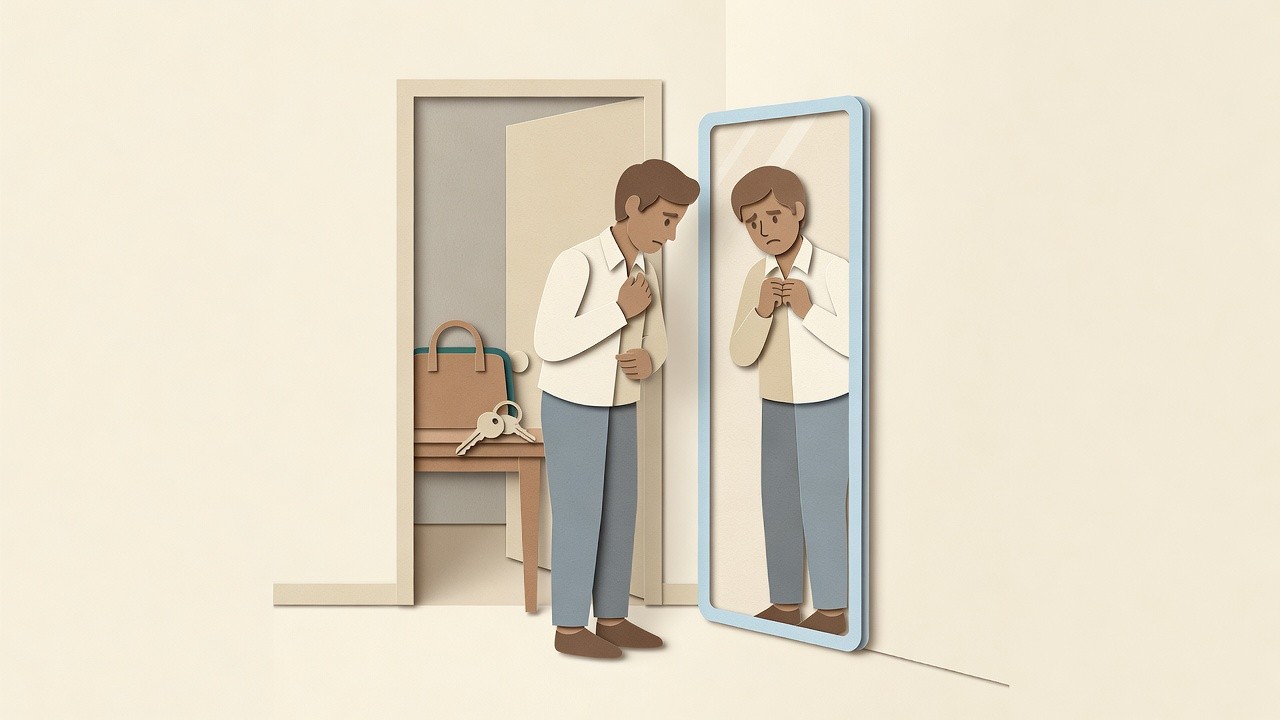
You are not short on character. You are short on a stable verdict about yourself — and that gets learned the hard way.
There is an inner voice that does not rest. It reviews every decision before you make it, undoes every compliment before it lands, looks for rejection where sometimes there is none, and doubts your accomplishments with admirable persistence. It is not character: it is a learned pattern operating with four concrete mechanisms. This space names them, measures them, and opens a first technical door — not self-help phrases for people who have already read too much.
Your character is not the problem. The filter you learned is.
Research separates four things that experience blends together: level self-esteem (how much you value yourself on average), self-efficacy (how much you trust yourself to figure things out), locus of control (what you attribute things to), and emotional stability. These four dispositions interact, and when several run against you, the full picture shows up: constant self-doubt, approval-checking, fast invalidation of praise, and magnification of minor errors. The revealing part: none of this requires any objective failure. People with solid careers and stable relationships carry the same inner uncertainty — because the filter operates earlier, in how information gets interpreted, not in what information arrives.
- Self-esteem instability predicts worse psychological functioning than stable low level — Kernis (2005) documented this with longitudinal follow-ups
- "Just be satisfied with yourself" is not enough: the filter operates pre-consciously and needs technical relearning, not goodwill
Where does your doubt live?
Eight questions about your last few weeks. It does not diagnose — it shows which gear spins hardest and where to start.
The four gears of doubt
Eight short observations about your last two weeks. Not a diagnosis — a map to decide where to start.
This is not a validated clinical scale. If several answers describe your life and it has lasted more than two weeks — especially if behaviors that harm your sleep, work or relationships appear — talking with a professional is a reasonable next step.
How often has this been true in the last two weeks?
Saved locally on this device (nowhere else). Nothing is sent.
Chronic insecurity: it is not lack of character — it is a stable self-doubt pattern you were taught
- Judge, Locke, Durham and Kluger (1998) defined the core self-evaluations construct: four interacting dispositions (self-esteem, self-efficacy, locus of control, emotional stability) that predict real-world functioning. Chronic insecurity shows up when one or more of these dispositions run against you. DOI: 10.1037/0021-9010.83.1.17
- Bartholomew and Horowitz (1991) articulated four adult attachment categories. The two insecure ones (preoccupied and fearful) produce precisely the clinical picture: constant self-doubt, hypervigilance to rejection cues, and disconfirmation of positive feedback. DOI: 10.1037/0022-3514.61.2.226
- Kernis (2005) showed that self-esteem instability — large day-to-day fluctuations — predicts worse psychological functioning than low level alone. Chronic doubt is not a mood state: it is an attention and memory architecture oriented to searching for evidence against yourself.
One thing today: the doubt tally
Before trying to change anything, measure how much the doubt votes. The simplest documented register in self-monitoring protocols: counting the times the filter took you off your own track. One day. Not five minutes: two.
- Pick any day today. Every time your head doubts one of your own accomplishments, looks for excessive confirmation, or reads hostility into a neutral response — add a tally on your phone or a scrap of paper.
- Do not try to stop them. Counting is not obsessing: it is inventory. The doubts exist today anyway; they are just invisible.
- At day's end write down the number and one thing: when they clustered (after a compliment, before a delayed message, in front of a decision).
- Stop there — no promise of improvement tomorrow.
- Repeat next [chosen day]. Comparing two different days already gives you a personal pattern no generic article can give you.
This is not therapy. It is the minimal operation of behavioral self-monitoring — making the invisible critic visible.
Read something that understands what you live
No sermons. Three texts about the pattern nobody told you were carrying.
If you want to explore additional resources we have researched and recommend, they are here:
By rdkterapia · No spam
Frequently Asked Questions
What is chronic insecurity?
It is not a mood: it is a stable pattern of doubt about one's own value, capacity, or belonging, sustained over time and across contexts. Unlike situational doubt, it operates as a filter: the person preferentially selects and remembers evidence that confirms it, and minimizes evidence that contradicts it.
Is chronic insecurity the same as low self-esteem?
Not exactly. You can have low average self-esteem and still function with reasonable stability, or have average self-esteem and live with large daily fluctuations and chronic insecurity. Kernis (2005) showed instability predicts worse functioning than level: chronic doubt weighs more than stable low self-esteem.
Is it something you "cure" or overcome?
It is not a disease with a cure, nor a flaw you overcome with willpower. It is a learned pattern dismantled through repeated, targeted practice on specific mechanisms: rejection hypervigilance, negative self-verification, and avoidance of occasions where the doubt could be updated. Like any learned pattern, it is modifiable, but on a months scale, not days.