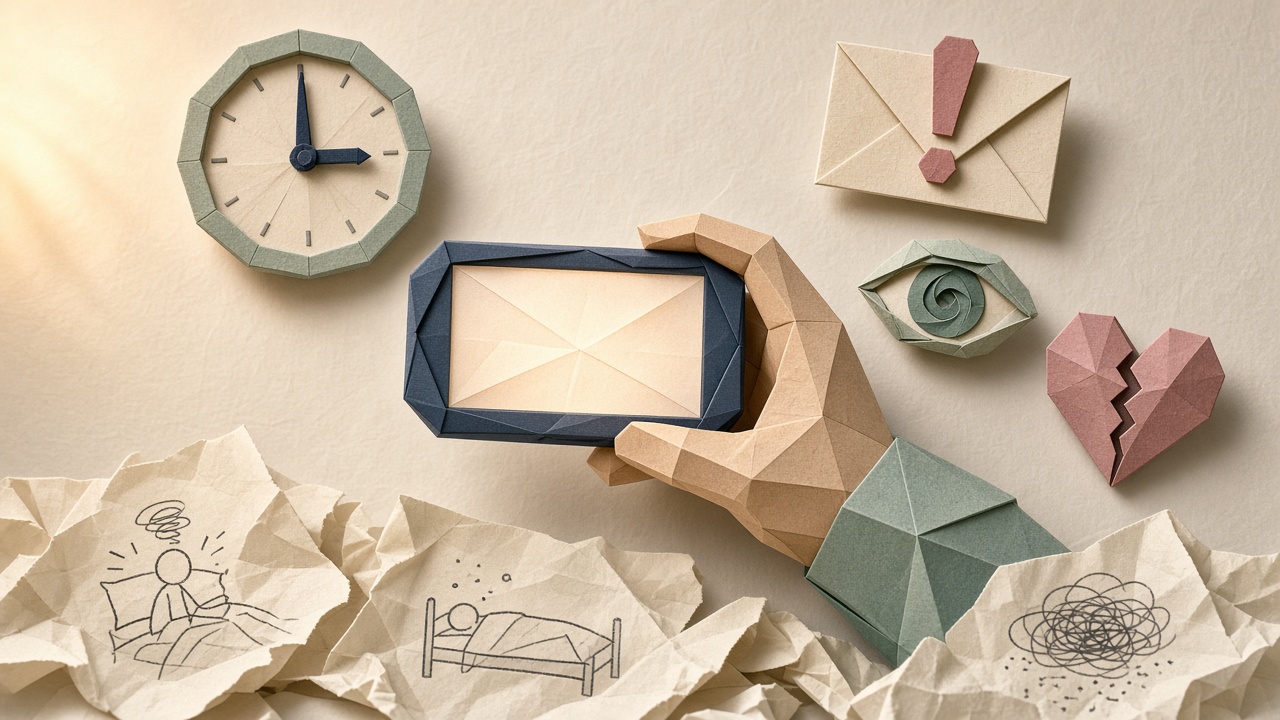
Social Media Addiction vs Social Use: 8 Differences
Heavy use of social media is not the same as addiction. Six concrete differences that separate a high-but-functional habit from a problematic pattern.
 Ricardo De Castro KingPsychologist · Meet the author
It is 8:14 PM. The kitchen table has been set for twenty minutes and two plates are already cold. Two girls in pajamas are each watching a tablet, and you are holding the phone while wiping the counter with your elbow. The Instagram feed has been open since you finished paying at the market. If someone asked how the family got to this point, you would probably answer “I don’t know, it happened little by little.” That sentence is the start of something worth looking at carefully before putting a name to it.
The confusion between “heavy use” and “addiction” is the most common trap when someone starts to wonder about their relationship with social media. Heavy use can be high and still functional. Addiction appears when the behavior slips out of control and starts costing other areas of life. We are going to separate them carefully, without rush and without alarm.
1. What you have been told — the six myths about “use vs addiction”
There is a set of phrases that show up again and again when someone starts to wonder whether their social media use is normal or has stopped being so. They sounded reasonable the first time. You repeated them as your own. And they are the ones keeping the pattern going without you noticing. They are not stupid — they are cultural. But the research dismantles them one by one. We will look at them in order.
The six claims we will go through are:
- Myth 1 · “I use a lot, but I am not addicted.”
- Myth 2 · “If I do it for work, it doesn’t count.”
- Myth 3 · “It is just a hobby, not an addiction.”
- Myth 4 · “It is my way of staying connected, not a problem.”
- Myth 5 · “Whenever I want, I can stop.”
- Myth 6 · “If it does not affect others, it is not that serious.”
None of them is absurd. All of them have a true version. The trap is staying with the version that exonerates you and leaving the uncomfortable part out.
2. Why each myth fails — the clinical basis
Before going into each one, a note common to all six. The myths survive because they offer something the pattern no longer offers: relief. Saying “it is just a hobby” excuses you from thinking about it. Saying “I can stop whenever I want” excuses you from the guilt. Saying “it is for work” excuses the general use. Each one moves attention elsewhere.
The research on problematic social media use, in particular Billieux and colleagues (2015), proposed a framework for distinguishing subtypes within what is called “behavioral addiction”: there is a pattern more tied to social reward seeking (the one you notice in constant checking of likes and reactions), a pattern more tied to negative emotional regulation (the one you notice when you open the feed to escape something that hurts), and a more impulsive pattern (the one that appears when no will can stop the scroll). Each subtype has different costs and calls for different approaches. The confusion between “use” and “addiction” is often a defense that flattens those differences. DOI: 10.1556/2006.4.2015.009
With that distinction in mind, the six myths stop being contradictory and start reading as excuses. One by one.
3. Myth 1 · “I use a lot, but I am not addicted”
That sentence is often true at the beginning. What separates it from addiction is the presence of interference with life domains and repeated failures to reduce. The scale validated by van den Eijnden, Lemmens, and Valkenburg (2016) measures nine criteria to distinguish problematic use from everyday use: preoccupation, tolerance, withdrawal, persistence, displacement, problem, deception, escape, conflict. If six or more are present in the last twelve months, the picture stops being “high use” and enters problematic use territory. DOI: 10.1016/j.chb.2016.03.038
The distinction is not in total time, but in three questions: does it generate costs in other areas? Have you tried to reduce and could not? Is there withdrawal-like discomfort when you cannot access it? If the answer to all three is yes, it is no longer “I use a lot” — it is a picture worth looking at more carefully.
4. Myth 2 · “If I do it for work, it doesn’t count”
It is the most comfortable explanation, and the most incomplete. It helps to separate two things: the hours of work use (messaging with clients, email, communities, content for the brand) and the hours of non-work use. If the first are 3 and the second are also 3 or 4, the explanation “it is for work” only covers part.
Andreassen and colleagues (2017), in a national sample of young adults, found that addictive use of social media is associated with narcissism and low self-esteem, even in people who report high professional use. What the research distinguishes is not “work vs not work,” but “directed use vs reflexive use.” When the pattern is held up by reflex — opening the feed “to rest for a bit” without a clear goal — the work explanation stops covering everything. DOI: 10.1016/j.addbeh.2016.03.006
5. Myth 3 · “It is just a hobby, not an addiction”
A hobby has structure: you choose when to do it, how much time to give it, what to look at. The difference with a problematic use pattern is exactly that: the choice. If you open the feed “to look for a bit” and two hours later you cannot remember what you looked at, it was not a hobby. It was a pattern.
The distinction matters because it puts the focus on something concrete: how much of your time on social media is chosen and how much is automatic? An honest way to measure it: for one week, note how many times you opened a network by reflex (without having decided to do so beforehand) and how many times you did it with a purpose. If most of them are by reflex, you already have a first data point.
6. Myth 4 · “It is my way of staying connected, not a problem”
Social media has a real and valuable function: keeping ties across distance, finding communities, accessing information. Kuss and Griffiths (2017) collected in their review that positive effects are well documented for support groups, migrant networks, and communities of practice. The useful question is not whether social media “are bad,” but what part of your use is within your control and what part is not. DOI: 10.3390/ijerph14030311
If you open a network and feel that you cannot close it even though you are no longer looking at anything useful, the “connection” function no longer explains what is happening. The behavior sustains itself, not by the tie.
7. Myth 5 · “Whenever I want, I can stop”
This phrase is the hardest to dismantle, because it is usually partly true. You can stop opening social media for a few hours. What you can no longer do, if the pattern is in place, is stop thinking about them. Withdrawal-like discomfort shows up as: an itch in the fingers to grab the phone, mild anxiety when you know a notification arrived, a kind of emptiness that appears when the phone is in another room.
If the answer to the question “could you not open any social media for 24 hours without telling anyone?” produces a small contraction in your chest, the sentence is no longer as true as it sounds. It is not a measure of your worth — it is a way to look honestly at a reflex you may not control as much as you think.
8. Myth 6 · “If it does not affect others, it is not that serious”
This is the quietest myth. The person with problematic use usually has work, ties, and a functional appearance. What changes is not the social performance. It is what is left afterward: worse sleep, lower mood, a book left half-read, a face-to-face conversation that got cut off because a notification arrived. It is a silent pattern that only the person living it notices, and only notices once they have been asking for a while.
Andreassen and colleagues (2017) confirm it: the costs of addictive social media use are more visible to the person who lives them than to the person watching from outside. What appears first is not a conflict with others, but a drop in mood, a dip in self-esteem, a sense of not being enough. If you wait for the pattern to “affect others” to recognize it, you will probably recognize it late. DOI: 10.1016/j.addbeh.2016.03.006
9. Table — heavy use vs problematic use across eight dimensions
The table below compares the two patterns dimension by dimension. The left column describes heavy use, functional even when high. The right describes problematic use, with costs in other areas. The idea is that you compare both columns and see which one looks more like your week.
| Dimension | Heavy use (functional even when high) | Problematic use (with costs) |
|---|---|---|
| Total time | Hours spent with a purpose (work, community, hobby) | Daily sum without feeling you “used” anything concrete |
| Open frequency | Opens with a goal (publish, reply, look up a topic) | Opens by reflex, without a conscious goal |
| Withdrawal | Little or no discomfort leaving the phone aside | Anxiety or emptiness when you cannot check |
| Sleep impact | An occasional late night | Late or fragmented sleep several times per week |
| Mood state | Stable before and after using | Emptiness, guilt, or irritability afterwards |
| Reduction attempts | You reduce with a decision and it holds | Repeated failures when you try to reduce |
| Relationships | Face-to-face conversations sustained | Conversations interrupted by reflex |
| Self-relationship | Stable self-esteem when comparing | Lower mood when comparing with others’ lives |
If the right column sounds more like you than the left in three or more rows, it is no longer “heavy use.” It is a pattern worth naming and looking at more carefully.
10. The case of the thread — when “use for work” stopped explaining everything
Lucia is 38. She works part time as a community manager and part time caring for her two young daughters. From the outside, she is fine: she attends meetings, answers messages, goes out with friends. On the inside, for more than a year now, social media have been running more hours than she wants to admit.
It started with the work side: she had to reply to comments on Instagram for a clothing brand. Then came the WhatsApp group from the girls’ school — messages at all hours. Then Twitter, “to stay informed.” And one day she realized that when she finished giving the girls dinner and put them to bed, instead of reading a book or resting, she stayed forty minutes scrolling without remembering what she had looked at. The post-session feeling was always the same: emptiness and a little guilt.
What cost her the most to accept was that the explanation “it is for work” did not cover everything. If work hours were 3 and non-work hours were also 3, something was happening outside the brand’s schedule. When she started to note the reflex opens, she discovered that most of them had nothing to do with work. They were habit, not function.
Three months after committing to a 21:00 to 22:30 window without opening social media (only reading, bathing, talking with her partner), Lucia was still using social media — that was not about quitting — but the difference was that now she decided it. The evening window, when she turned off the phone, no longer felt like she was failing. It felt like control.
10.1 · How to tell them apart in yourself — four honest questions
The difference between heavy use and addiction is not measured in total hours. It is measured in interference with life domains and in repeated failures to reduce. Let us put it in numbers without it being a clinical test.
Take a sheet and answer honestly:
- How many nights this week was the phone the last thing you saw and the first thing you touched on waking? If the answer is more than three, there is already a data point.
- How many times this week did you try to reduce time on social media and could not keep it more than seven days? If the answer is one or more, there is another data point.
- How long ago was the last time you felt worse about yourself after an hour on social media? If you cannot remember, it is probably recent.
- Is there any area of your life (sleep, study, work, ties, mood) that is paying the cost of time on social media? If the answer is yes, there is a third data point.
If two or more answers are yes, the right column of the table sounds more like you than the left. That is not a diagnosis, but it is an invitation to look more carefully.
11. What the evidence does support — what to do instead of just “quitting”
If after reading the six myths something shifted, it is worth moving to action. The evidence collected by Kuss and Griffiths (2017) on interventions for problematic social media use shows three things that do work, all behavioral and all applicable without special apps:
- Honest self-monitoring for one week, without changing anything. Note how many hours and how many opens. The act of recording alone tends to reduce use by 15–20%, not by willpower but by visibility.
- Defined no-use windows — one per day, with a concrete time, between 60 and 120 minutes. Heroic proposals (“today I use nothing”) last 48 hours and frustrate. Defined windows hold.
- Changing the environment before changing willpower — moving the apps out of the first folder, silencing notifications during work blocks, leaving the phone charging outside the bedroom. Willpower gets spent; the environment does not.
12. Exercise — one week of social-media-free windows
This is not therapy. It is a personal experiment of seven days. It is meant to be done in a normal week, with work or study in the background. The instruction is opposite to most proposals: do not try to stop using social media. Only define one window per day without them.
- Choose a short window (60–120 minutes) and give it a concrete time. Not “this afternoon” — 20:00 after dinner.
- Close the apps and silence notifications during that window. Sight and sound trigger the reflex; taking them out reduces the temptation without conscious effort.
- Do something else present during that hour: read, cook, look out the window, a face-to-face conversation, a walk without music.
- Note at the end of the day whether you held it or not. One line per day. Without guilt. Without reinterpreting.
- After seven days, look at the notes. The question is not “how many did I hold” — it is “what did I notice in the ones I held and in the ones I did not.”
Step 1 is the only real commitment. The rest are consequence. And step 5 is the one that tells you whether the pattern was just habit or something more tangled.
12.1 · How to keep going without punishing yourself
Three details that make the exercise more useful: do not put the window in the only free moment of your day (you will already fail and that is not the data point); do not look at the screen-time report during the exercise (if you open the app to check how much you have done, you have already lost the experiment); do not make it perfect (if one day you could not hold the window, note it anyway and keep going).
13. Details that open the topic
"I only follow my friends, I am not hooked."
Following friends is normal. The question is what you feel when you see their posts and how many times a day you go to look. If the answer is “many times” and “I feel worse,” it is no longer just following friends. It is constant exposure to comparison, which has a cost.
"Everyone uses social media, there is nothing weird about it."
It is true that use is massive. What the research distinguishes is the population frequency from the clinical picture. Most people use social media; a smaller percentage shows problematic-use criteria. The normality of the habit does not exclude that in your case it has become problematic.
"If it were that serious, I would have noticed by now."
Blindness to one’s own pattern is one of the most stable findings in the research. Kuss and Griffiths (2017) describe it as “difficulty identifying the problem in oneself.” The person with problematic use tends to underestimate the time spent on social media and overestimate their control.
"I just need to stop following certain accounts."
It can help. But if the pattern is held up by the behavior of opening the feed “to look for a bit,” unfollowing does not change the reflex. The work is in the behavior, not only in the content.
"Social media are my entertainment — what is wrong with that?"
Nothing, as long as it is chosen. The difference is in how much of that entertainment is your decision and how much is reflex. If you spend two hours “entertained” and cannot remember what you looked at, it was not entertainment. It was a pattern.
14. Crisis box and closing
If at this moment you are overwhelmed by social media use and you are having thoughts of harming yourself, or you feel you have lost control in an urgent way, the lines below answer free, 24/7:
| Country | Phone | Type |
|---|---|---|
| United States | 988 | Suicide & Crisis Lifeline (free, 24h) |
| United Kingdom | 116 123 | Samaritans (free, 24h) |
| Canada | 988 | Suicide Crisis Helpline (free, 24h) |
| Australia | 13 11 14 | Lifeline (free, 24h) |
| International | findahelpline.com | Global directory |
If you are in immediate danger, call your country’s emergency number (911, 112, 999, etc.)
We started with a scene: the kitchen with two cold plates, two girls with tablets, and a phone that was not put down. That scene is not “addiction” nor “normal use” — it is a concrete life in which social media occupy a place worth looking at carefully.
The question you can now answer yourself is not “am I addicted?” It is: what part of my social media use is within my control and what part is not? If the answer to that second part is uncomfortable, that is the starting point. Not the diagnosis — the starting point.
Lucia, from the case of the thread, did not end the experiment described as “addicted to social media.” She ended described as someone who now knows when she opens the feed by reflex and when by decision. That is the difference between use seen and use unseen. Once seen, there is still work. But the first step is already taken.
If this resonates, you do not need to leave social media today. You need to look more carefully at what place they are occupying. And what follows can already be done from there.
Where to get urgent help
If you are in crisis now: USA 988; UK Samaritans 116 123; Canada 988; Australia 13 11 14. This is not emergency care.