15 Things That Actually Help You Move On (Not Just 'Time')
Time alone does not heal a breakup. 15 practical ways to process the loss and move forward, plus a three-step identity rebuild and a week-by-week plan.
 Ricardo De Castro KingPsychologist · Meet the author
15 Things That Actually Help You Move On (Not Just “Time”)
If one more person tells you “time heals everything,” you have my full permission to scream into a pillow.
Time doesn’t heal anything by itself. Time plus sitting on your couch replaying the relationship on loop? That’s not healing. That’s marinating.
Research on breakup recovery suggests that improvement is gradual and varies widely; there is no universal 11-week deadline.
What actually heals is what you do with the time. So this is a collection of what tends to help after a breakup — even the kind where you forget how to eat for a week. Not the inspirational-poster stuff. The real, specific, unsexy things that actually moved the needle.
Here are 15 of them.
First, the map, because most people read this backwards. They start at 1 and do all fifteen in order, or they read the whole thing and quit. Neither works. What works is picking by symptom, not by number.
| What is actually wrong right now | Tips that target it | Effort |
|---|---|---|
| You cannot stop replaying the good parts | 1, 4, 10 — get it out of your head, give it a container, stop narrating | Low |
| Your space still feels like theirs | 3, 6, 13 — change what you see, stop the daily micro-doses | Low |
| Your body is wrecked: sleep, appetite, energy | 2, 8, 14 — movement, sleep structure, lower the bar | Medium |
| You are isolated and performing “fine” | 5, 11, 12 — one real conversation, be useful, read one true thing | Medium |
| You are dating to prove you are desirable | 9, 14, and the section below on rebounds | High |
| You genuinely do not know what comes next | 7, 13, 15 — plant one seed, answer prompts, watch for the first good day | Medium |
Three tips, this week. Not fifteen. Fifteen is how people end up with a list and no change.
1. Write the Unsendable Letter
Sit down and write everything you want to say to your ex. Everything. The angry stuff, the sad stuff, the “I still love you” stuff, the “how could you” stuff. Get it all out.
Then don’t send it.
This isn’t about communication. It’s about evacuation. Those thoughts are taking up space in your head and they need somewhere to go. Paper is safer than their inbox.
Read it again in a week. You’ll be surprised how different it feels.
2. Move Your Body (Even If It’s Just Walking)
I’m not going to tell you to “hit the gym” because when you can barely shower, bench pressing feels like a cruel joke.
But walk. Just walk. Around the block, to the store, anywhere.
Movement does something to a grieving brain that nothing else quite matches. It breaks rumination cycles, releases endorphins, and gives you a change of scenery — which matters when your apartment has become a museum of the relationship.
Start with 10 minutes. That’s it.
3. Rearrange Your Space
Your room is full of invisible landmines — their side of the bed, the mug they used, the spot on the couch where they sat. Every one of them triggers a memory loop.
Move things around. New sheets. Different layout. Put their stuff in a box (not the trash — you’re not there yet, and that’s fine) and put the box somewhere you can’t see it.
You’re not erasing them. You’re making your space yours again.
The letter is not about them
The most common misreading is that the unsent letter is a message in a bottle aimed at your ex. It isn’t. It is a drain. You are emptying something, not sending something.
The distinction matters because the two versions feel completely different. A message to them wants a response, and you cannot get one, so it circles. A drain wants nothing back, and that is why it works.
If you write it and then want to read it to them, that want is not a failure of the exercise. That want is the point. It is how you see the size of what you are carrying.
4. Set a “Wallow Window”
Here’s what nobody says: you’re allowed to feel terrible. The problem isn’t the feeling — it’s when it takes over 24 hours a day.
So schedule it. Give yourself 30 minutes a day to fully wallow. Play the sad songs. Look at the photos. Cry. Mean it.
When the timer goes off, do something else. Anything else.
This sounds mechanical, but it works because it gives the grief a container. It says: I’m not ignoring you. I’ll feel you at 7 PM. But right now, I have a life to get through.
Naming what you are avoiding is the hard part
People resist the wallow window because it sounds like self-pity, and self-pity feels like weakness. That reading is backwards, and it is worth saying plainly: scheduled grief is not self-pity. Self-pity is what happens when grief takes the whole day and you stop believing it will end. Scheduling is what people do because they believe it will.
The container is the point. Thirty minutes at 7 PM is not a smaller grief than sixteen hours of it. It is the same grief, with a door on it.
All day, unfenced          Wallow window            All day, unfenced
──────────────────         ─────────────            ──────────────
grief 16h                   grief 30m                grief 16h
you stop believing          you still believe        you stop believing
it will end                 it will end              it will end
    ↓                            ↓                         ↓
this is self-pity         this is engineering      this is self-pity
Same hours of feeling. Completely different future, because in the middle version you still get to be a person who does things.
5. Talk to One Person — Really Talk
Not a vent session where you monologue for an hour (though those have their place). I mean a real conversation where you let someone see the ugly parts.
“I’m not okay.” “I keep almost calling them.” “I’m scared I’ll never feel this way about someone again.”
Vulnerability with the right person — a friend who listens without trying to fix, a sibling who just sits with you — is one of the most healing things a human being can experience.
If you don’t have that person in your life right now, or if you’ve worn out your friends’ patience (it happens, no shame), a therapist is literally trained for this. Ricardo De Castro King’s online practice makes it easy to start.
6. Unfollow, Mute, Archive
You already know this. You’re just looking for permission.
Here it is: unfollow them. Mute their stories. Archive the chat. You don’t have to block them or make a statement. Just remove them from your daily scroll.
Every time you see their face on your screen, your brain gets a micro-dose of the thing it’s trying to quit. Stop feeding it.
7. Start One New Thing
Not a complete life reinvention. One thing.
A cooking class. A running route. A book series. A language app. Volunteering on Saturday mornings.
The point isn’t to distract yourself (though it does that too). The point is to create something in your life that has nothing to do with them. A seed that belongs entirely to your new chapter.
Why sleep is the first thing to fix
Sleep is not one of fifteen equal tips. It is the one that changes the others, because every technique on this list depends on a brain that can hold still for five minutes. Insomnia and breakup feed each other: you lie awake replaying, and tomorrow you have less capacity, and tonight the replay starts earlier.
Fixing the schedule matters more than fixing the falling asleep. Your body clock responds to when you get up far more than to when you lie down, which is why “just go to bed earlier” fails for most people and “get up at the same time” is the instruction that actually works.
Reactive (fails)              Circadian (works)
──────────────────            ────────────────────
Go to bed earlier             Same wake time daily
  ↓ wakes at 3am anyway         ↓ clock stabilises
  ↓ more time awake in bed       ↓ sleepiness arrives
  ↓ less tired tomorrow         ↓ falls asleep easier
  ↓ repeats                      ↓ repeats
8. Sleep Like It’s Your Job
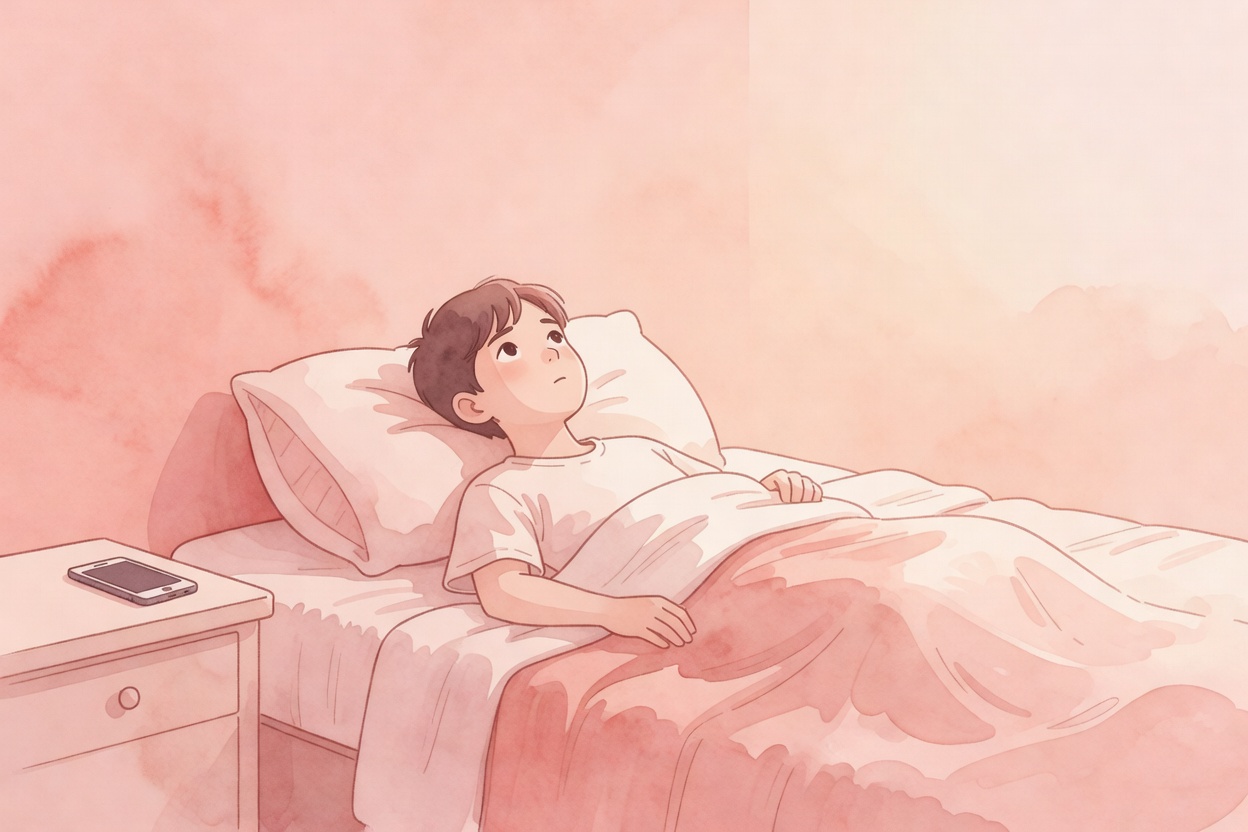
Breakup insomnia is brutal. Your body is exhausted but your brain won’t stop. You lie there and think and think and think.
Treat sleep as a priority, not a luxury:
- Same bedtime every night, even weekends
- Phone out of the bedroom (yes, really — you don’t need the temptation at 2 AM)
- No caffeine after noon
- A wind-down routine: shower, reading, something calming
If you need extra support, the sleep resources on MomentoVital give your brain something to follow instead of spiraling. A guided wind-down sounds ridiculous until the first night one actually works.
(We wrote a whole article about breakup insomnia if this is hitting hard.)
The comparison test
The rebound question gets answered badly because people ask it as a moral question: is it okay to date now? The useful version is diagnostic: can I be in this room without comparing them to the person who left?
If you cannot, you are not broken or unready in any moral sense. You are dating to get a data point about your own value, and that is a job a new person should not be asked to do. They receive a half-attention and an unfair comparison they did not choose.
Green light                      Yellow                     Red
──────────                       ──────                     ───
You forget they exist           You compare but            You tell them your
during the whole date           recover quickly            worth out loud
  ↓                               ↓                          ↓
You are choosing                 Slow down, no              This is a symptom,
                                decision yet               get support
9. Resist the Rebound
Your ego is bruised. Someone desired you, then didn’t. The fastest way to feel desirable again is to find someone new who wants you.
I get it. And I’m not going to moralize about it.
But I will say this: a rebound usually borrows energy from your healing and gives it to someone who doesn’t deserve the half-version of you. You’re not ready to give someone your full attention, and they’re not getting a fair deal either.
Wait until you can go on a date without comparing them to your ex. That’s your green light.
10. Stop Telling the Story on Repeat
There’s a difference between processing and perseverating.
Processing: “I’m talking about this to understand what happened and how I feel.” Perseverating: “I’m telling the same story to the eighth person this week and it feels exactly the same every time.”
If the retelling isn’t moving you forward, it’s keeping you stuck. Try writing it instead. Or tell it once, fully, to a therapist who can help you see the patterns you keep missing.
11. Do Something Kind for Someone Else
This one surprised me. In the thick of my breakup, a friend asked me to help her move apartments. I almost said no. I could barely function.
But I went. And for six hours, I was useful. I was solving logistics problems and carrying boxes and eating pizza on the floor of a new apartment. I wasn’t the person who got dumped. I was the person who showed up.
Helping others gets you out of your own head in a way nothing else does. It doesn’t fix the pain, but it reminds you that you’re still someone who matters to people.
12. Read One Good Book About It
Not a self-help book that tells you to manifest your best life. A real book, written by someone who understands heartbreak.
Recommendations:
- It’s Called a Breakup Because It’s Broken by Greg Behrendt — blunt, funny, practical
- Tiny Beautiful Things by Cheryl Strayed — not about breakups specifically, but about being human and hurting and surviving
- Attached by Amir Levine — understanding attachment styles changed how I see every relationship I’ve ever had
Free-writing has a failure mode nobody warns you about
After a breakup, unstructured writing very often becomes rumination on paper. You write the same three feelings in the same order, each entry ends where the last one did, and you end up with a thicker archive of the pain rather than any distance from it.
That is not journaling failing. That is a missing direction. Free-writing works when you already know what you want to find. Prompts supply the direction when you do not, and they work for the specific reason that they force a different angle than the one you have been circling.
13. Journal With Prompts (Not Free-Writing)
Free-writing after a breakup often turns into rumination on paper. You write the same feelings in the same circles.
Prompts give your brain a direction:
- “What do I want my life to look like in six months?”
- “What’s one thing I learned about myself in this relationship?”
- “What would I tell a friend going through exactly this?”
(Our toolkit has 30+ breakup journal prompts — grab them if you’re stuck.)
14. Let Yourself Be Bad at Things
Your focus is shot. Your motivation is gone. You’re going to be bad at work, bad at cooking, bad at responding to texts, bad at being a friend for a while.
That’s okay.
Give yourself a temporary pass. Lower the bar. “Good enough” is good enough right now. You don’t have to optimize your suffering.
15. Notice the First Good Day
It’ll sneak up on you. A day where you laughed more than you cried. A day where you went to bed and realized you didn’t check their profile. A day where something happened and your first instinct wasn’t to tell them.
When it comes, notice it. Write it down. Not because you’re cured — you’ll probably have a bad day tomorrow. But because it’s proof. Proof that the machinery is working. That you’re moving, even when it doesn’t feel like it.
What the research does and does not say about timing
The most repeated thing in breakup advice is a number, and the number is fake. There is no eleven-week schedule, no six-month rule, no point where you are officially over it.
What the research on grief does establish is closer to this: recovery is gradual, highly variable between people, and largely driven by two things — the severity of the loss, and how much social support you have. Not willpower, not how long you have been trying, and definitely not how much you understand it intellectually.
There is also a finding worth knowing because it explains why you are not being rational right now. Kross and colleagues (2011) showed that social rejection recruits partly the same neural regions as physical pain, and a later line of work found that some of the physical pain of rejection can be dampened by acetaminophen. That is not a metaphor and it is not a figure of speech: the hurt of a breakup registers in pain-processing systems, which is why a broken heart can produce a genuine physical sensation in your chest.
It is also why the advice to stop thinking about it so hard does not work. You cannot willpower a pain system. What moves the needle is what you do with the attention, which is what all fifteen of these are versions of.
The honest timetable
  First 2 weeks          Weeks 3-10              After that
  ─────────────          ───────────              ──────────
  The acute part.        Measurable but not       The relationship is
  Sleep, appetite        linear. Bad days        history rather than
  and focus are          are still normal        present tense.
  the problem.           and expected.
     ↓                      ↓                        ↓
  Reduce the load.       Start returning.        Notice the first day
  Do 2-3 tips.           3-5 tips if they work.  you didn't think
                                                  about them.
The trap is comparing your week three to someone else’s week three on social media. You are seeing the highlight of their recovery and the raw footage of yours.
What if I have been separated for a year and still feel this way?
A year is long enough that it is worth looking at more than the breakup itself. Persistent distress this far out often points at something the relationship was covering: a longstanding pattern you kept managing by being in the relationship, a loss before this one that never got processed, or a depression that was mislabelled as heartbreak.
None of that means you are doing it wrong. It means the question has changed. The question stops being “how do I get over this person” and becomes “what is underneath that keeps showing up in this shape.” That is a much better question and it is worth a therapist, because the second one needs someone who can stay with you across weeks.
Do I have to cut them off completely?
No, and a hard cut can be its own loss when you are already losing something. What matters is removing the daily micro-doses: the stories, the likes, the thumbnails. Archiving and muting do that without turning your life into a campaign.
Complete no-contact is worth considering when contact reliably pulls you back into the cycle, and especially if there was any coercion, violence, or harassment. In that case the cut is not about pain management, it is about safety.
What if I do not want them back, but I still want my old life back?
That is the most common version and almost nobody names it. You are not grieving the person alone. You are grieving the routine, the version of yourself that existed inside that relationship, the Tuesday evenings, the plans you had already made.
That grief is real and it does not have a solution. But it has a replacement, and the replacement is not found by getting the person back. It is found by building one small new thing that is yours, which is exactly what tips 7 and 13 are for.
The Truth About “Moving On”
Moving on isn’t a destination. It’s not a switch you flip. It’s more like the tide going out — so slowly you don’t notice, until one day you look up and realize you’re standing on dry ground.
You don’t need all 15 of these. Pick three. Do them this week. See what shifts.
And if you’re reading this at 2 AM with puffy eyes and an aching chest — you’re going to be okay. Not because I know the future, but because this is what humans do. We break. And then, stubbornly, we rebuild.
You don’t need all 15 of these. You need one. Tonight. The rest will come when you’re ready.
Explore our full breakup recovery toolkit for curated resources, journal prompts, and recommended tools to help you through. If you want someone who’ll sit with you through the hard parts, a therapist makes a real difference — Ricardo De Castro King works with breakups online, from your couch.