When burnout needs professional help
When burnout persists, disrupts sleep, harms relationships, or brings depressive symptoms, self-management may not be enough. Learn when to seek support.
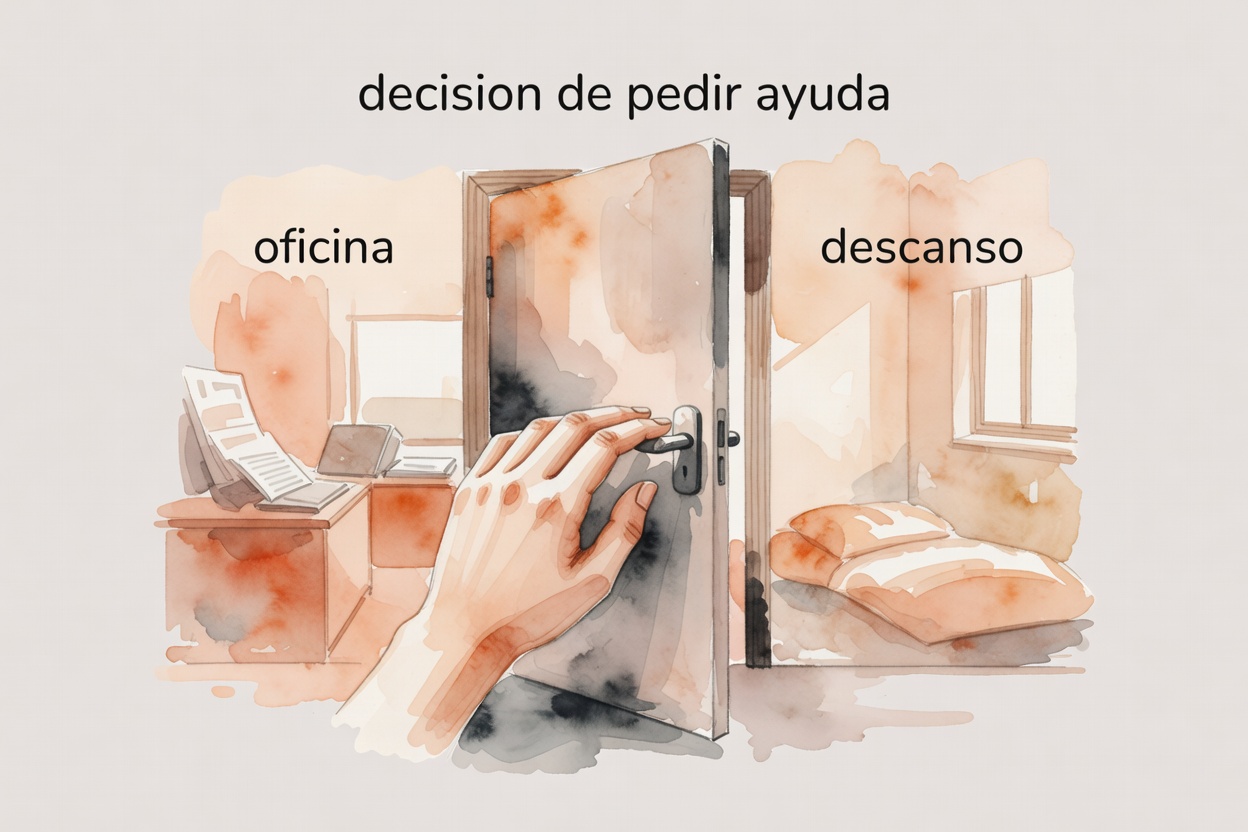
Self-care culture has a useful side and a side that gets in the way. The useful side: it gives daily tools that do help. The side that gets in the way: it suggests that if meditation, exercise, and sleeping well don’t recover you, something is failing in you.
Nothing’s failing in you. There are pictures self-management alone can’t move. And recognizing that threshold isn’t weakness — it’s precision. The same precision you use when you recognize that a three-week toothache isn’t for ibuprofen anymore, it’s for the dentist.
Clear signs it’s time
You don’t need all of them. One or two are enough to consider asking for support.
1. You’ve had stable symptoms for six months or more
Acute burnout can lift with life adjustments. Burnout lasting half a year or more, without improvement through rest and reasonable changes, is no longer in the “will resolve on its own” range. Toker et al. (2012, Psychosomatic Medicine) showed that sustained burnout predicts cardiovascular events — it’s not a benign condition when it becomes chronic.
2. All three dimensions of the thermometer are high
Emotional exhaustion + cynical distance + reduced accomplishment, all three in the high range. It’s the picture the WHO describes as established burnout. Here the work on work frame and personal habits remains important, but usually needs professional guidance to help prioritize and sustain changes.
3. Sleep is badly broken
Not “I’m sleeping worse these weeks.” Three or more nights a week with insomnia, waking between 3-5 AM without being able to return to sleep, waking tired even after eight hours. Sustained broken sleep is both symptom and amplifier — it feeds exhaustion and makes recovery harder.
4. Depressive symptoms appeared
- Persistent feeling of emptiness or sadness
- Pervasive loss of pleasure, even on vacation or weekends
- Thoughts of “it doesn’t make sense to keep going” or wanting to disappear for weeks
- Frequent crying without clear reason
- Feeling you won’t improve
Schaufeli et al. (2020) documented that untreated burnout increases the risk of clinical depression. If there are depressive symptoms, don’t wait. Entry is the same — therapy or general practitioner — and the earlier, the better the prognosis.
5. There are thoughts of harming yourself or of not wanting to go on
Not “today’s a bad day.” It’s recurring thought of disappearing, harming yourself, or not wanting to be here. If it shows up, get help now — don’t wait for next Monday.
In acute crisis:
- US: 988 (Suicide & Crisis Lifeline, 24/7).
- UK: Samaritans, 116 123 (24/7).
- Canada: 988 Suicide Crisis Helpline.
- Australia: Lifeline, 13 11 14.
- International: see findahelpline.com for country-specific lines.
There’s a crisis card on the home page with more resources.
6. The body is sending physical signals
- Frequent tachycardia without medical cause
- Chronic headaches or muscle pain
- Persistent digestive problems
- Dermatitis, hair loss, hormonal changes
- Repeated infections (chronic stress lowers defenses)
When the body speaks like this, the picture has been present for a while. A medical check is important to rule out organic causes, and in parallel, psychological support.
7. Alcohol, anxiolytic, or substance use went up
You started having drinks during the week to “unwind,” or sleeping pills more often, or any substance you didn’t use before. That’s the nervous system looking for exogenous regulation because self-regulation ran out. Not moral weakness — strong signal that structured support is needed before the pattern entrenches.
8. Close relationships are getting damaged
Your partner says they don’t recognize you. Your kids notice you different. Friends ask what’s going on. When burnout spills over from work and is damaging important bonds, urgency increases — not only for you, but because relationships sustain recovery.
9. You’ve tried basic tools and nothing moved
You’ve been applying detachment, relaxation, mastery, and some work adjustment for two months. The thermometer didn’t move. That doesn’t mean the tools don’t work — it means the picture needs another layer: specialized therapy, medical review, possibly psychiatry.
What kind of professional to look for
Clinical psychology
The most common approach for burnout. Therapies with most evidence:
- CBT (Cognitive-Behavioral Therapy): works with thought and behavior patterns sustaining the picture. Meta-analyses in Work & Stress (Maricuțoiu et al., 2016) show CBT significantly reduces the three burnout components.
- ACT (Acceptance and Commitment Therapy): useful when there’s conflict between work and personal values.
- Mindfulness-based therapies (MBSR, MBCT): consistent evidence for healthcare and teacher burnout, particularly for emotional exhaustion.
General medicine or psychiatry
When there are physical symptoms, badly broken sleep, generalized anxiety, or suspected depression. Doesn’t necessarily mean medication — means evaluation. Many people improve significantly combining therapy with medical follow-up.
Occupational therapy or organizational coaching
When the core of the problem is the work frame and there’s capacity to modify it. Useful combined with personal therapy.
What to look for when choosing
- Specific experience with burnout or work stress. Not every therapist has that skill.
- Evidence-based. Ask what approach they use and whether it makes sense to you.
- Bond. The first two meetings tell you a lot. If you don’t feel minimal connection, switch.
- Clear framework: frequency, duration, goals, cost.
Support apps and resources (don’t replace therapy)
- Calm and Headspace have specific programs for work stress and sleep.
- BetterHelp (or similar platforms in your country) connects with online therapists if you don’t have local access.
- Insight Timer is free and has specific guided meditations for burnout.
What’s NOT a serious sign
A heavy day, a hard week, a tougher period. Not everything is clinical burnout. There are demanding jobs that ask more in certain seasons and the system compensates afterward. The signs in this article are stable patterns — not an isolated peak.
If you’re going to ask for help
- Schedule the first appointment this week, not “when I have more energy.” Waiting to improve is the classic trap — burnout doesn’t improve on its own when it’s already been a while.
- Go accompanied if you can. Not mandatory, but some people arrive better if someone close knows what they’re doing.
- If the first session doesn’t fully convince you, don’t discard it immediately. Give it two or three. If by the third meeting you feel it isn’t helping, switch without guilt.
- Tell what’s there. Don’t filter. Professionals work with what they have — if you dress up the situation out of shame, the intervention falls short.
Closing
Asking for professional help isn’t failing at self-management. It’s recognizing the picture is at a threshold where you need another set of eyes — someone who can see what you can no longer see from inside. The cost of asking is low. The cost of not asking, when the picture requires it, is high and growing.
Burnout is one of the conditions with the best prognosis when addressed well and in time. What’s tricky is that we don’t always arrive in time — because we were told that having to ask for help means something about us. It doesn’t mean anything about you. It means you got as far as you could alone, and now comes the next rung.