Screens, Blue Light, and Your Brain at Night
Is your phone really the reason you cannot sleep? Learn what blue light does, why content matters, and which screen changes have the highest leverage.
 Ricardo De Castro KingPsychologist · Meet the author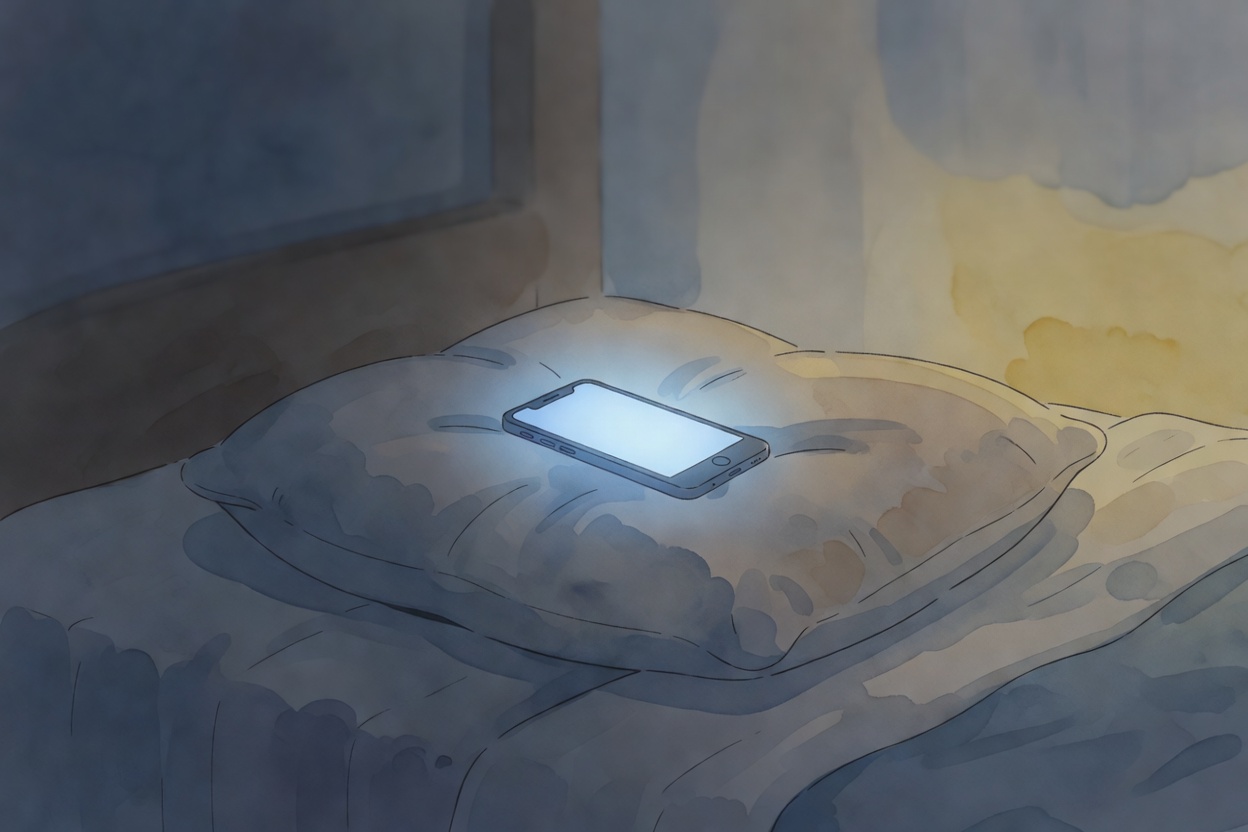
Screens, Blue Light, and Your Brain at Night
Every sleep article says the same thing: Put your phone down an hour before bed. And every night, you’re still scrolling at midnight.
Let’s be honest about what the science actually says — and what the real problem is.
The Blue Light Story (Partially True)
Blue light suppresses melatonin production. That’s real. Your phone, laptop, and TV emit blue-spectrum light that signals “daytime” to your brain.
But here’s what the headlines miss:
- The effect is modest. Blue light from screens can delay melatonin onset; controlled studies suggest the average effect is modest. That matters, but it’s not the difference between sleeping and not sleeping.
- Night mode helps. Using night shift, warm screen tones, or blue light glasses reduces the melatonin suppression significantly.
- A candle produces more blue light than most phones at arm’s length. Context matters.
The blue light narrative has been blown way out of proportion. It’s not that it doesn’t matter — it’s that it’s probably not the main reason you’re awake.
The Real Problem: What You’re Consuming
The bigger issue isn’t the light from your screen — it’s the content.
Scrolling social media before bed is problematic because:
- Comparison and emotional activation. Seeing other people’s highlight reels, arguments, or news stories triggers emotional responses that keep your brain wired.
- Infinite scroll hijacks your stopping point. There’s no natural end. “Just one more” becomes 45 minutes.
- Variable reward patterns. Social media is literally designed like a slot machine. Your dopamine system gets activated, which is the opposite of what you need for sleep.
- News anxiety. Checking the news before bed loads your brain with unresolved concerns right when it’s trying to power down.
Reading a Kindle, watching a calm nature documentary, or listening to a podcast are all screen activities — but they’re fundamentally different from scrolling Twitter or TikTok.
What the Research Actually Recommends
It’s not all-or-nothing
You don’t have to go screen-free to sleep well. Here’s a nuanced approach:
-
Switch content, not medium. 60 minutes before bed, shift from stimulating content (social media, news, work emails) to passive, calming content (a show you’ve seen before, a podcast, a sleep story).
-
Use night mode. It genuinely helps with the melatonin piece.
-
Stop the scroll. If you can’t stop scrolling, set a specific “put the phone in another room” time. The phone being within reach is the problem — not the light.
-
No checking after lights out. The single worst thing you can do is check the time when you wake up at night. The mental calculation (Only 4 hours left until my alarm) creates panic that prevents sleep.
The phone-in-another-room trick
Charging your phone in another room is one of the most effective sleep interventions that costs zero dollars. It eliminates:
- The temptation to check it when you can’t sleep
- The time-check anxiety
- The “just five more minutes” scroll
- The notification buzzes
Use a $10 alarm clock. Your sleep will thank you.
The Deeper Layer
Here’s what nobody talks about: we scroll at night because we’re avoiding something.
The phone is a tool for distraction. During the day, we have work, conversations, tasks. At night, it’s just us and our thoughts. And sometimes those thoughts are uncomfortable.
If you’re reaching for your phone at midnight, ask yourself: What am I avoiding right now?
Often the answer is:
- Loneliness
- Anxiety about tomorrow
- Unprocessed feelings from the day
- A sense of emptiness
Addressing that is the real sleep hack. No app filter can do it for you.
A Realistic Evening Plan
Instead of the impossible “no screens after 8 PM” rule, try this:
- 8:00 PM: Switch to calm content only. Night mode on.
- 9:30 PM: Phone goes to another room.
- 9:30-10:00 PM: Wind down (reading, light stretching, journaling, a sleep story on Calm).
- 10:00 PM: Lights out. If you’re not sleepy, that’s fine. Rest is still valuable.
This isn’t perfection. It’s a framework. Some nights you’ll scroll until midnight. That’s okay. The goal is to build a pattern, not a prison.
The Bottom Line
Your phone probably isn’t the reason you can’t sleep. But it might be the thing that’s making it harder to address the real reason.
Blue light matters a little. Content matters a lot. What you’re avoiding by scrolling matters most.
Put the phone down. Not because an article told you to — but because the quiet is where the healing happens.
If you want to know how severe your insomnia is before you change anything, the insomnia test (ISI) measures seven questions and returns a result immediately. Free, no registration.