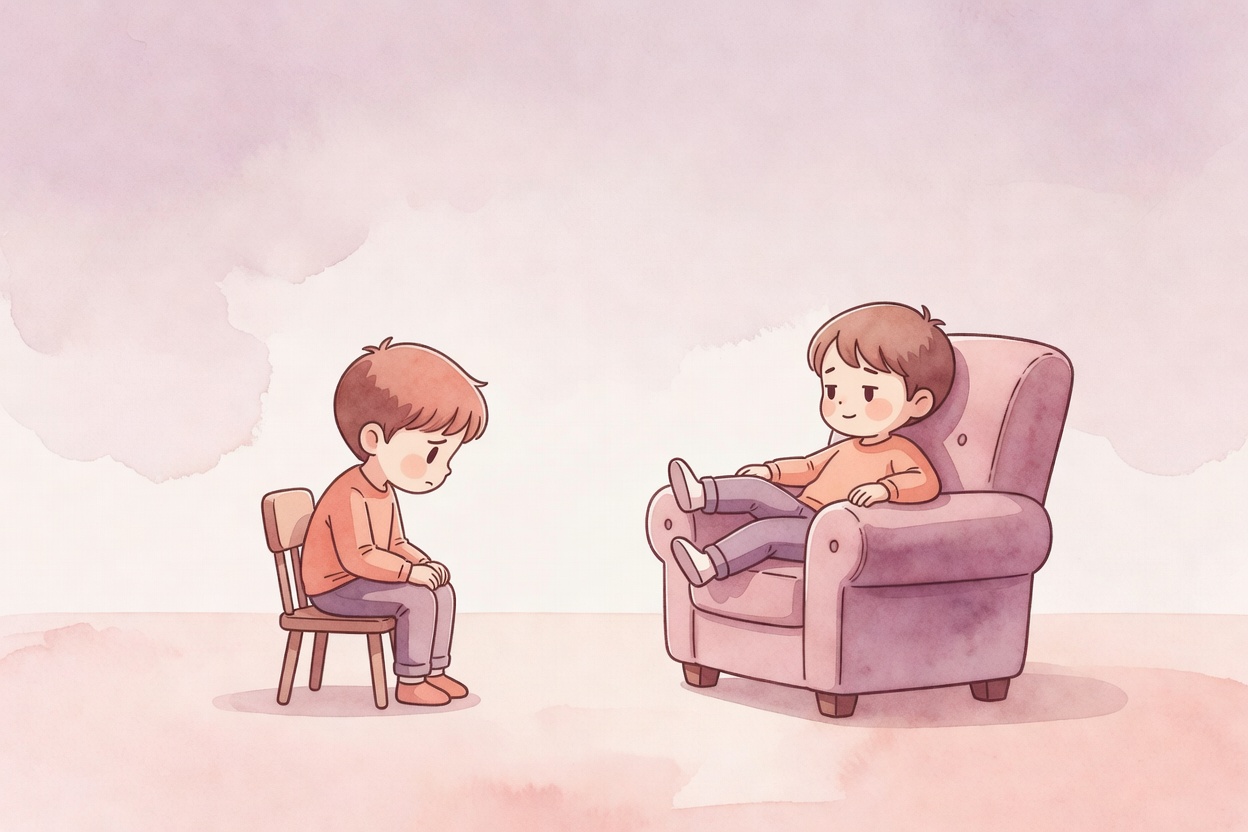
When low self-esteem needs professional therapy
When low self-esteem affects decisions, relationships, mood, safety, or daily functioning, professional support may be the next step
 Ricardo De Castro KingPsychologist · Meet the author
Many people with low self-esteem try to work it alone — books, exercises, readings, apps. Some manage it well this way, especially if low self-esteem is mild and responds to consistent work. Others hit a plateau: something improves, but the core doesn’t move. The same thoughts return. The same background sensation is still there.
When low self-esteem is deep, comes from childhood, and touches central schemas — solitary work often isn’t enough. Not because you don’t try. Because there are mechanisms that require a trained external eye to see and dismantle.
This article talks about when, what kind of therapy works better, and what to expect.
Signs that professional support is needed
One alone is enough to consider consulting. Two or more is a clear recommendation.
1. Low self-esteem conditions important decisions
You don’t apply for jobs you want because “I’m not up to it.” You don’t invite people who attract you because “why would they want something with me.” You let opportunities pass because deep down you believe you don’t deserve them. Each decision conditioned by low self-esteem confirms its power over you. Therapy breaks that power.
2. Depression appears
- Persistent fatigue with no medical explanation
- Frequent crying with no clear reason
- Loss of enjoyment in what you used to like
- Thoughts of “everything stays the same, it won’t change”
- Desire to disappear
- Severely deteriorated sleep or excess sleep
Untreated low self-esteem significantly increases the risk of major depression. If depressive symptoms are already present, wait less — early treatment has much better prognosis.
In acute crisis:
- Colombia: Line 106 (24/7, free).
- Spain: Line 024.
- Mexico: Línea de la Vida (55) 5259-8121.
- Argentina: Suicide Assistance Center, 135 / (011) 5275-1135.
- Chile: Salud Responde 600 360 7777.
- Peru: Line 113, option 5.
- United States: 988.
3. Thoughts of hurting yourself or disappearing
If thoughts like “it would be better if I weren’t here”, “everyone would be better without me”, or more direct thoughts of hurting yourself appear — consult without waiting. It’s not “just low self-esteem.” It’s a crisis signal. The lines above work 24/7 and are free.
4. Eating disorders
Severe restriction, binges, purging, compulsive exercise, tortured relationship with the mirror. Eating disorders frequently mount on deep low self-esteem. They require specialized treatment — they don’t resolve alone.
5. Repetitively painful relationships
You always end up in relationships where you’re treated badly. You put up with more than you should. You forgive things you shouldn’t forgive. Your low self-esteem is choosing for you and therapy is what breaks that pattern — alone is very difficult.
6. You worked alone for years without significant change
You read, applied exercises, 2-3 years passed and the background sensation is still the same. That’s not lack of effort. It’s deep schemas that need specific clinical work. Schema Therapy (Young) is designed exactly for that.
7. Growing isolation
You’re going out less, connecting less, avoiding more. Low self-esteem is shutting down your social life. Without intervention, the pattern consolidates.
8. Use of alcohol, substances, or shopping to “feel better”
If to bear the sensation of not being worth it, you use alcohol, anxiolytics without prescription, compulsive shopping, emotional food, or other forms of anesthesia — the risk is double: low self-esteem plus a dependence. Treating before is more efficient than after.
Which therapy has more evidence
Cognitive-Behavioral Therapy (CBT) for low self-esteem
Melanie Fennell (1999) developed the most-studied protocol for clinical low self-esteem in her book Overcoming Low Self-Esteem. Typical components:
- Psychoeducation about how low self-esteem is maintained.
- Central rule identification (e.g., “if I’m not perfect, I’m worthless”).
- Behavioral experiments — testing if the rule holds up in reality.
- Cognitive restructuring — working on automatic beliefs.
- New cognitive balance — developing a realistic view of oneself.
Typical duration: 12-20 weekly sessions. Notable improvement between weeks 8-14. CBT has solid evidence for moderate low self-esteem without deep trauma underneath.
Schema Therapy (Young)
For severe low self-esteem with deep roots in childhood — what Jeffrey Young (2003) called “early maladaptive schemas.” Typical schemas in low self-esteem:
- Defectiveness/shame: “there’s something wrong with me.”
- Abandonment/instability: “those who matter to me end up leaving.”
- Emotional deprivation: “no one understands me or will be able to care for me as I need.”
- Unrelenting standards: “if I’m not perfect, I’m worthless.”
- Subjugation: “I have to prioritize what others need.”
Schema therapy lasts longer (1-3 years) and works with specific techniques (imagery, empty chair, limited reparenting in the therapeutic relationship). Solid evidence for chronic low self-esteem with traumatic background.
Mindful Self-Compassion (MSC)
8-week program developed by Neff and Germer (2013). Group-based. Controlled trials show significant reduction in depression, anxiety, shame, and increase in self-compassion. Very good option as complement to individual therapy or as first entry to working on the relationship with oneself.
Compassion-Focused Therapy (CFT)
Paul Gilbert developed this therapy specifically for people with chronic shame and severe self-criticism. Integrates evolutionary and attachment elements with compassion training. Growing evidence for deep low self-esteem with much self-criticism.
Brief psychodynamic
For people where low self-esteem is interwoven with deep relational patterns. Variable duration. Useful when CBT alone “doesn’t touch” the core.
How to know which type fits
If low self-esteem is moderate and you have good general functioning → CBT (Fennell) or MSC as first option.
If there are clear roots from childhood, repeated pattern in relationships, nuclear sensation of “defectiveness” → Schema Therapy.
If self-criticism is the dominant component, with much shame → CFT or MSC.
If there’s depression, eating disorder, or serious relational problems → integrated treatment with professional combining approaches.
You don’t have to decide exactly which type — that’s the therapist’s decision after evaluating. Your part is consulting with someone who knows how to do broad evaluation and who explains what they propose and why.
About medication
Low self-esteem on its own isn’t treated with medication. But if there’s comorbid depression or comorbid anxiety disorder, an SSRI (sertraline, escitalopram, fluoxetine) can help therapeutic work progress better. It’s a psychiatrist’s decision, not a psychologist’s.
Medication doesn’t change your self-esteem. It can lower depression/anxiety enough for therapy to reach the core.
What to look for when choosing a therapist
- Specific experience in clinical low self-esteem. Ask directly: “what approach do you use for low self-esteem? Have you read Fennell, Young, or Neff?”
- Evidence-based approach. CBT, schemas, CFT, MSC — all have solid research. “Integrative therapy” without clear components, less reliable.
- Between-session work. Therapy that works for low self-esteem assigns tasks — if there’s nothing between session and session, you’re paying for conversation, not treatment.
- Rapport. After 3 sessions you should feel they understand you and there’s direction. If not, change — it’s not lack of faith, it’s therapeutic fit adjustment.
What to expect in the first session
- Broad evaluation — they’ll ask you about childhood, important relationships, work, emotional patterns, current symptoms.
- First mapping of the problem — what maintains the low self-esteem, what the main patterns are.
- Treatment proposal — what approach, estimated duration, how work is done.
- Don’t expect changes yet. The first session is diagnostic, not intervention.
What is NOT a sign you need therapy
- A bad day where you felt useless.
- Insecurity before something new and important.
- Shyness in an unknown context.
- Doubting about big decisions.
- Occasionally comparing yourself with someone on something specific.
- Not being 100% sure of yourself all the time.
If you read this and felt relieved, you’re probably not facing clinical low self-esteem — you’re facing the normal variability of feeling about yourself.
Closing
Deep low self-esteem isn’t resolved with more solitary effort. It’s resolved with specific clinical work, and evidence-based approaches exist and work. It’s not an option you didn’t reach — it’s treatment you haven’t accessed yet.
If any of the signs above resonated, scheduling a consultation this week is a small step with big effects. Low self-esteem has a very strong internal bias to postpone (“when I have more energy”, “when I’m better”) — precisely because its function is to prevent you from doing things that could change it.
Don’t let it decide for you. That decision is yours.
If you want a concrete reading of where you stand, the self-esteem test (Rosenberg) takes ten items. Free, no registration.