The safety behaviors that seem to protect you and expose you
Safety behaviors can feel protective but keep social anxiety going. Learn to spot them and reduce them one at a time through gradual exposure.
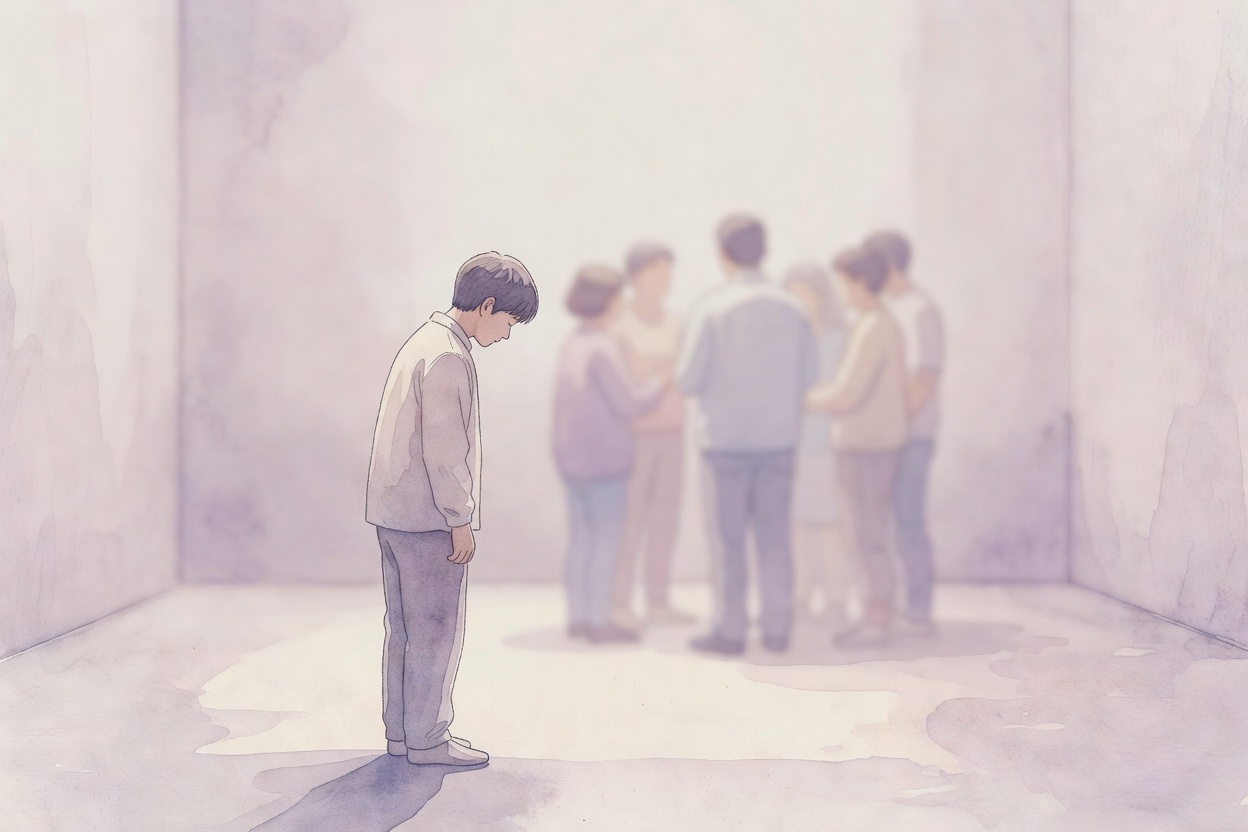
Safety behaviors are the small things you do so that anxiety “doesn’t show” — speaking more quietly, avoiding eye contact, rehearsing the phrase three times before saying it, standing near someone known. They’re automatic. They happen without you thinking. And they are — according to the Clark-Wells model (1995) — one of the three central mechanisms that maintain social anxiety.
The paradox: every behavior you did to hide the anxiety is what makes it more visible and what prevents it from disappearing.
This article gets into how to detect them and dismantle them.
Why safety behaviors are a problem
Three reasons:
1. They block corrective learning
Therapeutic exposure works because your brain learns “I could be in the situation, anxiety rose and fell, nothing serious happened.” If you went out with safety behaviors on, the learning that consolidates is different: “I could be there, but because I was careful. Without the behaviors it would have been terrible.”
The brain doesn’t learn to let go of the phobia — it learns to depend on the behaviors. Next time you’re worse because you internally believed you survived thanks to crutches.
2. They disconnect you from the real interaction
Many safety behaviors are forms of distracting yourself from the situation — checking your phone, looking at the floor, writing things in a notebook, thinking about what you’ll say next. That takes you out of the real conversation. The other person registers the disconnection. What tried to protect shows you more distant than you wanted.
3. They usually produce exactly what you fear
If you talk very quietly so the trembling voice doesn’t show, the other asks you to repeat — and there the voice sounds nervous. If you avoid eye contact so you don’t go blank, you seem avoidant. If you rehearse the phrase a thousand times and say it with an artificial pause, it sounds weird. The behaviors produce the social signal they were trying to hide.
The most common safety behaviors
Verbal
- Speaking more quietly or faster
- Giving short answers to not elaborate
- Keeping the conversation in safe territory (weather, formal work)
- Asking a lot so you don’t have to share anything yours
- Rehearsing what you’re going to say before saying it
- Using set phrases or repetitive fillers
- Laughing at what you don’t find funny to fill space
Bodily
- Avoiding eye contact — looking at the table, fingers, phone
- Tensing the body so trembling doesn’t show
- Crossing arms or covering the neck
- Hiding hands (hands in pockets, squeezed against you)
- Leaning on objects (table, chair) to stabilize
- Closed, small posture
Avoidant
- Arriving late to not have to socialize in the preamble
- Leaving early before the hardest part starts
- Sitting near the exit
- Placing yourself at the edge of the group, not the center
- Sitting next to someone known even if the conversation isn’t useful
- Choosing “helper” roles (serving, cleaning, passing things) to not have to converse
Chemical / physiological
- Alcohol before the event (“one drink to relax”)
- Coffee to “wake up” beforehand (actually, to have attributable physical symptoms from caffeine)
- Anxiolytics without prescription
- Eating or drinking constantly to not have to talk
Cognitive
- Monitoring your performance internally (“how am I sounding?”)
- Mentally rehearsing the next phrase
- Catastrophically anticipating (“he’ll ask me X and I won’t know”)
- Counting minutes until you leave
- Calculating when you can escape to check the phone
How to detect them (the hard part)
Most are automatic. Specific self-observation work is needed. Three strategies:
1. Post-event, direct question
After an interaction (ideally within the hour, while fresh), ask yourself:
- What did I do to “be better”?
- What did I avoid doing out of fear of how it would sound?
- What did I tell myself to keep functioning?
- Where did I look, what did I do with my hands, how was my posture?
Write it down. At first you’ll notice 3–4 behaviors. With practice, you detect 10–15.
2. Observe someone without social anxiety
Notice what someone comfortable socially does:
- Looks in the eyes without anxiety.
- Takes pauses without filling with fillers.
- Says things without rehearsing them.
- Their posture is open.
- Their voice has natural variation.
The opposite of each of these things is — probably — one of your safety behaviors.
3. Record yourself (if you can)
Video or audio of one of your interactions (with permission, obviously). Watching it the next day is disarming but useful: you notice things mental replay didn’t register and you’ll see yourself more normal than you felt. You also notice the behaviors — low tone, weird pauses, closed posture — you didn’t know you were doing.
How to dismantle them
The key rule: one at a time, in gradual exposure, not all at once.
Step 1: Inventory
List all the safety behaviors you detected.
Step 2: Grade them
Which to drop first. Start with one that is:
- Medium difficulty (not the easiest, not the hardest).
- Visible (that you notice you removed it).
- Present in several situations (so you can work it many times).
Classic example: avoiding eye contact.
Step 3: Exposure without that specific behavior
In the next social exposures, only that behavior goes. The others remain, because if you drop many at once you get overwhelmed.
In the eye contact example: in the next interactions, you maintain gaze when greeting, when the other speaks, when answering. The rest (low tone, postures, etc.) you leave the same for now.
Step 4: Repeat until it’s neutral
You continue with that behavior dismantled for 1–2 weeks. When maintaining eye contact stops requiring conscious effort, you move to the next.
Step 5: New behavior
You add another. For example: not arriving late. And so on.
In 2–3 months of systematic work, most people manage to dismantle 5–8 safety behaviors. The effect: social interactions feel different, more “real,” and anxiety — paradoxically — starts to drop, because the system is no longer spending energy sustaining the crutches.
The mistake of trying to dismantle them all at once
Very common: “today I expose myself as if I had no social anxiety.” You enter a meeting forcing yourself to look, speak loudly, open posture, without rehearsing, without leaving early. Result: total overload. Your system collapses, you leave with anxiety 10/10, you confirm you “can’t.”
One at a time is counterintuitive but it’s what works.
Specific cases
Social alcohol
If you habitually drink before or during social events to lower anxiety, this behavior is one of the most important to dismantle — because beyond the social problem, it generates progressive dependence. Dismantling it asks:
- Lowering amount gradually.
- Exposures without alcohol in small contexts first.
- If there’s already dependence, professional support — don’t try alone.
Phone as refuge
Looking at the phone at every social moment is a very sticky behavior. To dismantle it: leave it in the bag or pocket during the whole interaction. At first anxiety rises. In 3–4 interactions it drops.
Eye contact avoidance
Perhaps the most visible, perhaps the hardest. A bridge technique: look between eyebrows, not directly in the eyes, at first. Gives the appearance of eye contact without the intensity. Then you move to eyes.
Closing
Safety behaviors are the silent enemy of social anxiety. Each seems to protect you — and each keeps you trapped. Dismantling them is a central part of the work, not an additional one.
Start today detecting just one. The one you see first. Next week, dismantle it once. The following week, again. In three months, there’ll be noticeable change — not in “how you feel socially” in the abstract, but in how anxious you need to be to function.
That’s the real goal. Not never feeling anxiety. Feeling it without needing crutches.