What burnout is and how to spot it early
Burnout is more than tiredness. Learn Maslach’s three dimensions, the subtle signs, and when persistent work stress needs a different response.
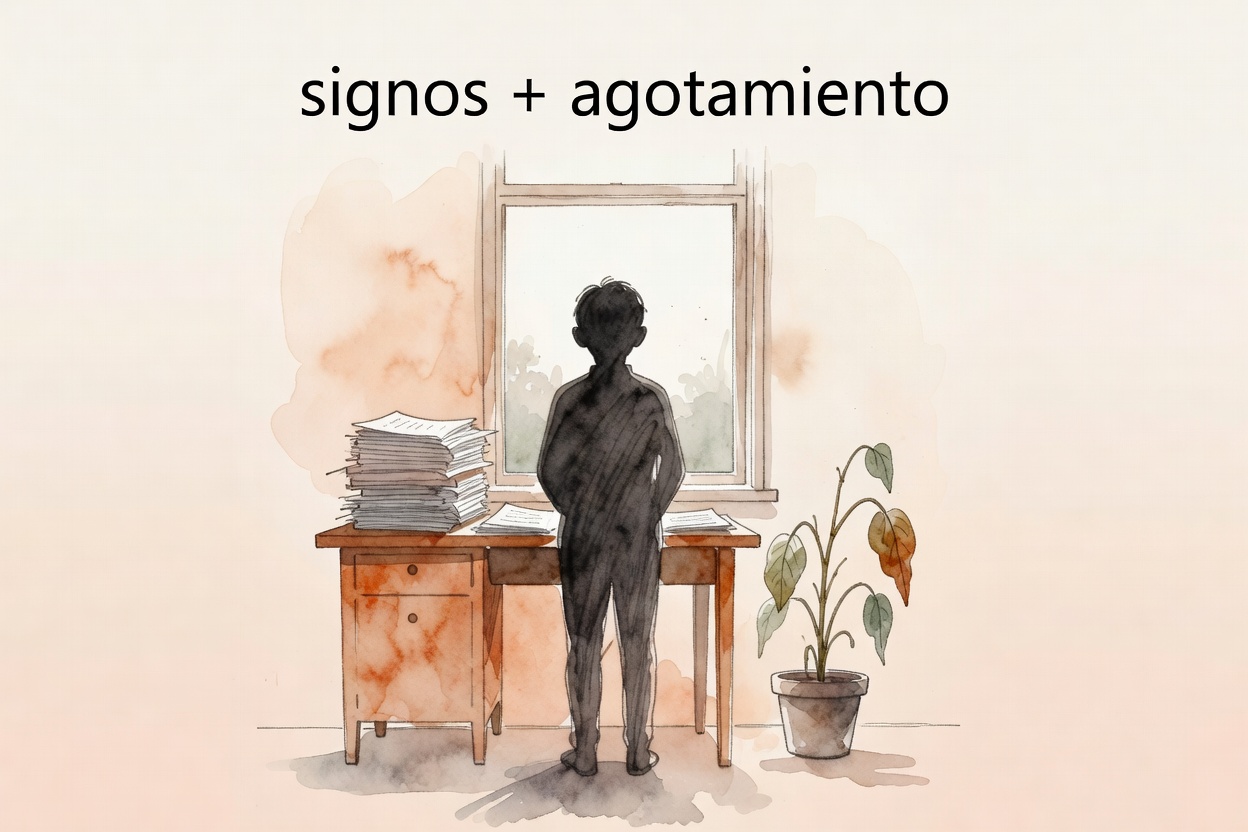
The word burnout gets used for everything. A heavy Monday, a project that ran long, a week of bad sleep. That’s not burnout — that’s being tired. Burnout is something else, and when it arrives it doesn’t announce itself. It slips in sideways, dressed up as “I’ve been like this for months but I should be able to handle it.”
The WHO formally recognized it in ICD-11 (2019, in force since 2022) as an occupational phenomenon — not a disease, but a syndrome resulting from chronic workplace stress that hasn’t been successfully managed. What doesn’t make the headlines: burnout has three separate dimensions, and almost never do all three appear at once early on. That’s why it goes unseen for so long.
The three dimensions (Maslach)
Christina Maslach — the Berkeley psychologist who has studied this since 1976 — described burnout in three pieces that can sit at very different levels:
1. Emotional exhaustion
Not just being tired. It’s the feeling that you have no reserve left. You get to the afternoon and don’t have it in you to answer a message in the family group. A normal conversation feels heavy. An email makes you close your eyes before opening it.
2. Depersonalization or cynical distance
You get more sarcastic, drier, more “professional in the bad sense” with the people you work with. Clients, patients, coworkers start to feel like problems rather than people. You don’t recognize yourself in that tone. And you don’t like it.
3. Reduced personal accomplishment
Work you used to do with pride starts looking mediocre. You think “anyone could do this” about work that takes years of skill. The sense that what you do matters — it’s dimmed.
Burnout rarely starts with all three at once. It almost always begins with emotional exhaustion. Months later cynical distance appears. The drop in personal accomplishment comes last — and it’s usually the signal that you’ve been in it far longer than you thought.
Signs that don’t look like burnout
The typical lists say: tiredness, irritability, headaches. All true. But in therapy the signs that show up first are different — more subtle, more normalized:
Turning off the camera in meetings that used to feel fine. Not shyness. It’s that holding a face of interest is draining.
Reaching for your phone mid-conversation with someone you love. Your system is looking for a break it can’t ask for out loud.
Postponing replies to friends — not to work. When social energy gets rationed down to only what’s obligatory.
Feeling relief when someone cancels. If “I can’t make it” sounds more like rest than disappointment lately, your system is asking for something.
A real weight on Sunday night. Not “ugh, Monday.” Actual weight on the chest, sometimes a stomachache. The body warns before the mind does.
Losing taste for things you used to enjoy. This is the sign most often confused with depression. The difference: in burnout, pleasure usually returns when there’s real distance from work; in depression, it stays flat even then.
What the recent research says
A meta-analysis published in JAMA Network Open (2023) on burnout among healthcare professionals found prevalence between 30 and 50% depending on specialty and measurement. The number isn’t the key — the key is that it’s no longer rare. It’s epidemiological.
More relevant: a longitudinal study in Work & Stress (Schaufeli et al., 2020) showed that burnout predicts depression, but depression does not predict burnout. Meaning: if you leave burnout untreated, there’s a real probability it turns into a depressive picture — with all the added recovery time that brings.
The cost of not catching it early is long. The cost of catching it is nothing.
When it’s burnout and when it isn’t
Three questions that help separate:
1. Does the weekend restore you? If two days off give you back real energy — it’s tiredness, not burnout. If by Sunday afternoon you’re already back where you were on Friday — something else is going on.
2. Do you still enjoy things when you’re not working? Tiredness leaves enjoyment intact. Burnout dims it across the board. If a show you used to love isn’t hooking you, if dinner with your partner feels like a chore — that’s burnout talking.
3. Did your actual capacity drop, or just the feeling? An actual drop in output, with errors you didn’t use to make, is a strong sign. A drop in sensation (you think you’re doing badly at things you’re still doing well) is the reduced accomplishment piece.
What to do right now
If several of these signs ring true, three useful things this week:
Use the burnout thermometer on the landing page. It returns your three dimensions separately — not a single score — and that orients where to start.
Do an 8-minute body scan before bed. Sonnentag (2007) showed that mental detachment from work — not just physical pause — is what activates recovery. Body scan is one of the few practices that moves the needle in minutes.
Read the article on recovering from burnout, which walks through the four recovery factors with concrete examples.
If you’ve been like this for many months
Self-management is valuable but not always enough. If all three dimensions are high, if there’s a sense that nothing will change, if sleep is badly broken or there are thoughts of disappearing for weeks — that needs another set of eyes.
It’s not failure. It’s reading the picture accurately. A professional can work the frame of the job with you — not only the symptoms. The article on when to get help has clear indicators.
Burnout doesn’t clear with a long weekend. But it does reverse — with the right frame and real time. Recognizing it is the first rung, and you already stepped on it.