MV Moment · Self-worth and value
When you cannot love yourself (and the phrase comes back every night)
Self-rejection is not part of your personality. It is almost always learned in your earliest bonds. Understand where it came from, and open space to stop rejecting yourself.
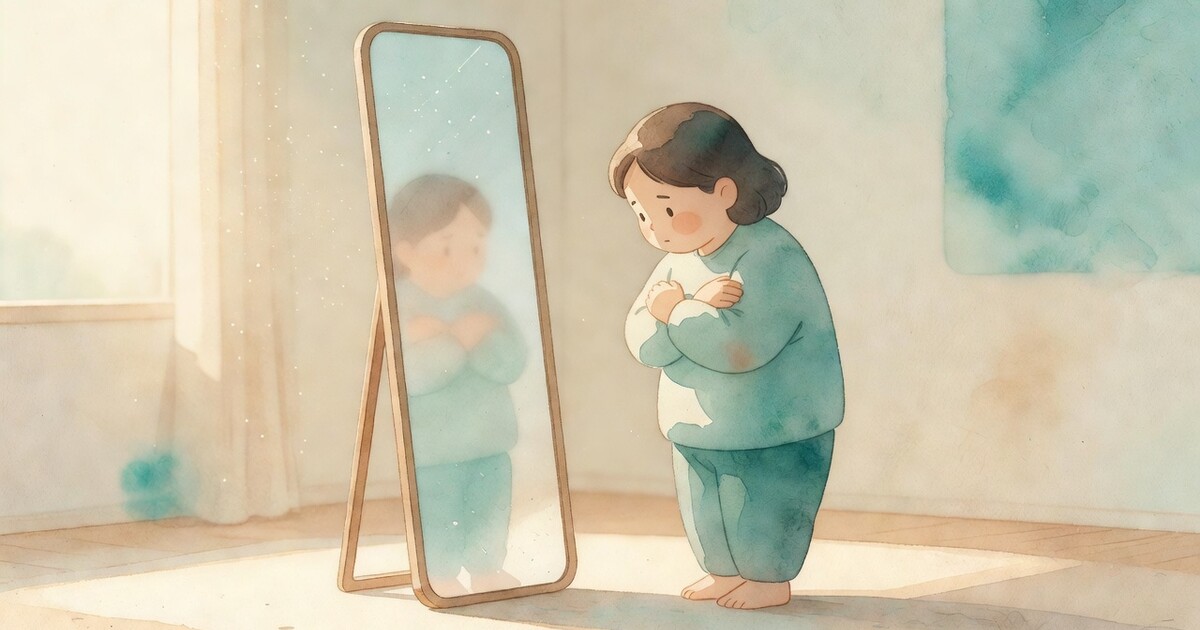
Why don't I love myself?
Not loving yourself is not a factory defect: it is a learned pattern, mostly in the early bonds where love was not unconditional. If you were repeatedly told you were “difficult,” “selfish,” “too sensitive,” or “too quiet,” you learned to read your interior with those lenses. The good news: what is learned can be unlearned, with time and daily practice.
What it feels like to live hating yourself (and why it shows up more at night)
In the shower, brushing your teeth, looking at the ceiling: that is when it comes. An inner look that does a roll call. You replay something you said and judge yourself harsher than anyone you know would. “There it goes again.” Or worse: “If I were different, this would not have happened to me.” The phrase can take a thousand forms, but they all share the same gesture: you look at yourself from outside and you do not approve.
Self-rejection gets stronger when distractions go down. During the day, activity distracts it. At night, noise distracts it. And the nighttime silence adds what the body carried all day without processing. That is why at 11 pm the phrase gets louder than at 7 am.
What often happens is not really “I do not love myself.” It is “I cannot love myself yet with these lenses.” The difference is the bar — and it can change.
You are not broken. You are tired of a voice that is not yours
Not loving yourself is very common. Many people live with that voice and on the outside function with apparent normalcy. But the cost goes inward: it is hard to sleep, hard to enjoy, hard to trust what is yours. That is not weakness — it is the body carrying something it was not taught to set down.
One check that helps: does the voice that rejects you sound like the cadence of someone else? If you stay very still, you will be able to identify whose voice you learned to sound like. A father or mother who did not approve. A school period where the others were the mirror and you were the shadow. A partner who kept you small to feel big. They are not the ones to blame — they are the ones who planted a lens. And that lens can be changed.
Another check: would you reject yourself if you were a friend? When someone you love tells you something hard, do you say “what a bad person you are”? You say “I can’t believe that happened to you, you didn’t deserve it.” Why not you? The phrase you say to yourself would not be accepted by a judge. It is time to leave it as such: a phrase, not a truth.
The borrowed lens: why your self-rejection has an author
A metaphor helps. Imagine that as a child you were given a pair of glasses. Those glasses had a filter: every time you looked at someone, you saw them as better than you. Every time you looked at your own achievement, you saw it as smaller. With those glasses on, it was logical not to love yourself. But the glasses were borrowed. Someone else chose them, in another context, for other reasons.
Self-rejection is rarely invented out of nothing. It is built by repeating the model of someone you saw a lot, especially in the early years. Research shows that people who grew up with unstable emotional bonds or with excessive criticism tend to internalize that voice (Lippens and colleagues, 2022, DOI 10.1002/cpp.2744 — children with adverse histories and later self-hatred are associated with distinguishable clinical diagnoses). That is why the phrase often sounds “yours” but the cadence does not sound like your voice — you can trace it, if you give yourself the time.
The trap is this: once the lens is installed, it feels like yours. Not “those glasses,” but “this is how I see myself.” And because it feels like yours, it is hard to challenge it. But if you put on different glasses — glasses that show you what the other lens made invisible — the rejection starts losing volume. Self-compassion is one of those lenses.
What psychology knows (without putting you to sleep in the process)
It is worth knowing two things, a warm one and a cold one.
The warm one. Self-compassion is not self-indulgence or self-pity. It is the opposite: it is treating yourself with the same care you would treat a friend. Kristin Neff, a psychologist at the University of Texas, has spent almost two decades researching how self-compassion reduces self-rejection, perfectionism and rumination (Neff, 2003a — classic chapter in the APA book; Neff and Germer, 2013, DOI 10.1037/a0032110, validated Mindful Self-Compassion program). One of her researchers, Karen Bluth, has applied it to adolescents and parents, and reports concrete changes in how they talk to themselves.
The cold one. The combination of early adverse experiences and adult self-hatred predicts clinical distress that is not explained by adversity alone (Lippens and colleagues, 2022, DOI 10.1002/cpp.2744). I say this carefully: the seed sometimes comes from far away, but it is not a sentence. If the body built that rejection with the repetition of messages, it can dismantle it with the repetition of different messages, day after day. It is not magic; it is emotional re-education, and psychotherapy has specific tools for it.
The action is not “accept yourself more.” It is to learn to treat yourself the way you would treat someone you love — and that is practiced.
Three concrete exercises that start today (no motivation needed)
Here are three, not because you have to do all of them, but so you can choose the one that resonates most. Each one takes five minutes.
One. The friendly voice. The next time you criticize yourself with a harsh phrase, stop and ask yourself: “if a friend said this to me, would I believe them?” If the answer is no, do not believe it from yourself either. It is an old voice, not yours.
Two. The letter to yourself. Take two minutes and write a short letter to yourself, addressed to you. Start with: “Dear me: I am sorry you have carried this alone for so long. Today…” Do not rate yourself. Do not correct yourself. Just write what you would say to someone who went through the same thing.
Three. The daily gesture of care. One single thing, every day. It does not matter if it is eating well, going to bed earlier, making time to read, not looking at the phone in the morning. Those things that quietly take care of you start teaching the body that it is not just an entity in charge of producing.
With just one of the three, done this Monday and evaluated next Sunday, you already have new information about what it feels like to treat yourself differently. Repetition is what moves the needle.
What you actually need this week (not your whole life)
Self-compassion is not just something you “know.” You have to exercise it, like a muscle. Three short practices that work as training.
Day 1 and 2: just observe. Day 1 and 2: just observe. Every time you notice a harsh internal criticism, note the time and context. Without trying to change it. Just register. You need the map before you can edit it.
Day 3 to 5: translate. Day 3 to 5: replace. When the criticism appears, instead of fighting it, say softly: “I am talking to myself harshly now. Do I want to keep talking this way?” It is not arguing with the voice; it is pausing it for five seconds, and choosing differently.
Day 6 and 7: review. Day 6 and 7: review. Note: how many times this week did you talk to yourself more kindly than the week before? You are not looking for zero criticism — you are looking for less, less intense, less permanent. That is the real metric.
If you do just this for a week, you will see a difference you can feel in your body: the chest loosens in some situations where it used to tighten. If that happens, it counts. If it does not, that is also fine — the body has carried this voice for years; it will reset itself over weeks and months, not over a weekend.
The thermometer for when to ask for professional help
Self-rejection sometimes asks for more than personal practice. It deserves professional attention if:
- The internal criticisms are constant and severe, and show up at any time of day, not just at 3 am.
- You have isolated yourself from people close to you in the last few months, without clear warning.
- You have thoughts that the world would be better without you, even if they are brief.
- You have stopped keeping basic routines: sleeping, eating, moving.
- The body has started expressing it physically: chronic headache, contractures, anxiety attacks.
If any resonates, do not keep reading. Booking a session with a professional is the first step, not the last resort. Traducción y Anclaje Therapy works specifically with the hardened inner voice and helps dismantle it step by step. It is not exaggeration. It is taking care of yourself for real.
What you feel vs. what is underneath
| What you feel | What is usually underneath | What to try today |
|---|---|---|
| “I don’t like myself” when I make a small mistake | An inner voice with an impossible standard, installed early | Separate the mistake from the person: the mistake changes, you stay |
| Shame when remembering a moment from the past | Unprocessed guilt that the body filed as self-attack | Talk to yourself the way you would talk to a friend in that moment |
| Avoiding looking at yourself in the mirror | Dissociation from your own body, learned through messages | Look at one physical detail you like — a gesture, a gaze, not the whole |
| A harsh inner tone of voice you would not use with anyone | The cadence of someone who taught you to read your interior that way | Say that same phrase out loud, to yourself, as if you were someone else: it softens |
| You don’t recognize any of your own achievements | The “hyper-critical” lens erases achievements from the field of view | Ask someone to name three things you did well this week |
What this article does not promise you
It does not promise that tomorrow you will love yourself the way you would want to love yourself. It promises a map: where the voice passes, where it comes from, what to do when it appears. The map does not take you, it orients you. The walking part is still yours, small every day.
A final observation worth making: self-rejection is very similar to a low ceiling. Your whole life you bend, you adjust to the small ceiling, and one day you forget you can stand up and look at it from below. Removing the ceiling takes time. And it is done with daily practice, not with phrases. But it gets done.
This is not a defect of your character. It is an old adaptation you no longer need. What you learned to say to yourself was, for a long time, a way of protecting yourself from something that hurt. You no longer need that protection because what hurt cannot get into the same place anymore. Your body can learn to listen to you differently, and it starts with you: stop repeating the phrase that no longer serves you.
Questions you might be asking yourself
Why don’t I love myself if I am a “decent” person?
Because self-rejection is learned, especially in bonds where love was conditional: if attention depended on your performance, your body or your obedience, you learned to check your value every time something went wrong. Being “decent” is not enough when the internal standard is unreachable.
Is hating myself the same as having low self-esteem?
It is not the same, though they feed each other. Low self-esteem is an evaluation: “I am worth little.” Self-rejection is an active attitude: “I don’t like myself, the way I am bothers me, I’d rather not be the way I am.” The second has more impact on mental health and usually starts earlier in childhood.
How do you learn to love yourself?
Not with phrases that the head receives and discards. You learn when the body starts registering evidence that you are treatable: eating well, resting, talking to yourself with more kindness, doing small things you choose. Self-compassion (Neff, 2003) is the piece that has the most research backing: treating yourself as you would treat a friend.
Does self-rejection come from childhood or from now?
Almost always the seed is old. Lippens et al. (2022) show that the combination of adverse experiences in childhood and adult self-hatred predicts distinguishable clinical distress. But the everyday trigger (the phrase you say to yourself when you make a mistake) you repeat today. The old part explains why; the new part is what can be changed.
When does self-rejection call for professional help?
When it starts making decisions: turning down plans because you don’t feel worthy, isolating yourself from people close to you, neglecting your health, or having ideas that the world would be better without you. That is no longer just self-criticism: it is treatable clinical suffering. Asking for help is not exaggeration; it is the first real step.
If this has been heavy for a while, talking to someone trained helps
Reading helps, but when self-rejection already dominates decisions — turning down plans, isolating, neglecting food or sleep — the work slows down if you do it alone. A trained professional can help you dismantle the hardened voice, not with phrases, but with the body and time.
Ricardo De Castro King’s practice offers online sessions of Traducción y Anclaje Therapy. The first one is an evaluation session, at your pace and without commitment. It is not exaggeration: it is the real professional path when what was small starts to become large.
This content is for educational and informational purposes and is not an evaluation or treatment by a mental health professional. It is written by Ricardo De Castro King, psychologist, Professional License 106127. If you are in crisis or have thoughts of harming yourself, please seek immediate professional help or contact an emergency line in your country.
Your voice map: 6 minutes to look at the voice that talks to you
This tool is not a test. It is a map: walk through five questions to see where the voice that talks to you comes from, what turns it on, and how to replace it without fighting it. Whatever you write stays in your browser; nothing is sent to any server.
To take with you
The pocket guide for this moment
5 pages: the 5 translations you just lived, the 6 steps of your voice map, and a 7-day plan to start softening the way you treat yourself. I'll send it to your email, free.
Professional support
And if this has been heavy for a while, talking helps?
Reading helps you understand. Talking with someone trained helps you change. This is the practice of Ricardo De Castro King, psychologist, Professional License 106127. The first one is an evaluation session to learn about your case, at your pace and without commitment.
When to seek professional help
This is information, not a diagnosis. If any of these signs are in your life right now, talking with someone trained matters more than continuing to read.
- USA & Canada — 988, Suicide & Crisis Lifeline
- UK & ROI — Samaritans 116 123
- Australia — Lifeline 13 11 14
- International — findahelpline.com