The mental replay: why you relive every interaction
Post-event replay can turn an ordinary interaction into a remembered failure. Use facts, a single processing window, and mindful labeling to interrupt the loop.
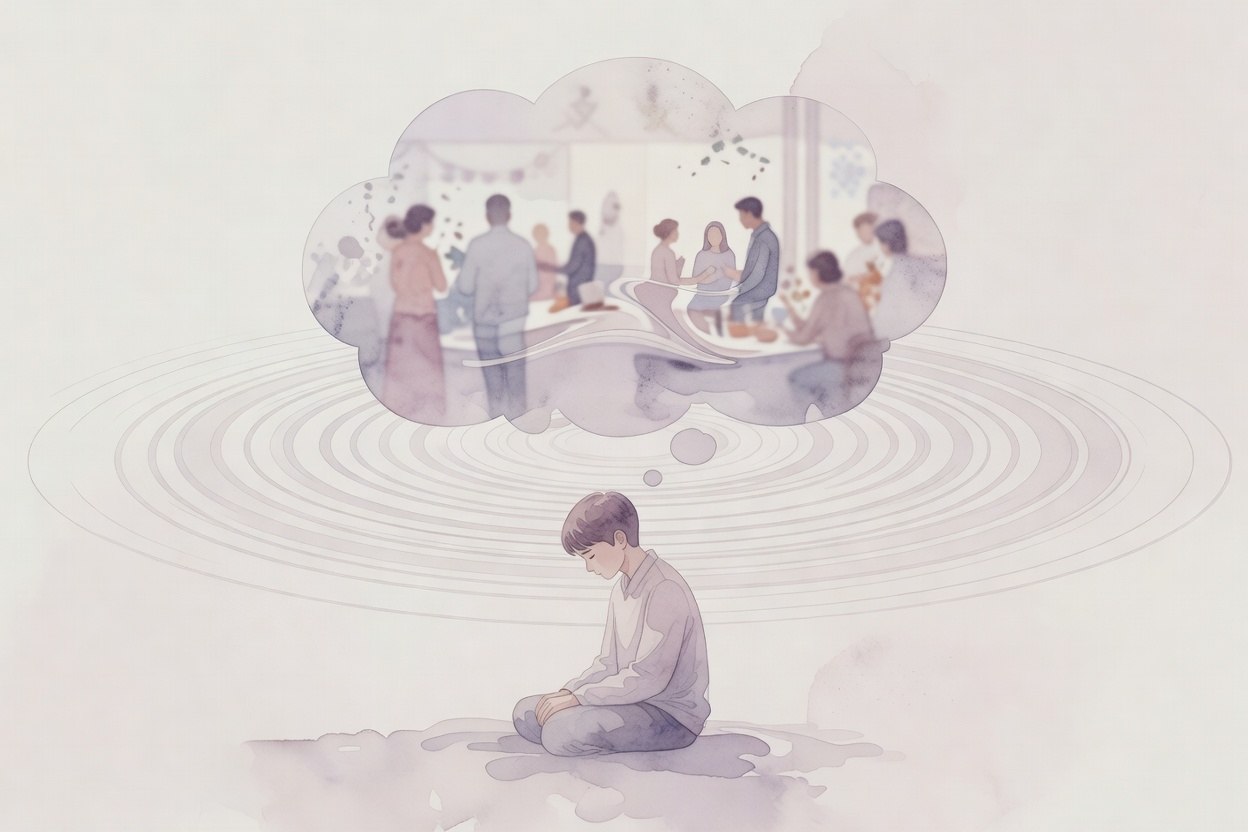
You get home after a meeting, a dinner, a presentation. Forty minutes later you’re still turning it over. Two hours later you’re still going. At night, when you want to sleep, your brain plays the recording again, but worse: a specific detail — “why did I say that?”, “my voice sounded weird”, “he laughed strangely when I mentioned…” — starts weighing more and more.
The next day, the interaction that initially left you neutral already feels like a failure. And by the third day, sometimes, it’s already a wound.
This has a technical name: post-event processing. It’s one of the three pillars of the Clark-Wells (1995) model of social anxiety. And it has specific interventions — because if you leave the replay unworked, each new social interaction enters the system with a prior wound.
What the replay actually does
During the day, your brain has lots of things competing for attention. At night, or in moments of low activity, the memory system “consolidates” — reorganizes what was lived, decides what to save, what to edit, what to prioritize.
In people without social anxiety, that process is relatively neutral. In people with social anxiety, the process becomes negatively biased: the brain re-examines the interaction looking for failures, not successes. Each awkward pause gets archived as “they noticed.” Each neutral external comment is remembered as judgment. Each silence of yours is coded as “I didn’t know what to say.”
Abbott and Rapee (2004) designed an elegant experiment to measure this. They recorded people with social anxiety giving a speech. Immediately after, they asked them to evaluate how it went — and also asked an external observer to evaluate the same. At 24 hours, they asked the person with social anxiety again how they remembered their performance.
The result:
- Right after: they already rated their performance worse than the external observer.
- At 24 hours: they rated it even worse. Memory had degraded in a negative direction.
In people without social anxiety, the evaluation stabilized or slightly improved over time. In people with social anxiety, it worsened. Social memory, in social anxiety, is a file that corrupts over time in an unfavorable direction.
Why this happens biologically
Three mechanisms together:
1. Self-referential memory
During the interaction, self-focused attention (another Clark-Wells pillar) made you process your own internal experience more intensely than external stimuli. You registered a lot: chest sensation, how your voice sounded, how you imagined you were being seen. Less you registered: what the other person said, their real expression, the full context.
When remembering, you have lots of internal material (discomfort sensations) and little external material (real feedback). The brain fills in the gaps — and fills them with more of the same bias that dominated during the event.
2. Emotion as memory bias
Research on emotional memory shows that emotional states at the time of remembering bias the memory itself. If you’re anxious while remembering, the brain selectively retrieves content consistent with anxiety. If you think about the dinner while feeling shame, your brain will bring you more details consistent with shame.
The replay is self-fueling: feel bad → remember worse → feel worse → remember much worse.
3. Memory consolidation during sleep
During REM sleep, the hippocampus reorganizes the day’s memories. If you slept ruminating, negative emotional content consolidates strongly. That’s why many people with social anxiety feel that “when I wake up, memory is worse” — it literally is. The brain finished archiving it with the tone of the rumination.
Why the replay doesn’t help
A frequent mistake is thinking replaying serves to “process” or “learn from the interaction.” It doesn’t work that way. Kashdan and Roberts (2007) research showed that more post-social rumination time:
- Doesn’t improve future interactions.
- Does worsen mood.
- Does increase social avoidance.
- Does predict secondary depression.
Replaying doesn’t prepare you better. It wears you out.
What does work: contrasting with facts
The intervention with most evidence for working the replay is what Clark-Wells call post-event reformulation with facts. It consists of shifting attention from your subjective internal experience to what objectively happened. Not “how I felt” but “what they said exactly” and “what happened after.”
The 4-question method (Clean Replay)
The Clean Replay on the landing is built with this method. It asks you, for a specific interaction:
- What actually happened? The facts. Not your interpretation — what the other person said, what you did, what happened after. As a camera would read it.
- What am I assuming without evidence? Identify assumptions you’re treating as facts (“he thought it was weird”, “they’ll talk about it later”). Mark them as hypotheses, not knowledge.
- What counter-evidence is there? Did the other person keep talking with you? Propose meeting again? Laugh at something you said? Those signals get archived less than negative ones — they must be actively retrieved.
- What would a friend who saw everything tell me? Simulate the external perspective. It’s usually radically different from the internal one.
Doing it in writing, the first time you start ruminating, cuts the negative consolidation loop. Not instantly — it takes practice. But in 4–6 weeks of regular use, most people report that spontaneous replay attenuates.
Other interventions that help
Don’t use the first 60 post-event minutes to ruminate
If right after the interaction you know you’re going to enter replay, fill those 60 minutes with something that requires external attention: cooking, walking, showering, calling someone you trust about another topic. Rumination needs “dead time” to start. If you remove it, you cut its fuel.
Single processing window
If you feel something really asks to be processed (not dismissible as “typical replay”), give yourself a 15–20 minute window, once, with paper and pen. Write down the 4 questions. Then close. If your head returns to the topic, remind yourself: “I already processed this.” You don’t process 15 times — once with method is more effective.
Label the replay as such
The simple phrase “I’m in replay mode” — said mentally when it starts — helps deactivate it. It’s called mindful labeling and has documented effect (Lieberman et al., 2007). By naming the state, identification with it drops.
Regulate the biology that feeds the replay
Broken sleep, alcohol, low physical activity: all increase rumination. Sleeping well, moving the body, and avoiding post-social alcohol lower replay intensity measurably.
When the replay indicates therapy is needed
Three signs:
- The replay lasts more than 24 hours regularly after normal interactions.
- It generates growing avoidance (you cancel things because you can’t handle the subsequent replay).
- There are already depressive symptoms — crying without reason, fatigue, disinterest, thoughts of not wanting to continue.
If you recognize this, the article when to get help for social anxiety gets into which professional and which therapy.
Closing
The replay isn’t “thinking too much.” It’s a specific, documented mechanism with neurobiological bases — and with interventions that work. It doesn’t take willpower to stop it; it takes method.
Next time you feel the “why did I say that?” loop starting, instead of following the thread, try cutting with the 4 questions. At first it’s hard. With practice, the replay stops having the power to colonize the night.