Why happiness does not last
The good things stop feeling good, the baseline settles back, and you wonder what is wrong with you. The hedonic treadmill, frequency, the pursuit paradox.
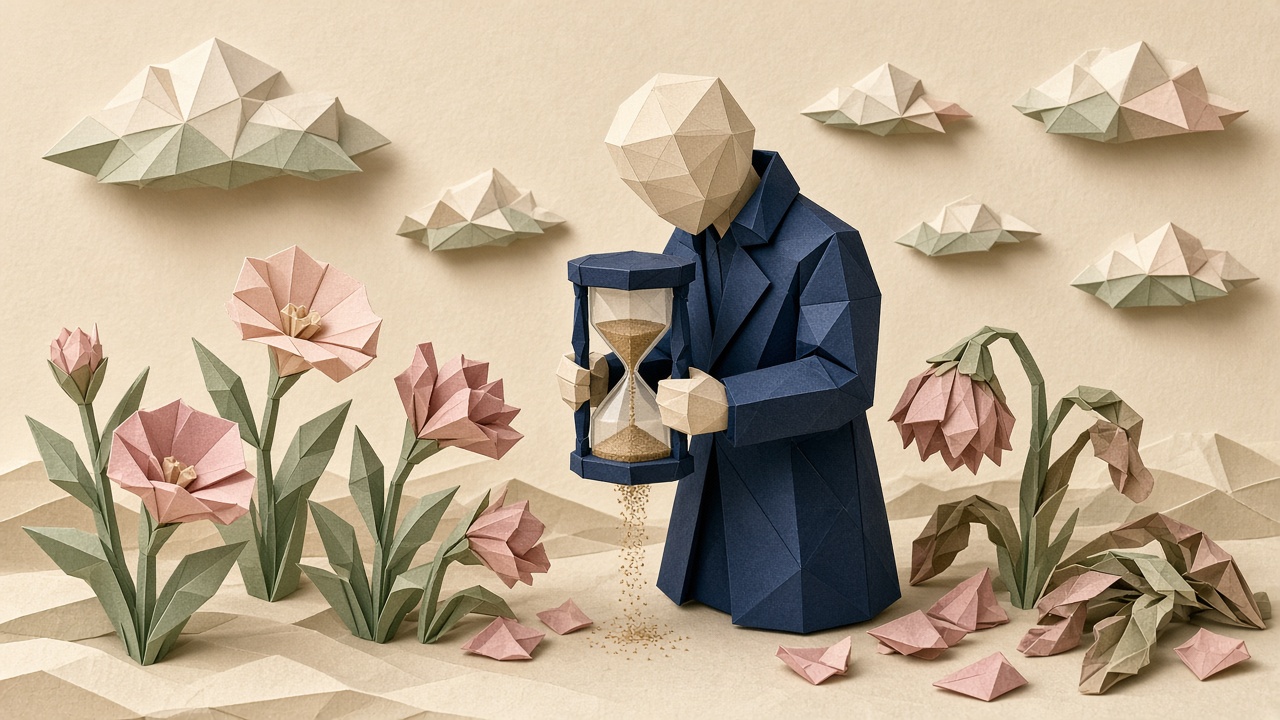
It is a Tuesday afternoon, late. You are sitting at the kitchen counter with a small bowl of figs and a wooden spoon, the light through the window almost-but-not-quite over. Three months ago you started a new thing — the job, the move, the relationship, the morning practice — and for a few weeks the days had a different weight. The coffee tasted like something. The walk home was something you looked forward to. You sent a friend a message saying, “I think this one is going to stick.” Today the figs are fine and the morning practice is something you do on the way to making coffee. The lift is gone.
This article is for the person at that counter. The one who has done the things they are supposed to do and assembled a life that looks fine on paper — and who is quietly wondering why fine does not feel like enough. The answer is not that you chose wrong. The answer is the hedonic treadmill.
The pages below are built around three ideas. The first is the treadmill itself — the pattern Lyubomirsky, King and Sheldon (2005) named and measured. The second is frequency over intensity — the case Fredrickson (2001) made for small positive moments as the route to lasting resources. The third is the paradox of pursuit — what happens to happiness when you make happiness the goal. The closing pages hold one small exercise.
1. The good news that felt good and then did not
The first part of the story is the most common. Something good arrives. A new relationship, a new city, a new job, a new routine. For a stretch of weeks the world has a different grain. You sleep better. You notice more. You describe the change to a friend as “finally landing.”
Then the lift fades — not because the new thing stopped being good, but because you stopped noticing it the way you did.
This is the hedonic treadmill, and it is the default for almost every pleasant change. Lyubomirsky, King and Sheldon (2005) reviewed the evidence and called it the hedonic adaptation mechanism: most of the boost from a positive change is temporary, and the subjective baseline settles back toward its set-point within months (DOI: 10.1037/0033-2909.131.6.803). The same pattern shows up across domains — income, marriage, health, even weather. The first weeks are warm. The weeks after are normal.
The mechanism is not a personal failing: it is how the nervous system calibrates. Adaptation is the cost of paying attention to anything.
The good news is that the set-point itself is not fixed. Lyubomirsky and colleagues estimated that about fifty percent of the variance in subjective wellbeing comes from a partly heritable set-point, about ten percent from life circumstances, and about forty percent from intentional activity — what you do, attend to, and practise. The forty percent is the working margin. It is not infinite, but it is the part you can actually work with.
2. The myth of the one big peak
The culture sells peak experiences. The promotion. The trip. The wedding. The book launch. The new apartment. The pattern is: spend, arrange, anticipate, arrive, post, return to baseline. The peak is real. The baseline returns.
Fredrickson (2001) made a careful case for why this pattern is the wrong target. Her broaden-and-build theory holds that the function of positive emotions is not to feel good in the moment — that is a side effect — but to broaden the momentary thought-action repertoire, which in turn builds durable physical, intellectual, and social resources (DOI: 10.1037/0003-066X.56.3.218). The peak gives you a story. The frequent, low-intensity positive moments — calm interest, gratitude, quiet joy — give you a wider lens, more options in attention, faster recovery from setbacks.
This is why the post-vacation return disorients: the trip was a peak, the workdays are the frequency, and the workdays build the resources that let you enjoy the next trip.
A useful distinction: intensity is a single reading on a meter. Frequency is a count across time. The research suggests that for sustainable wellbeing, frequency matters more. Not because peaks are bad — peaks are good — but because a peak is one reading, and a habit of small positive moments is hundreds.
| Source of wellbeing | Type | Duration | What it builds |
|---|---|---|---|
| Peak experience (trip, promotion) | High intensity, brief | Days to weeks | A memory; brief lift |
| Habit (morning walk, weekly call) | Low intensity, frequent | Years | Attention resources, social capital |
| Relationship, sustained | Mixed intensity, ongoing | Years | Trust, shared history, recovery support |
| Solitary practice (gratitude journal, music) | Low intensity, frequent | Years | Attentional habits, baseline shift |
| Novelty chase | High intensity, frequent | Months before fatigue | A series of peaks; set-point unchanged |
The table is not a ranking. It is a map of what each source does to the baseline. Peaks lift the reading. Frequency lifts the baseline itself.
3. The midweek test
A small test, useful in the moment. It is a Wednesday afternoon. Something happens that a few weeks ago would have produced a real lift — a friend sends a message, you finish a small task, the light in the kitchen is unusually good. Notice the lift. Notice how long it lasts. Notice what you do in the hour after.
If the lift is brief and you find yourself scrolling ten minutes later, you are watching the treadmill do its work. The good thing was good. The nervous system is recalibrating. Nothing is wrong with you. The system is doing what systems do.
If the lift lasts a little longer, and you find yourself noticing more — the next message, the next small thing — you are watching frequency do its work. The good thing was good. The system has more room to receive good things because the baseline has more room to hold them.
Both are real. The test is just a way to see which pattern you are in this week.
4. The myth that happiness is a destination
The destination myth says: keep working, keep saving, keep doing the work, and one day you will arrive at a place where the days feel good and stay feeling good. The myth is patient, and the myth is expensive.
The destination myth confuses the conditions for happiness with its structure. The conditions matter — sleep, money, relationships, health — but they are necessary, not sufficient. The structure is the practice running underneath them, and a practice does not arrive anywhere. It runs on the way.
Lyubomirsky, King and Sheldon (2005) put it carefully: the intentional-activity margin — about forty percent of the variance — is a set of small repeated acts: what you attend to, what you practise, what you do with your Tuesdays (DOI: 10.1037/0033-2909.131.6.803).
What this looks like, in a real week:
- One morning walk, twenty minutes, no phone.
- One conversation with a friend that is not about logistics.
- One evening meal eaten with attention.
- One act of small help, given without tracking the return.
- One moment of noticing what is good, registered briefly.
None of these is a peak. All of them are frequency. The week they add up to is not a destination. It is a practice.
5. The set-point, in three lines
A short framework, useful to hold onto.
The set-point is the level your subjective wellbeing returns to after most changes. It is partly heritable, partly circumstantial, partly intentional. The intentional part — what you practise, attend to, and repeat — is the working margin. That margin is not a guarantee. It is what the practice builds over months.
The set-point is movable. Not by much, not by force, but by sustained, intentional practice over months. The Lyubomirsky et al. estimate is that intentional activity accounts for about forty percent of the variance. The set-point moves slowly because the nervous system is conservative. The practice that gains ground is the practice that does not stop when the lift stops.
| Lever | Estimate of impact | What the lever does |
|---|---|---|
| Genetic set-point | ~50% of variance | Anchors the level |
| Life circumstances | ~10% of variance | Moves the floor |
| Intentional activity | ~40% of variance | Moves the working level |
The numbers are rough. The point is that the levers are different, and that two of them — circumstances and intentional activity — are at least partly available to you.
6. What frequency actually looks like
Frequency is a vague word. Here is what it looks like in practice, drawn from the Fredrickson (2001) review and the broaden-and-build theory.
Frequency is three or four small positive moments across a day — not one big peak. A coffee you actually taste. A walk where you notice the sky. A conversation where you listen for what was meant.
Frequency is the opposite of the scan: scanning looks for the next thing to lift you; noticing lets it arrive. The scan is high-effort and exhausting. Noticing is what the nervous system was built to do.
The morning-routine myth is partly right and mostly wrong: the routine is right, the elaborateness is wrong. A two-minute walk attended to beats a forty-minute routine on autopilot — the point is attention, not duration.
7. The week as a unit
Treat the week as the unit. Not the day. Not the month. The week.
Most research on gratitude, on positive emotion, on intentional activity, uses the week as the unit of practice. Emmons and McCullough (2003) had participants write down three good things once a week. The effects on wellbeing showed up at ten weeks, not at ten days. The week is small enough to feel doable and large enough to register change.
A practical week, drawn from the literature:
- Monday. Write down three good things from the weekend, with one sentence on why each happened. The why sentence is the part that does the work.
- Wednesday. Twenty-minute walk, no phone. Notice three things you would not have noticed with the phone.
- Friday. One conversation with a friend that is not about logistics. Listen for what they actually meant.
- Sunday. One small act of help, given without tracking the return. Notice how it felt.
None of these is large. All of them are frequency. The week they add up to is what the research has measured.
8. The case against the goal of happiness
The goal of happiness is one of the most common goals in the culture, and one of the most expensive.
Lyubomirsky, King and Sheldon (2005) reviewed the evidence on whether pursuing happiness as a goal produces happiness. The short answer is that it does, sometimes, but not always — and the failure mode is specific. When people pursue happiness and monitor their progress toward it moment by moment, they tend to feel less happy, not more (DOI: 10.1037/0033-2909.131.6.803). The monitoring turns the practice into a measurement, and the measurement turns the moment into an evaluation.
This is the paradox of pursuit. Happiness pursued as a direct goal becomes an object, and the object can be failed at. The failure is not the moment itself. The failure is the gap between the moment and the goal.
What this looks like in real life: you start the gratitude journal, and within a week you are scoring it. Three good things, but were they good enough? The scoring is the failure mode. The journal was the practice. The scoring converted the practice into a performance.
The fix is not to abandon the goal. The fix is to redirect the goal. The practice is the goal. The lift is a side effect. The base is what the practice builds over months.
9. The paradox of measurement
Measuring happiness is a useful research tool and a hazardous personal practice. The research depends on measurement. Personal life is disrupted by it. The reason is the same reason the paradox of pursuit works: measurement turns attention into evaluation, and evaluation changes what attention does.
A useful discipline: measure your happiness at the level of weeks, not hours. The day-to-day lift is volatile and not informative. The week-to-week trend is what the practice moves. The daily mood is the noise around the signal.
This is also why mood-tracking apps have mixed effects in the research. They make the noise visible. They do not, on their own, move the signal. Moving the signal requires practice, not measurement.
10. What actually moves the set-point
The set-point moves through intentional activity. Not any activity. Activity that is repeated, attended to, and connected to meaning or connection or growth. The list below is what the research has consistently measured.
| Practice | What it does | Where the evidence is |
|---|---|---|
| Three good things a week | Shifts attention toward what sustains wellbeing | Emmons and McCullough (2003) |
| Counting blessings | Reduces the hedonic impact of small negatives | Emmons and McCullough (2003) |
| Acts of kindness | Builds social connection and meaning | Lyubomirsky and colleagues (2005) |
| Using your strengths | Aligns activity with what you actually enjoy | Seligman and colleagues, positive psychology |
| Meaningful conversation | Builds relational resources | Reis and colleagues, intimacy research |
| Movement, outdoors | Lifts mood through body and light | Consistent across cohorts |
The list is not exhaustive. The pattern is. Every item on it is repeated. Every item on it is connected to something other than the self in the moment. Every item on it builds a resource that outlasts the moment.
The set-point moves when these practices are sustained across months. The set-point does not move when the practices are performed on autopilot. The attending-to is what makes the practice work.
11. The exercise: one frequency, one week
This is not a quiz. It is a one-week experiment. Pick one practice from the list above. Commit to it for seven days. Notice what shifts.
Step 1. Pick one practice that fits a real gap in your week. If sleep is shaky, start with the morning walk. If relationships are thin, start with the conversation.
Step 2. Anchor the practice to an existing anchor. The walk goes after the morning coffee. The journal goes before bed. The conversation goes on the Sunday call. The anchor reduces the cognitive load of doing the thing.
Step 3. For seven days, do the practice. Do not score it. Do not measure whether it is working. The measuring is the failure mode. The doing is the practice.
Step 4. At the end of seven days, notice the week as a unit. Did the week have a different grain? Did small positive moments arrive more often? You are looking for frequency, not intensity. A week that has slightly more small moments is a week that moved.
Step 5. If the week moved, repeat it. The repetition is what builds the resource. The first week is the experiment. The weeks after are the practice.
The exercise is small. The exercise is the part of the forty percent you can use.
12. Caja de crisis
Low happiness crosses into something to ask for help about when any of the following has been true for more than two weeks:
- Low mood has been steady, and the things that used to lift you up do not lift you up.
- Sleep has shifted (too little or too much) without a medical reason.
- Appetite has shifted without a medical reason.
- You have withdrawn from people you care about.
- You have started using alcohol, food, or substances to lift your mood, and the dose is creeping up.
- You have had thoughts that you would rather not be here, even briefly.
- You have noticed a flatness that looks like depression, not just unhappiness.
If any of these is present, the next step is a conversation with someone trained — a primary care provider, a therapist, or one of the lines below. The frequency work above is one route to wellbeing. It is not a substitute for care.
If you are in the United States
- 988 — Suicide and Crisis Lifeline, free, 24/7.
- Crisis Text Line — text HOME to 741741 from anywhere in the US.
- SAMHSA National Helpline — 1-800-662-4357, free, confidential, 24/7, English and Spanish.
If you are in the United Kingdom
- Samaritans — 116 123, free, 24/7.
- NHS 111 — for non-emergency mental health support, available 24/7.
If you are in Colombia, México, España, Argentina, or elsewhere in Latin America
- Colombia — Línea 123 for emergencies, Línea 106 for psychosocial support, both free and 24/7.
- México — SAPTEL 55 5259-8121, 24/7.
- España — 024, suicide prevention line, free and 24/7.
- Argentina — Centro de Asistencia al Suicida, 135.
- Global directory — findahelpline.com lists free lines in over 130 countries.
The hedonic treadmill is real, and the practices that move the set-point are real, and the gap between the two is what the next few weeks are for. If the gap is large, talking to a professional is not a last resort. It is the next step.
13. The thing under the thing
So: which one of these is sitting under your low mood right now?
Not the surface story. The thing under the thing. The pattern that runs underneath the surface story.
For most people, the thing under the thing is one of three patterns. The first is the hedonic treadmill — the lift has faded, and the baseline has returned, and the next peak has not arrived. The second is the scan — the constant looking for the next thing to lift you, which exhausts the system that would have noticed the small positive moments. The third is the paradox of pursuit — the measuring of happiness has turned the practice into a performance, and the performance has stalled.
Pick one. Notice where it sits. Notice what it costs you to keep it there. Notice what it would feel like to set it down — not forever, but for a week. Set the measuring down. Set the scan down. Set the chase down.
Then notice what is left. What is left, in most weeks, is the practice. The walk. The conversation. The journal. The week. The frequency. The set-point, slowly, over months.
You do not have to set down all three today. The setting-down is the practice. The next week is the practice. The small positive moment, attended to, is the practice.
14. Where to go next
Two tools that work well when the goal of happiness has become the obstacle:
- Three-good-things journal — Emmons and McCullough (2003). Two minutes a week. Saved on this device.
- Pleasure-vs-purpose thermometer — Lyubomirsky and colleagues (2005). Pick one act a day. Score both.
Both are in the happiness tools page.
If the lift has been gone for weeks, or if the small positive moments have stopped arriving, the next step is a conversation with someone trained. You can start through rdkterapia.com — specialists in low mood, anhedonia, and chronic dissatisfaction.
You are not behind. The treadmill is the default. The practice moves the base. The first week is the one you actually start.
FAQ — Why Happiness Does Not Last
Why does happiness not last? The boost from any new positive change fades — the hedonic treadmill. Lyubomirsky, King and Sheldon (2005) reviewed the evidence: wellbeing is anchored by a partly genetic set-point, and most new sources of pleasure settle back toward it. The fix is changing what the set-point rests on. DOI: 10.1037/0033-2909.131.6.803
Is it normal to feel less happy over time even when nothing has gone wrong? Yes. Fredrickson (2001) argued that frequent, low-intensity positive emotions, not one big peak, are what broaden attention and build durable resources. The work is in the frequency, not the peak. DOI: 10.1037/0003-066X.56.3.218
What is the hedonic treadmill in plain language? The boost from any new positive change fades and wellbeing returns to its baseline. The set-point can move — through meaningful engagement, connection, and intentional activity — but it moves slowly and only with practice.
Can you raise your happiness baseline? Yes — about forty percent of the variance is intentional activity, the part you can actually work with. The other fifty percent is genetic, about ten percent is circumstances. The forty percent is real.
When is low happiness something to ask for help with? When low mood has been steady for more than two weeks, when sleep or appetite has shifted without a medical reason, or when there have been thoughts of not wanting to keep going. If any of these fits, the next step is a conversation with someone trained.