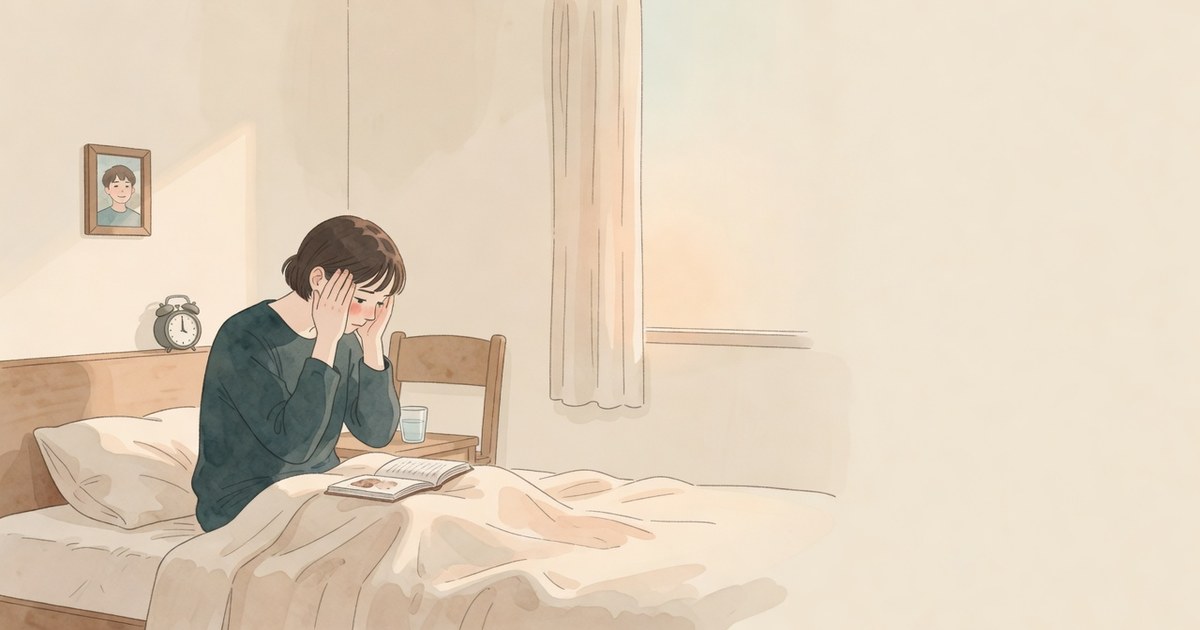
If you talk to yourself as you would talk to no one, that is not character.
There is an inner dialogue many people know by heart: the voice that appears after the mistake and does not leave, the one that replays what you said three hours ago, the one that compares you and always finds you lacking. The one that punishes you for resting, for being wrong, for not being enough. If that voice is yours, you are not “too demanding”. It is a pattern — self-criticism — that Blatt and colleagues (1982) described as a stable dimension of how you treat yourself inside, distinct from adaptive high standards. This space is to recognise it, not to turn it into an identity. Self-criticism is not who you are. It is something you learned, and it can be relearned.
You are not “too hard on yourself”. The voice after the error is the pattern.
Self-criticism does not appear by itself when you grow up. It is learned in childhood, in families where affection was tied to performance, in schools where a mistake felt like a character failure, in rooms where “being hard on yourself” was confused with discipline. Blatt and colleagues (1982) described a stable inner treatment — excessive concern with your own failures, inferiority, harsh self-evaluation — distinct from adaptive perfectionism. If you treat yourself badly when you are wrong, that is not strength. It is a pattern you work on, the way you work on a chronic knot.
- It is ordinary to replay the mistake three hours later and still find yourself at fault
- It is ordinary to feel you “do nothing right” even when the evidence says otherwise
- It is ordinary to fear rest because you “have not earned it”
- It is ordinary to compare yourself with whoever is in front of you and feel they are “more”
Where does your self-criticism operate most: body, mistakes, comparison, or rest?
Six questions about the last two weeks. It does not diagnose — it shows where to soften the inner dialogue first.
Why self-criticism is not “having high standards”: it is a treatable risk factor
- Blatt, Quinlan, Chevron, McDonald and Zuroff (1982) split two dimensions of depressive experience: dependency (interpersonal) and self-criticism (intrapersonal). Self-criticism — excessive concern with your own failures, inferiority, harsh self-evaluation — tracked with more severe depression, poorer treatment response, and higher relapse. DOI: 10.1037//0022-006x.50.1.113
- Dunkley and Zuroff (2006) pulled pathological self-criticism apart from perfectionism components (personal standards, concern over mistakes, doubts about actions). Self-criticism predicted distress above those dimensions. High self-critics were the ones who responded worst to “adaptive” perfectionism. DOI: 10.1016/j.paid.2005.08.008
- Self-criticism is not “being demanding” and not “having high standards”. It is a stable way of treating yourself — an inner dialogue you learned and can relearn. If you talk to yourself as you would not talk to someone you care about, that is not character. It is a pattern, like a chronic knot in a muscle.
One thing today
Self-criticism does not come apart with positive slogans or “more self-esteem”. It comes apart when you notice the voice, tell when it is information and when it is punishment, and answer yourself another way. Blatt et al. (1982) treated self-criticism as a dimension you can work — not a character trait. DOI: 10.1037//0022-006x.50.1.113
- Pick a recent moment (not the worst: a medium one) when you spoke badly to yourself.
- Write what you said, in second person, exactly as you said it — do not soften it.
- Write what you would say to a friend who told you the same story. The gap between the two versions is information.
- Do not judge yourself for the first version. The second one is trained, not born.
Read something that understands the inner dialogue
Not sermons. Three short texts about a pattern many people live in silence.