Chronic insomnia: why it is not just 'bad habits' and what the current clinical evidence says
If you have been sleeping poorly for weeks or months, it is not just tiredness. Chronic insomnia is a treatable disorder, and the first line is no longer pills. Here is the current clinical evidence.
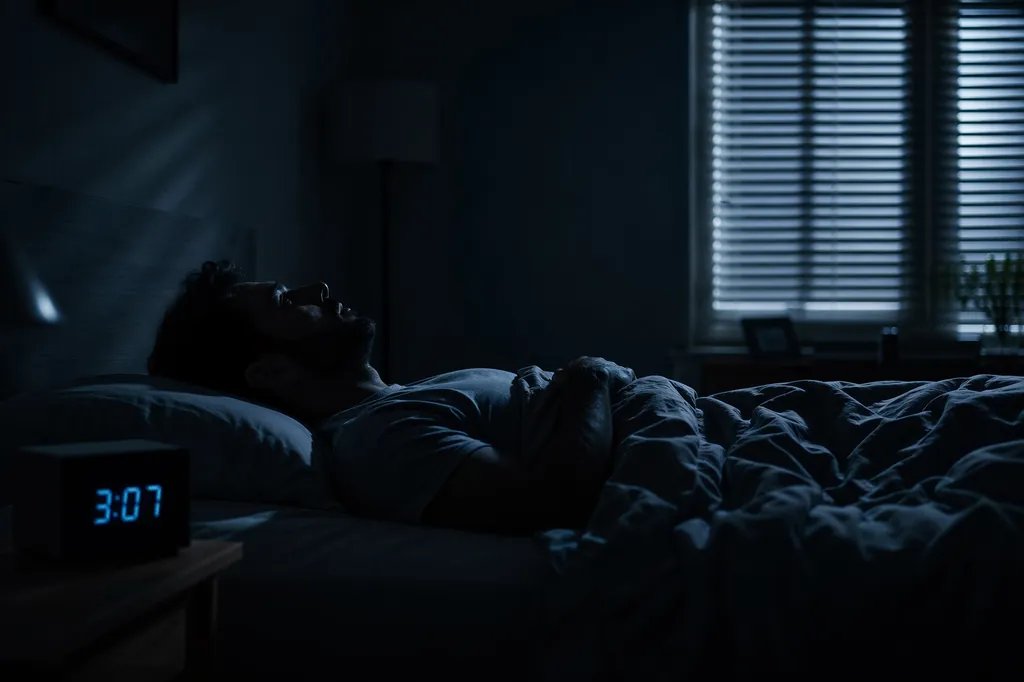
If you have been sleeping poorly for more than a month, if you go to bed tired and wake up the same, if you have already tried herbal teas, putting the phone away, counting sheep, and nothing works, this article is for you. I am not going to tell you that it is “stress” or that you should “sleep 8 hours.” I am going to show you what the clinical guidelines of the AASM, the ESRS, and the AACP say. And the short conclusion: the first line of treatment for chronic insomnia is no longer pills. It is a psychological therapy that has been around since the 1980s, with recent updates (Edinger 2021), called CBT-I.
This article is intentionally long. If you prefer to jump to a specific term (sleep onset, maintenance, sleep hygiene, CBT-I, apnea, melatonin), the insomnia glossary with 11 defined terms is available. And if you already know that your problem is anxiety + insomnia, see waking up at 3am with anxiety: 4 express techniques, which shares the CBT-I logic applied to the moment of crisis.
What the DSM-5-TR calls chronic insomnia (real criteria)
Insomnia is not “sleeping little.” It is a disorder defined with clinical criteria. The DSM-5-TR (the latest edition of the mental health diagnostic manual) says that to diagnose chronic insomnia, all of the following conditions must be met:
- Difficulty falling asleep, staying asleep, or early morning awakening, almost every night.
- Frequency: at least 3 nights per week.
- Duration: for at least 3 months.
- Daytime impact: fatigue, irritability, concentration problems, non-restorative sleep, etc.
- Not better explained by another sleep disorder (such as apnea) or by use.
If you recognize yourself, you have a clinical picture with a name and a treatment. It is not “I am a light sleeper.” It is chronic insomnia. And it has a solution.
Worldwide prevalence is around 10-15% of the adult population, according to recent epidemiological studies. It is one of the most common health disorders, and paradoxically one of the least treated with the right tool.
Why sleeping pills are NOT the first line (clinical evidence)
Here is the part that many doctors have not yet told you. The AACP (Qaseem et al., 2016) clinical practice guideline explicitly recommends that the first line of treatment for chronic insomnia in adults be CBT-I (cognitive-behavioral therapy for insomnia), not drugs.
And the medications? Benzodiazepines (such as lorazepam) and Z-drugs (zolpidem, zopiclone) have three serious problems:
- Rapid tolerance: after a few weeks you need more dose for the same effect.
- Dependence: stopping them produces rebound insomnia (worse than before).
- Adverse effects: falls, morning confusion, cognitive decline in older adults.
The AASM (Edinger et al., 2021) updated its clinical practice guideline with the same conclusion: CBT-I is the first-line intervention for chronic insomnia, with the strongest recommendation (“strong recommendation”). Hypnotics are reserved for specific cases or short-term supervised use.
The ESRS (Riemann et al., 2017), the European guideline, agrees: the first option is psychological therapy. Medication can help punctually, but it does not address the cause.
If you have been taking something to sleep for years and have not tried the psychological alternative, there is a pending conversation with your doctor.
What CBT-I is and why it is first line
CBT-I stands for Cognitive Behavioral Therapy for Insomnia. It is not “talking about your childhood.” It is a structured protocol, 6 to 8 sessions, with homework to do at home. It has over 40 years of scientific evidence and meta-analyses show that:
- 7 out of 10 people who do it improve significantly.
- Effects are maintained long term (12-24 months), which pills do not achieve.
- It works without medications, without adverse effects, without dependence.
CBT-I addresses three concrete things:
- Sleep habits: restructures the bed-sleep association (the bed only for sleeping, fixed schedule, wake at the same time).
- Thoughts about sleep: combats nighttime rumination and anticipatory anxiety (“tonight I will not sleep”).
- Nervous system regulation: relaxation techniques, stimulus control, bed-time restriction.
It is not magic. It is a protocol. And studies show it is the most cost-effective intervention for chronic insomnia, according to the NSF (National Sleep Foundation).
The 5 CBT-I techniques explained in plain English
1. Stimulus control
The idea is simple: your brain needs to relearn that bed = sleep, not reading, not eating, not staring at the ceiling with anxiety.
Step by step: if you have been awake in bed for more than 20 minutes, get up, go to another room, do something boring with dim light, and come back to bed only when you feel real sleepiness. Repeat as many times as necessary.
2. Sleep restriction
It sounds counterintuitive, but it is one of the most powerful techniques. If you spend 9 hours in bed but only sleep 5, the protocol asks you to limit bed time to 5.5 hours (your real average + 30 min). Sleep concentrates. And little by little it expands.
Important: the first nights are hard. But it works.
3. Sleep hygiene (what DOES work)
You have heard this a thousand times, but the typical list is poorly told. What the evidence says:
- YES: wake up at the same time every day, including weekends.
- YES: natural light exposure in the morning (15-30 min).
- YES: cool bedroom (18-20°C), dark and quiet.
- YES: light dinner at least 2-3 hours before bed.
- NO: the “8 mandatory hours” idea. Each person needs a different range. Some sleep 6 and are fine.
The cliched list of “no coffee after 3pm” is overrated. What impacts most is schedule regularity, not isolated rules.
4. Cognitive restructuring
Chronic insomnia generates automatic thoughts: “I will not sleep”, “tomorrow I will be destroyed”, “this is killing me.” Those thoughts feed anticipatory anxiety and the vicious cycle.
CBT-I teaches you to question those thoughts: is it true that “I will not sleep”? What would happen if I slept 5 hours? Does it really “kill me” or just leave me tired? It is not empty positive thinking. It is realistic substitution.
5. Relaxation and breathing
Relaxation techniques (4-7-8 breathing, body scan, progressive muscle relaxation). They work better as tools to “lower activation” than as “tricks to fall asleep.” If you expect them to put you to sleep, they do not work. If you use them to stop the body from fighting, yes.
The 4-7-8 technique (inhale 4 sec, hold 7, exhale 8) is popular, but the evidence shows it works mainly because it displaces attention from rumination, not because of a special physiological mechanism.
When to seek professional help
CBT-I works, but you cannot apply it alone without guidance. The signs that you need professional help are:
- Insomnia more than 3 nights per week, for more than 3 months (DSM-5-TR criteria).
- Clear daytime impact: fatigue, irritability, work errors, non-restorative sleep.
- Symptoms that accumulate: anxiety, sadness, alcohol or sleeping pill use.
- Suspected other disorder: sleep apnea (snoring, breathing pauses), restless legs, depression.
Important: if you are having thoughts of harming yourself or that life is not worth it, seek immediate help. Chronic insomnia is a risk factor for depression and suicidality. You are not alone.
CBT-I can be done with a specialized psychologist, and more and more digital options are available (validated apps like Sleepio, CBT-i Coach from the VA) if in-person access is difficult. The first session with a professional is an evaluation at your pace, not a treatment commitment.
Closing: chronic insomnia is treated, not endured
If you have read this far, you have probably been carrying this for a while. The good news is that chronic insomnia has treatment with robust evidence, and that treatment is not a pill. It is CBT-I, a structured therapy you can start this week with a professional.
Next time someone tells you “sleep 8 hours and put the phone away,” you now know that is not the complete answer. The answer is deeper, more treatable, and within reach.
If you want to start, the first session with Ricardo is a full evaluation of your case. No commitment, at your pace. Book → rdkterapia.com/therapy/
If you are in crisis or having thoughts of harming yourself, seek immediate help:
- 988 (United States): Suicide & Crisis Lifeline.
- Samaritans (UK): 116 123.
- Línea 106 (Colombia): 24/7, free.
- Línea de la Vida (Mexico): 800 911 2000.
This article does not replace professional medical attention. If you suspect sleep apnea or another disorder, consult a specialist.
Sources (YMYL strict, DOIs verified):
- Qaseem A, et al. (2016). Management of Chronic Insomnia Disorder in Adults: A Clinical Practice Guideline From the American College of Physicians. Annals of Internal Medicine. https://doi.org/10.7326/M15-2175
- Edinger JD, et al. (2021). Behavioral and psychological treatments for chronic insomnia disorder in adults: an American Academy of Sleep Medicine clinical practice guideline. Journal of Clinical Sleep Medicine. https://doi.org/10.5664/jcsm.8986
- Riemann D, et al. (2017). European guideline for the diagnosis and treatment of insomnia. Journal of Sleep Research. https://doi.org/10.1111/jsr.12594
- National Sleep Foundation. Sleep Duration Recommendations. https://www.sleepfoundation.org/sleep-duration-recommendations
- American Psychiatric Association. (2022). Diagnostic and Statistical Manual of Mental Disorders, Fifth Edition, Text Revision (DSM-5-TR). American Psychiatric Association Publishing. ISBN 978-0-89042-575-6.
Disclaimer: this article is informational and does not substitute diagnosis or professional medical treatment. If your insomnia is chronic, seek a mental health professional with CBT-I training.
Professional support
What if this calls for more than an article?
Reading helps you understand; talking with a trained professional helps you change. Ricardo De Castro King — licensed psychologist — offers online therapy in Spanish. The first session is a no-commitment consultation to understand your situation.