Can't sleep?
Your mind won't stop. Your body is exhausted but wired. You're not broken — this is fixable.
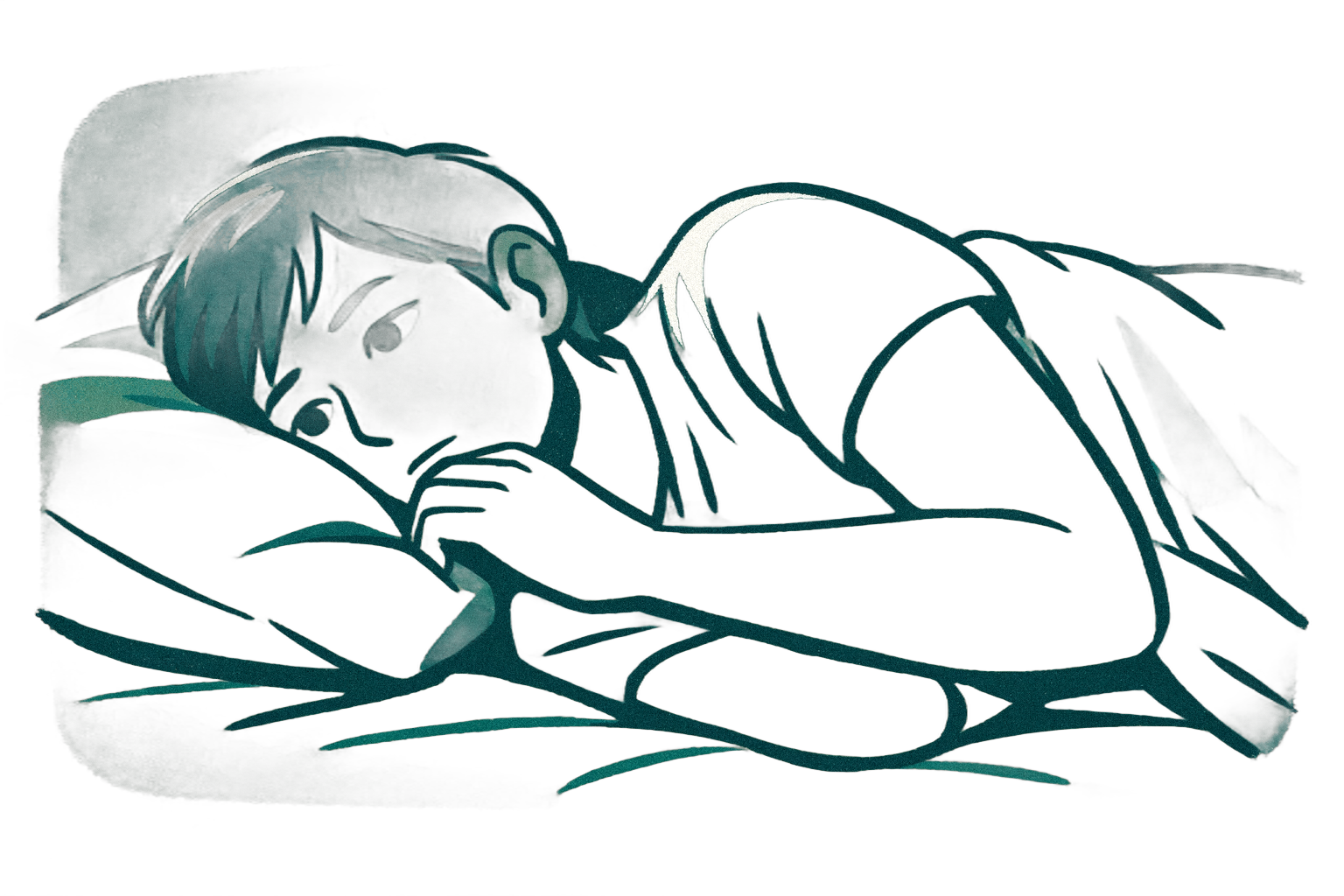
You're not just 'bad at sleeping'
Insomnia isn't a character flaw — it's usually your nervous system stuck in overdrive. Stress, anxiety, grief, screens, and life changes all rewire your brain's relationship with sleep. The good news: it can be rewired back.
- It's normal to dread bedtime
- It's normal to feel exhausted but unable to sleep
- It's normal for your mind to race the moment your head hits the pillow
- It's normal to feel like you've tried everything

Try something right now
These exercises are used in clinical therapy. They're free and you can do them right here.
Your Sleep Efficiency Audit
Three questions about your typical week. The app calculates your sleep efficiency and gives you a concrete first step based on CBT-I — the evidence-based treatment for insomnia.
Based on CBT-I Bedtime Restriction (Spielman et al., 1987; Riemann et al., 2017). Educational only — not a diagnosis. If you have had severe insomnia for over a month or significant daytime symptoms, please consult a professional.
Your sleep pattern
New bedtime → fixed wake time. When efficiency ≥ 85% for 5 of 7 nights, add 15 min.
An efficiency this low over time deserves professional attention. This tool can orient you, but it does not replace a clinical evaluation.
Saved on this device.
Why sleep doesn't come through willpower
- Sleep isn't a decision — it's a letting go. Spielman et al. (1987) documented that compressing the sleep window to match real sleep — not desired time — improves sleep efficiency from 59% to 86% in eight weeks. The body learns to consolidate when given the opportunity.
- CBT-I (Cognitive Behavioral Therapy for Insomnia) is the intervention with the strongest evidence for chronic insomnia. Riemann et al. (2017) place it as first-line in the European sleep guidelines, ahead of pharmacotherapy, because the effects persist after treatment ends.
- What consolidates sleep is the consistency of wake time, not when you go to bed. Harvey (2002) integrated this into his cognitive model of insomnia: the circadian pacemaker responds to a fixed wake time more than to any other habit.
- Morin et al. (2006) reviewed CBT-I evidence from 1998–2004 and confirmed that the behavioral component — not medication — is what produces lasting change. Slow breathing below is the body's entry point: sleep shows up when the body stops defending itself.
Body Scan
Mindfulness technique (MBSR, Jon Kabat-Zinn). 12 zones, about 4 minutes. Not about relaxing — about inhabiting your body.
If you have body trauma, the scan can activate strong sensations. You can stop anytime. If something overwhelms you, open your eyes and return to the room.
Breathe
You've returned to your body
It doesn't matter how many times you got distracted. Coming back is the practice.
What's keeping you up at night?
A few questions to understand your sleep pattern and find what might actually help.
Read something that gets it
Not advice from someone who's never been there. Real writing about real pain.
If you want to explore additional resources that we've researched and recommend, they're here: