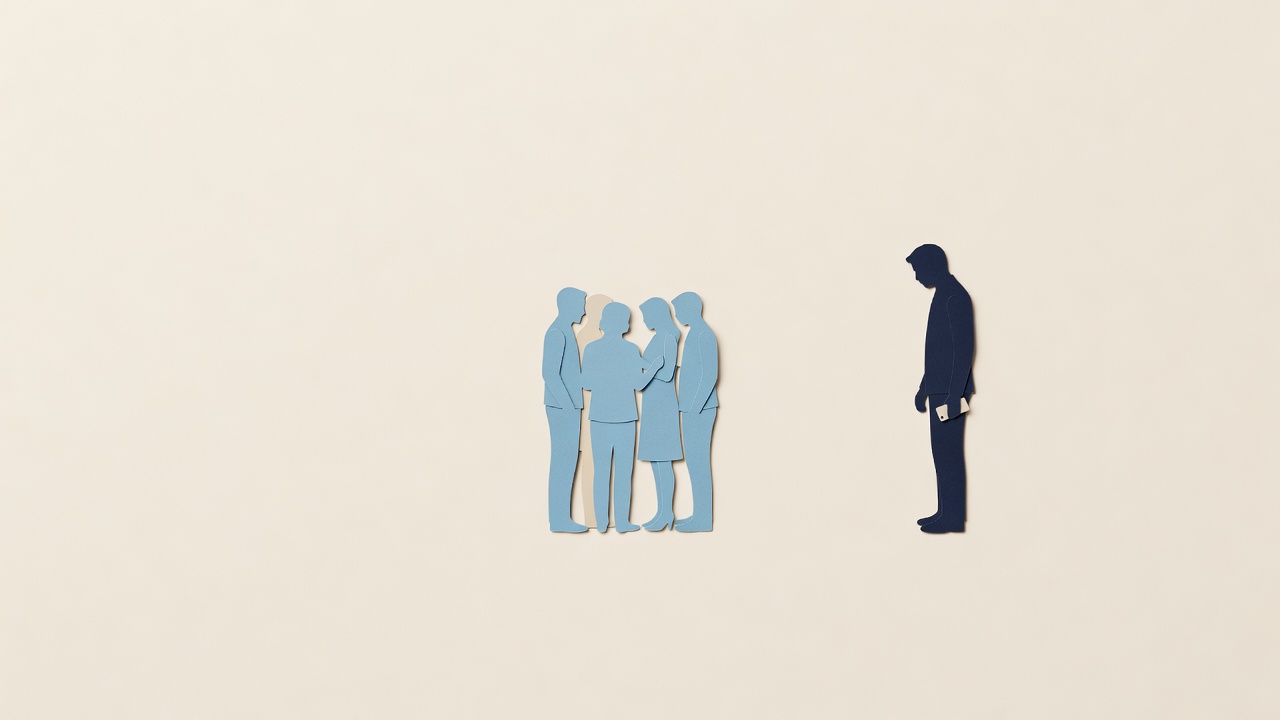
When the fear of being left decides for you
You want to be close. And yet, before you write, before you suggest something, before you walk over to that table, something does the math. You reread the message you sent. You read a no on a neutral face that nobody said. You step back right before exposure and call it tiredness. This is not shyness or weak character: it is a radar you learned to switch on, and it is still on when it no longer needs to be. This space names it without scolding you, shows you which of its shapes weighs most in you, and opens one concrete first door — no self-help slogans for people who have heard too many.
It is not that you are weak. Being left out really does hurt.
Before any advice, one finding that changes the tone of everything. Eisenberger, Lieberman and Williams (2003) put people in a scanner and left them out of a game with no explanation. Once excluded, regions of their brains tied to physical pain came online. This is not a metaphor: rejection hurts in a fairly literal sense. If it hurts like that, it makes sense that your system learned to prevent it — to read faces, weigh tones, step back before exposure. That radar has a function and once had a logic. The problem is that at some point it stopped telling real danger from imagined danger, and now it decides things that are not its to decide. Leary, Tambor and Terdal (1995) added the other half: self-esteem appears to work as an inclusion gauge, which is why when the radar fires, more than comfort moves — the worth you assign yourself moves. In the map below we split that radar into four shapes so you can see which one weighs most in you.
- The fear shows up with the people who matter most. With a stranger there is nothing to lose; with a friend of years, there is everything. That is the tell.
- The radar needs no real rejection to fire. Williams and colleagues (2000) showed it with a simple ball that stopped being passed: that alone was enough for belonging and self-esteem to drop.
Which of the four shapes of the radar rings loudest in you?
Eight observations about your last few weeks. It does not diagnose — it shows which shape of fear of rejection weighs most and where to start easing it.
The four shapes of the radar
Eight questions about your last two weeks. Each shape asks for a different intervention: lowering vigilance is not the same as holding your self-worth, and neither is the same as dropping the people-pleasing.
This is not a validated clinical scale. If several answers describe what you live and it has been that way for more than two weeks — above all if the fear is blocking relationships, work or decisions — talking to a professional is a reasonable next step. The crisis line is at the end of this page.
How often has it been like this in the last two weeks?
Stored locally on this device (nowhere else). Nothing is sent anywhere.
Fear of rejection: not shyness, not a weak character — a radar you learned to switch on before the no arrives
- Downey and Feldman (1996) described rejection sensitivity and how it works: the person anticipates rejection with anxiety, spots it fast even when the signal is ambiguous, and reacts before anything has happened. The radar does not wait for the no to arrive: it deduces it early. DOI: 10.1037/0022-3514.70.6.1327
- Eisenberger, Lieberman and Williams (2003) saw it on an fMRI scanner: being excluded brings online brain regions tied to physical pain. You are not exaggerating when you say a rejection hurts. It hurts because, to the brain, belonging is not a luxury. DOI: 10.1126/science.1089134
- Leary, Tambor and Terdal (1995) proposed that self-esteem works like an inclusion gauge: when it drops, it is a signal that your place in the group is at risk. That is why rejection does not just bother you — it touches the worth you assign yourself. DOI: 10.1037/0022-3514.68.3.518
One thing today: a trivial question to a stranger
The radar runs on predictions that never get checked. The only way to check them is to expose yourself, and you start with the smallest thing there is: an exchange with no consequences, with someone you will never see again. Today is not about beating the fear, but about collecting a piece of data the radar did not have.
- Think of a trivial question you can ask today to someone you do not know: the time, how to get somewhere, whether that is the right queue. Pick the one that costs you least.
- Ask it without preparing, without over-smiling and without apologising for asking. Just the question.
- Notice what happens in your body as you say it. Name the sensation in one word: tension, heat, hurry.
- Listen to the whole answer before you leave. Most people answer fine, and that is the information you are after.
- At the end of the day, write one line: what you asked, what happened and how you came out. Not what you feared and not what you wanted: what happened. Repeated over a week, that datum starts to compete with the prediction.
This is not therapy. It is what exposure protocols do: start at the lowest rung and let experience do the work willpower cannot.
Read something that gets what you are going through
No sermons. Three texts on the fear of being left: what it is and how it takes hold, how it shows up in daily life, and why confusing it with introversion leaves you stuck.
If you want to explore additional resources we have researched and recommend, they are here:
By rdkterapia · No spam · Unsubscribe any time