Introvert vs extrovert: what actually changes
Introvert and extrovert are not opposites: they are extremes of the same continuum with a midpoint where most people live.
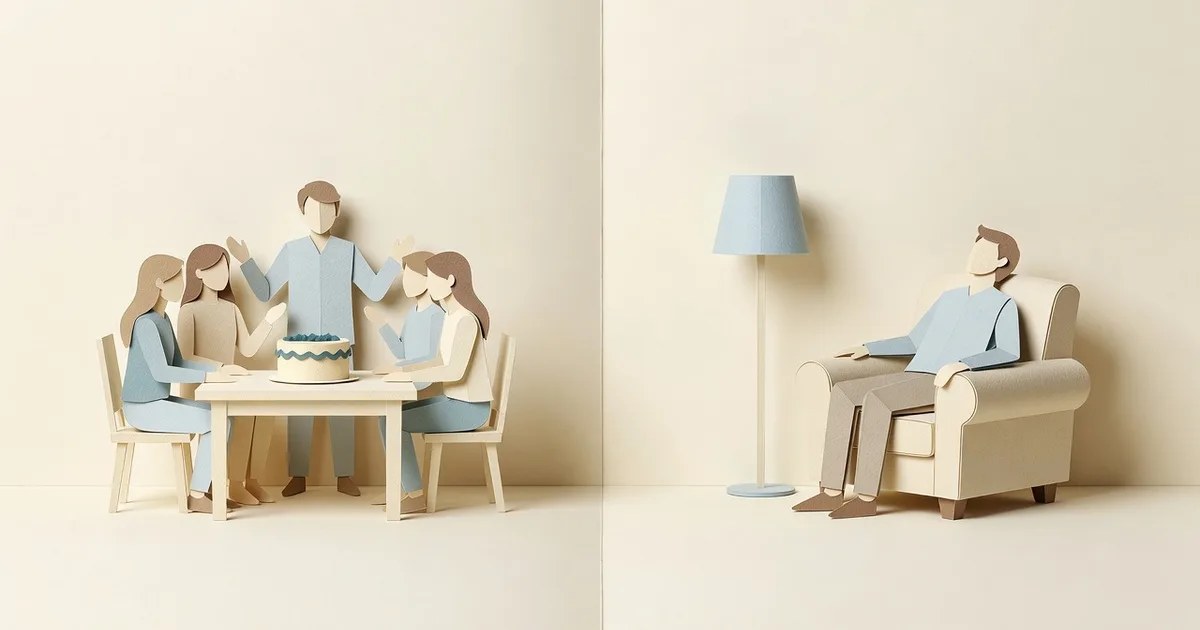
Introvert vs extrovert: what evidence says actually changes (and what does not)
“I am the extrovert of the family, my brother the introvert.” The phrase seems to close an explanation. But if you look at it carefully, it confuses five things psychology separated decades ago. That popular conversation keeps mixing them has a cost: people apply advice that does not fit their case, people label themselves with something they are not, and people spend years trying to “be more” of what they are not —or are and do not know it—. This piece reviews what evidence actually supports on the differences between the two extremes of the continuum, what gets exaggerated, and what almost never gets named: the middle range where most people live.
This piece does four things. First, it separates the three axes where the difference is measured with rigor from the four things attributed to it without evidence. Second, it shows how the difference between the extremes looks in concrete contexts —not in caricatures—. Third, it presents the uncomfortable fact: most people are not at either extreme. Fourth, it leaves you with an operational distinction to know what part of what you feel is the dimension and what part is something else.
1. The phrase: what it says and what it does not say
“I am an extrovert” usually means five different things at once: I like people, I talk a lot, public speaking does not cost me, I am assertive, and I have a lot of energy. The five correlate in everyday conversation, but research measured them apart decades ago. The introversion–extraversion dimension, in its technical operationalization, measures three central things —not five—. And there are other dimensions that cover the rest.
The confusion has a clinical effect: people who consider themselves extroverted because “they like people” discover, when measured, that they score as introverted in activation and high in agreeableness (which is a separate dimension). The label was identitarian, not descriptive. And vice versa: people who consider themselves introverted because “they do not like public speaking” discover they are very sociable but with evaluation anxiety (shyness), not with preference for solitude (introversion).
When someone tells you “I am an introvert” or “I am an extrovert,” the useful question is: which of the five things the phrase mixes do you actually want to say? Without that precision, any conversation about the dimension loses focus.
|| Popular belief | What the dimension actually measures | What a different dimension covers | ||---|---|---| || “I like people” | Sociability (part of the dimension) | Agreeableness (separate dimension) | || “I talk a lot” | Verbal activation | Assertiveness (separate dimension) | || “Public speaking does not cost me” | Comfort with exposure | Self-esteem (separate dimension) | || “I am assertive” | Disposition to initiate | Agreeableness + low reactivity (combination) | || “I have a lot of energy” | Activation/energy | General vitality (state, not trait) |
2. What evidence DOES support: three axes with measured difference
Lucas, Diener, and Grob documented in 2000 the three central characteristics of extraversion in cross-cultural samples: high positive affect, sociability, and energy
Axis 1: baseline positive affect. Extroverts report higher background mood on average: easier smiling, more spontaneous laughter, more positive reactivity to everyday events. But “higher” is not “absence of negative affects”: research shows extroverts also feel sadness, anxiety, and irritability —just that the background state does not tip as much toward the negative pole—. An introvert can be happy, deeply happy, only that the baseline state is more neutral and less reactive to external stimuli.
Axis 2: pursuit of social stimulation. Extroverts initiate more interactions: they organize, call, propose, seek conversation. Introverts accept and enjoy when the interaction happens, but they do not initiate as often. The distinction is not “enjoyment” —introverts enjoy as much as extroverts when context allows— it is “initiation.”
Axis 3: activation level / energy. Extroverts report higher general activation: more energy to sustain tasks, greater physiological response to stimulus, greater sense of “I am activated.” Introverts report a lower average activation level —and that is why social stimulus charges them less and drains them more, in relative terms—.
| Axis | Extrovert | Introvert | Measure used in research |
|---|---|---|---|
| Baseline positive affect | Higher (background mood more reactive to events) | Medium (mood more stable, less reactive) | PANAS, positive affect scales |
| Pursuit of interaction | More frequent (initiates, organizes, calls) | Less frequent (accepts, enjoys when it happens) | Self-reported frequency of social contacts |
| Activation level | Greater physiological and subjective response | Lower response, greater preference for internal activation | Cortisol under social stress, vitality self-reports |
| Recovery after interaction | Faster (positive reactivation) | Slower (needs silence to recover) | Pre/post-interaction affect difference |
What matters: the three axes are relatively independent. A person can be high in sociability (axis 2), medium in baseline positive affect (axis 1), and high in activation (axis 3). Asymmetric profiles are more common than pure profiles. That is why the labels “I am an extrovert” or “I am an introvert” are usually caricatures: they describe an average profile, not a specific score on each axis.
3. What evidence does NOT support: four exaggerated attributions
Four things popular conversation attributes to the introversion–extraversion dimension but that research measures separately. Confusing them has practical cost, because it leads to applying interventions that do not fit.
“Extroverts are better leaders.” That is not a dimension data point, it is a cultural bias. Research shows that leadership styles that work vary by context: charismatic leadership favors more extroverted profiles in fast-change contexts; analytical leadership favors more introvert profiles in technically complex contexts. Both styles have comparable effects on team performance; the difference lies in what type of context best activates each.
“Introverts are better listeners.” Partly true, partly confused. Introverts can be very good listeners —but there are also excellent extrovert listeners—. What research does show: introverts tend to prefer fewer interruptions, which in some cultures facilitates deep listening; but active listening as a skill is a trainable capacity, not a byproduct of the introversion–extraversion continuum.
“Extroverts are more assertive.” Assertiveness is a separate dimension. You can be extroverted and very unassertive (initiate a lot of social contact, but struggle to set limits), and you can be introverted and very assertive (prefer less interaction volume, but have a firm clarity about your own limits). The two axes are independent.
“Introverts are deeper.” Depth of processing is a cognitive variable, not a personality one. There are introverts with shallow processing —think fast, decide fast, talk fast in intimate contexts— and extroverts with deep processing —think with time, prefer writing over speaking, review before deciding—. The introversion–extraversion dimension does not directly predict cognitive depth.
4. The relation with positive affect: what evidence does clarify
One of the most robust relations in personality research is the one linking extraversion with positive affect. But the relation is not linear nor universal. Lucas and Fujita published in 2000 an analysis of the factors that influence that relation and found something counterintuitive
What does that mean in practice? Two people with the same extraversion score can have very different positive affect levels depending on their life context. An extrovert in a socially rich context (work with people, active social life, compatible partner) reports high positive affect. The same extrovert in an incompatible context (solitary work, isolated social life) reports lower positive affect —similar to that of an introvert in their compatible context—. The operational conclusion: context is not an addition to personality, it is part of what produces well-being.
That has an implication popular culture rarely says. “I am extroverted, I should be happy” is a phrase that confuses trait with state. Evidence says: extraversion is a factor that predisposes to positive affect under favorable conditions, not a guarantee of happiness under unfavorable ones. The same applies the other way: “I am introverted, I should not expect to be happy at social events” is a generalization that ignores context.
| Position + context | Expected positive affect | Why |
|---|---|---|
| Extrovert + socially rich context | High | Activation and sociability get reinforced |
| Extrovert + socially poor context | Medium-low | Trait does not compensate unfavorable context |
| Introvert + chosen solitary context | Medium-high | Effective recovery in chosen silence |
| Introvert + socially demanded context | Low | Spending without recovery, secondary exhaustion |
5. A real person: the case that shows both extremes in the same biography
I am a 35-year-old professional. I work in marketing, on a team of six, with daily meetings, coffee with new people twice a week, and a broad network I keep intentionally. Outwardly, “I am an extrovert.” Inside, something has not quite fit the label for years, and this piece cost me to write precisely because of that.
What I learned when I measured myself with rigor: I am high in sociability (axis 2), medium-high in positive affect (axis 1), and low in activation (axis 3). That is: I enjoy social interaction when it happens, I do not initiate it with the frequency my self-image suggested, and I find it energetically demanding even when I enjoy it. The “extrovert” label described me partially and pushed me into more interaction than my axis 3 could hold. The result: I had been carrying for two years a specific tiredness at the end of each week that my doctor attributed to work stress and I attributed to not being “extrovert enough.”
What changed when I dropped the label and looked at the axes separately: I started dosing interaction without guilt. I learned I can be sociable and also protect my activation, without that making me “less extroverted.” The tiredness resolved as soon as the calendar stopped being built for the person the label suggested. And the guilt for declining invitations disappeared when I understood that declining was not rejecting my identity —it was regulating my axis 3—.
The revealing part of the case: the identitarian label (“I am an extrovert”) had me trapped in a script that was not mine. The by-axis description gave me permission to be me —varied, sociable, with a need for silence— without feeling I was failing an identity. That is the practical difference between using the dimension as a label and using it as a map.
6. The fact that unsettles: most people are in the middle
Cohen and Schmidt proposed in 1991 the term “ambiversion” to describe those who score in the middle range of the introversion–extraversion continuum. The central observation was uncomfortable for the popular use of the dimension: the distribution of scores in non-clinical samples is not bimodal (two separated groups). It is unimodal with a high center. That is: the most common position in adult samples is the middle range, not either extreme
That means the people who score clearly in one extreme or the other are less frequent than popular conversation suggests. The modal position —the most common— is moving between the two poles depending on context. An ambivert can look extroverted at work (initiates, talks, organizes) and look introverted in personal life (eats alone, reads, does not answer the phone). Both are true at the same time, and neither is the “real” one.
What does that imply for the question “am I introvert or extrovert”? That for most people, the correct answer is not one of the two options, but a by-axis description with contextual variation. Saying “I am ambivert and in this context I am more introverted” is more precise —and more useful— than picking a team.
7. The most common error: treating the dimension as fixed identity
Once I understood the dimension is measured by axes and most people are in the middle, came the second confusion to dismantle: treating the position as if it were identity. Research shows the baseline position on the continuum has a heritability of 40-60%
The problem appears when the position becomes an identitarian label: “I am an introvert, do not ask me to speak in public” or “I am an extrovert, do not ask me to meditate alone.” Each label closes options research shows are trainable or at least modulable. The introvert can learn to speak in public without stopping being an introvert —it will cost more, will need more recovery, but they can—. The extrovert can learn to enjoy chosen solitude without stopping being extroverted —it will be harder than for an introvert, but it is possible—.
The distinction that holds this piece together is operational: the dimension is map, not destination. It describes tendencies, it does not close possibilities. The three axes are partially trainable, and the context is modifiable. What popular culture calls “being an introvert” or “being an extrovert” is, in most cases, a frozen version of a continuum that moves.
A practical illustration: a person who scores clearly introvert and works in a role with constant client-facing interaction learns, over twelve months, to handle that load with shorter recovery windows between meetings and tighter scheduling. Her baseline position does not change — she is still clearly introvert — but her capacity to function in that role improves measurably, because she stopped fighting the dimension and started designing around it. That is what “map, not destination” looks like in practice: same person, different operating envelope.
Caja de crisis
If you arrived at this piece carrying something heavier than curiosity —a social anxiety that has paralyzed you for months, an isolation that deepens on its own, or the persistent sense that something does not fit how you function— please do not keep reading without talking with someone. The introversion–extraversion dimension is not a clinical picture, but its interaction with anxiety, depression, or trauma is, and reading more articles does not replace an evaluation.
Colombia: Lines 123 / 106 (psychological and emotional care, free, 24h). United States: Suicide & Crisis Lifeline 988 (free, 24h). United Kingdom: Samaritans 116 123 (24h). Spain: Teléfono de la Esperanza 717 003 717. Argentina: Centro de Asistencia al Suicida (135 / (011) 5275-1135 from mobile). Mexico: SAPTEL 55 5259-8121. International directory: findahelpline.com
Get professional help through rdkterapia — no spam, you can unsubscribe whenever you want.
9. Clinical details almost no one mentions
Is the dimension inherited equally in men and women?
The 40-60% heritability reported in twin studies holds consistent across gender. The differences observed in mean trait expression (slight greater extraversion reported in women in some samples, slight greater introversion in men in others) are modest and vary by culture. The variance within each gender is much greater than the variance between genders —universal advice by gender does not apply—.
Does the position change with exercise?
Yes, with nuances. Regular physical activity modifies general activation level, which can shift the subjective perception of the dimension without moving the baseline position on the continuum. An introvert who exercises regularly can report higher disposition to social interaction —because their general activation system is more regulated—. But the change is modest and depends on the type of exercise; it is not linear.
Is the dimension related to sexual orientation or gender identity?
No consistent relation documented in research. The three central dimensions of the continuum (positive affect, sociability, activation) distribute similarly across orientations and identities. Variations observed in specific samples are attributable to contextual factors (social support, experienced discrimination), not to the dimension itself.
Does the position on the continuum affect response to psychoactive drugs?
Not directly. What is observed: stimulants (used for ADHD) can temporarily increase general activation and, with it, the disposition to seek social interaction —but that is drug effect, not trait change—. Sedatives can do the opposite. The baseline position does not get modified pharmacologically in a sustained way.
Why are there so many home tests online that do not work?
Because they confuse self-image with trait. An introvert with high self-esteem can describe themselves as “I enjoy solitude, I am selective with my time” —and get an “introvert” result—. The same person, if going through a moment of low self-esteem, can describe the same behaviors with a negative tone —“I isolate myself, people do not like me”— and get a different result. The problem: the test measured tone, not trait. Research uses population norms that control that bias; home tests do not.
10. To close: what changes and what does not
If you got here, you have already separated three things popular culture mixes: that the dimension is measured by axes, not by a single point on a line; that four of the five things people attribute to it are separate dimensions; and that most people are in the middle, not at the extremes.
What changes between introvert and extrovert is the position on three measurable axes: baseline positive affect, pursuit of interaction, and activation level. What does not change: that both are normal variants with advantages in different contexts; that the two can combine with other dimensions (agreeableness, assertiveness, shyness) that give rise to very varied profiles; and that the baseline position is partially fixed but not completely —there is more play than the identitarian label suggests—.
The next piece of this hub goes into detail on the middle range —ambiversion, where most people live, and the one popular culture describes worst—. Start there if the “I am introvert” or “I am extrovert” label never quite fit you.