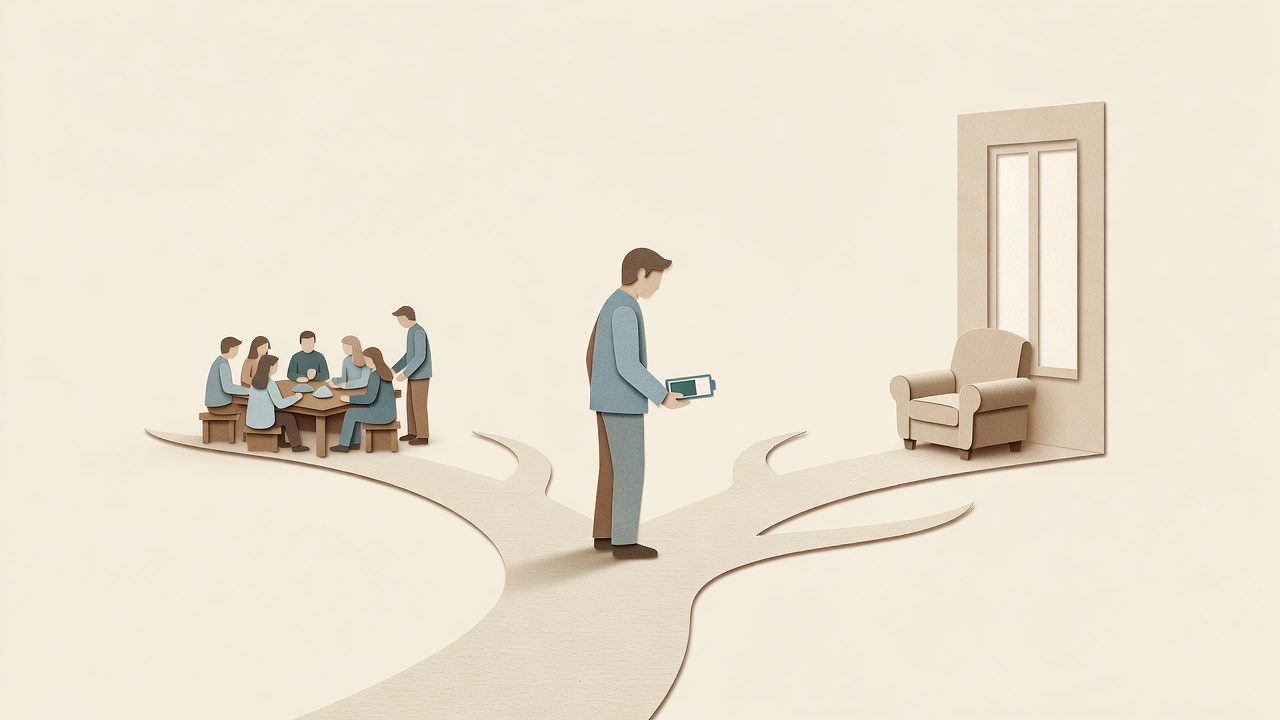
A social event has been weighing on you for days. Or the idea of another one feels like relief you would rather not admit.
Maybe you already pinned a label —introvert, extrovert, weird— and the label stuck. Maybe you never pinned one, but for a while now something does not fit with what your environment expects from you. This space shows you the real model: the introversion–extraversion dimension as a continuum —not as two teams—, the evidence on what changes between the extremes, where most people live, and why social energy —more than personality— is the variable that holds up your fit.
You are not missing "being more sociable." You are missing an understanding of your own dose of interaction.
Introversion and extraversion are not two opposing teams: they are the extremes of a continuum. Personality psychology has measured them as a single dimension since Eysenck, and cross-cultural evidence shows three central characteristics of extraversion —high positive affect, sociability, and energy— that are different from agreeableness or assertiveness. Most people are not at either extreme: they score in the middle range, which Cohen and Schmidt called ambiversion in 1991, and adapt their behavior to context. That is why generic advice —"go out more," "talk more," "be more spontaneous"— usually fails: it assumes an extreme most people do not occupy.
- The position on the continuum has a documented genetic basis (40-60% heritability in twin studies), but also shifts with age and context — it is not a fixed sentence —
- "I am shy" and "I am an introvert" describe different things — shyness is fear of social evaluation; introversion is preference for less stimulation — and they are measured separately
Where are you on the continuum?
Seven questions about your last week. It does not diagnose — it shows your probable position between introvert, ambivert, and extrovert.
The introversion–extraversion map
Seven short observations about your last week. It is not a clinical test — it is a map to know where you sit on the continuum and how much social energy you can hold this week.
This is not a validated clinical scale. If your answers describe a pattern that has been costing you weeks or months and combines with extreme fatigue, persistent isolation, or relational suffering — talking with a professional is a reasonable next step.
How often has this been true over the last week?
Saved locally on this device (nowhere else). Nothing is sent.
Introvert or extrovert is not two teams: it is a continuum, with a midpoint where most people live
- Lucas, Diener, and Grob documented in 2000 the three central characteristics of extraversion —high positive affect, sociability, and energy— in cross-cultural samples, separating them from confounded variables such as agreeableness or assertiveness. DOI: 10.1037/0022-3514.79.3.452
- Cohen and Schmidt proposed in 1991 the term "ambiversion" to describe those who score in the middle range of the introversion–extraversion continuum —the modal position in non-clinical samples—. Most people move between both extremes depending on context. DOI: 10.1207/s15327752jpa4305_14
- Zelenski, Sobocko, and Whelan synthesized in 2023 the evidence on preference for solitude: it is not a sign of deficit but a stable variable with adaptive value —introverts report higher subjective well-being when they voluntarily choose to be alone—. DOI: 10.1002/9781118427378.ch11
- If you have spent years trying to "be more sociable" or feeling odd for needing more solitude than those around you, the key is not forcing yourself toward an extreme: it is measuring your real social energy, adjusting the dose of interaction you can hold, and understanding that the middle range is not indecision —it is flexible regulation of context—.
One thing today: the social energy log
Before trying any change —stop canceling, go out more, talk more— it pays to do something simpler: for one week, note at the end of each day how much social energy you spent and how much you had left. The most basic documented exercise to start regulating your dose without guessing: one line at the end of the day, a score from 0 to 10, and a note about what happened. Seven minutes total.
- Pick three moments of the day to check in: midday, when you get home, and before sleep.
- At each moment, write in a note or journal: "social spending today from 0 (none) to 10 (a lot)."
- At the end of the day, sum or average: does the number match how you feel?
- If it matches on most days, you already have your baseline. If it does not, there is a gap between your spending and your perception — and that is already useful information.
- After a week, look at the high-spending days (5-10): what kind of interaction was there? With how many people? In what context? The pattern usually shows up within 7 days.
This is not therapy. It is the minimum operation of energetic self-knowledge that supports any later adjustment.
Read something that understands what is happening to you
No slogan. Three pieces on the introversion–extraversion continuum, with evidence and without self-help advice.
If you want to explore additional resources we have researched and recommend, they are here:
By rdkterapia · No spam · You can unsubscribe whenever you want
Frequently Asked Questions
Are introvert or extrovert something you are born with?
It has a documented genetic basis —40-60% heritability in twin studies per Jang, Livesley, and Vernon (1996)— and an environmental component that modifies it across life. It is not a fixed label: it is a position on a continuum, and the position can shift slightly with age and practice.
Is being an introvert the same as being shy?
No. Shyness is fear of social evaluation; introversion is preference for less stimulating environments. An introvert may not be shy at all —and an extrovert can be deeply shy—. The two are measured separately and get confused popularly.
Are most people really introverts or extroverts?
Most people score in the middle range of the continuum, which Cohen and Schmidt called ambiversion in 1991. The pure extremes are less frequent than popular conversation suggests. The modal position is moving between the two extremes depending on context —not staying fixed in one—.