What being an introvert really means
Being an introvert is not being shy or antisocial: it is processing the world from the inside. The evidence explains it and separates it from three myths.
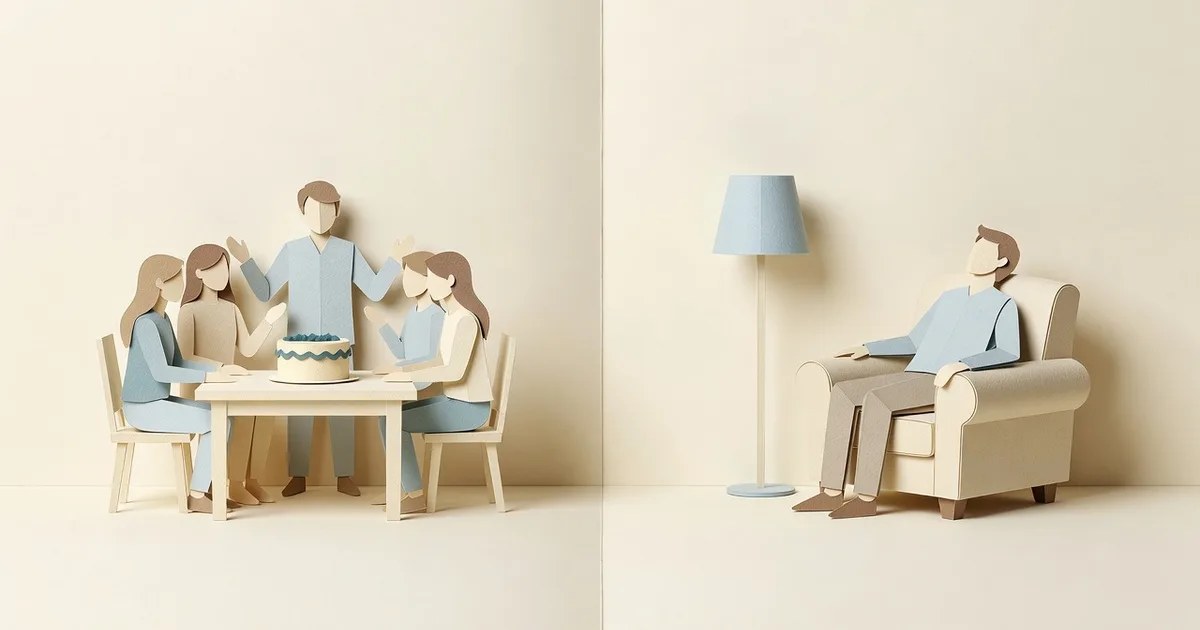
What it means to be an introvert: the evidence and the three myths that do not hold it
It is eleven at night. You are closing the kitchen after a day that included a work meeting, a call with your mom, a conversation with a friend you care about, and coffee with someone you know. Nothing was unpleasant. Nothing was dramatic. But something in you asks for silence. Not physical tiredness —you know that one—. It is something more specific: the sense of having spent a resource that now needs to refill without external demand. If that rings familiar, this piece concerns you. And if it does not, it likely concerns someone you care about and never asked in the right way.
This piece does four things: it fixes what evidence says about introversion when measured with rigor —not when used as an identity label—; it separates three confusions that popular culture spread and that research dismantled decades ago; it shows what introversion looks like in a real life —not in caricature—; and it leaves you with an operational distinction: when the preference for solitude is neutral data, when it is functional, and when it starts being a problem.
1. The technical definition: three measurable traits the introvert shows reversed
The way personality psychology operationalizes the introversion–extraversion dimension comes from Eysenck and was consolidated with the five-factor models. The most cited cross-cultural description is from Lucas, Diener, and Grob, published in 2000: they identified three central characteristics of extraversion that replicate across samples of over thirty countries —high positive affect, sociability, and energy—
What matters about the model is that the three characteristics are relatively independent. A person can be high in sociability (enjoys conversation, feels comfortable with people) but low in activation (does not seek out social stimulus on their own). That combination exists, it is common, and it describes a pattern that neither the “introvert” label nor the “extrovert” label captures well. Research uses separate scores, not a single point on a line.
|| Central trait | What it looks like in an extrovert | What it looks like in an introvert | Question it answers | ||---|---|---|---| || Positive affect | Higher baseline mood, more easy smiling, more easy laughter | Medium positive affect, not low — just less reactive to external stimulus | What is your background mood? | || Sociability | Enjoys and seeks interaction, it charges you with energy | Enjoys interaction when it happens, but does not seek it on their own | How much does being with people activate you? | || Energy / activation | More activated by social context, seeks external stimulus | More activated by internal context, seeks silence and solitary tasks | Where do you recharge vs where do you spend? |
The crucial thing: none of the three is good or bad on its own. They are differences in the preferred mode of activation regulation. An introvert with high sociability is perfectly capable of having a great time at a party and, at the same time, needing hours of silence afterwards so as not to end at zero.
2. The heritability: why the “leave your comfort zone” culture does not work equally for everyone
There is one fact the popular conversation about “being more social” rarely considers. Jang, Livesley, and Vernon published in 1996 a twin study —monozygotic and dizygotic— estimating Big Five heritability —including the introversion–extraversion dimension— at around 40-60%
That does not mean the position is fixed. It means that pushing an introvert to “be more social” through willpower alone has the same effect as pushing a short person to “be taller” through diet: not much. The environmental component modulates trait expression, but does not rewrite it at will. Where change does happen is in the capacity to function well in higher-stimulation contexts —a different thing from stopping being an introvert—.
This has a practical implication that almost never gets said. The strategy that works best is not “go out more,” it is dosing. If your baseline load is X hours of manageable social interaction per week, your work is not to increase it indefinitely —it is to stay within a range where you end the week with energy, not at zero—. The evidence backs this: Zelenski, Sobocko, and Whelan synthesized in 2023 the research on preference for solitude and found that the voluntary choice to be alone is associated with higher subjective well-being, not with problematic isolation
3. Myth one: “being an introvert is being shy”
The confusion is so persistent that it deserves separate treatment. Shyness is fear of social evaluation: anxious activation at the possibility of being judged. Introversion is preference for less external stimulation: there is no fear, there is a difference in preferred regulation mode. Coll, Kagan, and Reznick published in 1984 a classic paper on behavioral inhibition in young children that helps separate both from infancy
The confusion has a concrete cost. Non-shy introverts hear advice to “work on shyness” that does not apply to their difficulty. Non-introverted shy people hear advice to “go out more” that does not recharge them. Both confusions erode self-image: the non-shy introvert thinks they have a social problem they do not have, and the non-introverted shy person thinks they do not like people when what is happening is that anxious activation blocks enjoyment.
| Characteristic | Introversion | Shyness |
|---|---|---|
| Core | Preference for less external stimulation | Fear of social evaluation |
| Physiological reaction to people | Neutral or slightly activating | Anxious activation (tachycardia, avoidance) |
| Enjoyment of interaction | Can be high when context allows | Blocked by worry about judgment |
| Recovery | Solitude, solitary activities | Avoidance + solitude forced by fear |
| Useful work | Dosing, dose adjustment | Gradual exposure, work with evaluation |
4. Myth two: “introverts are antisocial”
This myth confuses preference with deficit. Research on preference for solitude (Zelenski and colleagues, 2023) shows that introverts are not antisocial: they have fewer interactions than extroverts, yes, but the ones they have tend to be more intense, more intimate, and of higher reported quality
A useful image: for an introvert, a one-hour conversation with someone close can be equivalent —in load and in satisfaction— to three hours of light interaction with several acquaintances. That does not make them better or worse; it makes them different in regulation mode. When they are forced into three hours of light mode, the night’s balance is negative. When they choose the format, the balance can match what an extrovert gets in their preferred context.
There is one fact that often unsettles: some longitudinal studies suggest that the most stable adult friendships tend to be those that maintain a contact frequency compatible with the introvert baseline of at least one of the members. The pressure to keep constant interaction wears down introverts’ relationships more than any other measured variable. Dosing, not volume, is what sustains connection.
5. Myth three: “introversion is a problem that gets cured”
This is the most damaging myth because it pathologizes a normal variant. The research is consistent: introversion is a stable position on a continuum, not a clinical picture. The diagnostic criteria (DSM, ICD) do not include it as a disorder because it does not produce functional impairment on its own —impairment appears when it is subjected to contexts systematically incompatible with the individual’s baseline—.
Where impairment does appear is in combination with sustained social pressure: jobs that require continuous high-intensity interaction (customer-facing, sales, highly visible leadership positions) with no possibility of recovery. That does not get fixed by “being more social,” it gets fixed by role adjustment, real breaks within the workday, and choosing contexts compatible with one’s own baseline. An introvert in a compatible role shows no functional impairment. The same person in an incompatible role shows exhaustion that gets misdiagnosed as burnout, anxiety, or depression.
A repeated clinical observation: the exhaustion of the chronically overstimulated introvert looks more like apathy than anxiety. The person stops enjoying what they used to enjoy, not because they are depressed in a clinical sense, but because the activation system is permanently saturated. The distinction matters because the approach differs: it does not get treated with antidepressants, it gets treated with load adjustment.
6. A real person: the case that shows introversion in play
A composite scene to show what introversion looks like in a concrete life. A 32-year-old woman, professional in a role requiring coordination with many teams. Outwardly, she functions: she delivers, her team describes her as “good people, approachable.” She has a stable partner, two close friends, a family that loves her. It is the typical case of someone who “has nothing to complain about” and yet has been carrying for two years an exhaustion that does not get explained by hours of sleep or by objective workload.
What was happening inside: every Monday at eleven in the morning, after three team meetings, she felt she had “spent something” that was not physical tiredness. She needed to walk alone to recover. By Friday at the end of the workday she arrived home in a neutral state —neither happy nor sad, simply depleted— and needed until Sunday night to feel like herself again. She started declining invitations. She started feeling guilty for declining. She started confusing the guilt with the problem.
What her case shows when read through the right lens: she has a high introvert baseline, a professional role with high interaction, and no systematic recovery space between the two. The symptom is not introversion —it is the incompatibility between her regulation mode and context—. The approach that started working was not “be more social” —it was negotiating real breaks within the workday, protecting deep-work blocks, and stopping pathologizing the need for silence—.
The revealing part of the case: she had been treating the symptom for two years with the wrong strategies without touching the variable that held everything —the incompatibility between her regulation mode and context—. Once that variable was adjusted, the specific exhaustion resolved without further interventions.
7. How it is measured — without internet tests
If you want to know where you are on the continuum with a minimum of rigor, there are three paths the evidence supports:
Personality tests with norms. The NEO-PI-R (Costa and McCrae) and the IPIP-NEO are the most used. They measure the Big Five with validated questions on large samples. They have public shortened versions (IPIP-50) that give an acceptable reading to orient you, not to diagnose. What they measure: position on each dimension, including the introversion–extraversion continuum.
Structured self-observation. A week of brief logging (three lines at the end of the day) on how much social interaction you had, how much energy you had left, and in which contexts you recharged. It is the lowest-cost, highest-utility method for operational self-knowledge, because personality tests tell you where you are —the log tells you how that works in your concrete life—.
Internet tests with caution. What circulates as “introvert test” on social media is usually a disguised self-report version —questions like “do you like parties?” that measure self-image, not trait—. They can orient you, not decide anything about you. The difference with a normed test matters: an introvert who does not consider themselves introverted scores low on those tests, and that does not mean their position changed —it means the test measured something else—.
| Method | What it measures | Cost | Operational utility |
|---|---|---|---|
| Normed test (NEO-PI-R, IPIP-NEO) | Position on each dimension with population norm | Medium (some public versions) | High for orientation, low for daily self-knowledge |
| Structured self-observation (1 week) | How your position works in your concrete life | Low (notebook or notes) | Very high for adjusting dose and designing the week |
| Casual internet tests | Self-image of introversion/extraversion | Very low | Low: they measure tone, not trait |
8. The fact that changes the reading: age matters
Longitudinal research shows that the position on the continuum moves slightly with age, and the typical direction is toward greater introversion in mid-adulthood —it is not uncommon to move from a more extroverted score in the twenties to a more introvert one in the forties—. The interpretation researchers give: accumulated practice works as implicit training of the regulation system, and with the years there is greater preference for quality over quantity of interaction.
For someone in their twenties who feels more introverted than their peers: that may be your age, not your “essence.” For someone in their forties who feels more extroverted than before: it may also be your age, not a regression. The full puzzle piece includes the life stage, not only the score on a test.
Caja de crisis
If you arrived at this piece carrying something heavier than curiosity —an isolation that deepens on its own, a social anxiety that has paralyzed you for months, or a persistent sense that something does not fit with how you function— please do not keep reading without talking with someone. Introversion is not a clinical picture, but its combination with anxiety, depression, or trauma is, and reading more articles does not replace an evaluation.
Colombia: Lines 123 / 106 (psychological and emotional care, free, 24h). United States: Suicide & Crisis Lifeline 988 (free, 24h). United Kingdom: Samaritans 116 123 (24h). Spain: Teléfono de la Esperanza 717 003 717. Argentina: Centro de Asistencia al Suicida (135 / (011) 5275-1135 from mobile). Mexico: SAPTEL 55 5259-8121. International directory: findahelpline.com
Get professional help through rdkterapia — no spam, you can unsubscribe whenever you want.
10. Clinical details almost no one mentions
Is the position on the continuum inherited or learned?
Both, with different weights. Jang, Livesley, and Vernon estimated heritability at around 40-60% in their 1996 twin study
Do introverts have worse mental health than extroverts?
With nuances. The introvert position as such is not a risk factor for depression or anxiety. What is observed: greater vulnerability to the effect of systematically incompatible contexts —roles with high interaction and no recovery—. In those contexts, introverts report more exhaustion, more secondary apathy, and more withdrawal. But in compatible contexts, well-being indicators are comparable.
Does introversion change with therapy?
Not the base position, but functional regulation does. What improves with therapeutic work is the capacity to function in higher-stimulation contexts without the balance being catastrophic —managing spending, choosing contexts, effective recovery—. Therapy does not “extrovert” anyone; it helps use the available range with more precision.
Is there a difference between introverts by gender?
Research shows moderate differences in mean trait expression by gender, but the variance within each gender is greater than the variance between genders. In practice, that means there is as much variability among women as among men, and universal advice by gender (“women are more emotional,” “men are more solitary”) does not apply to energetic regulation.
Does the introvert position change with medication?
Not directly. Psychoactive drugs that affect mood (antidepressants, anxiolytics) can modify general activation and, with it, the disposition to seek social interaction. But the base position on the continuum is trait, not state, and is not modified pharmacologically in a sustained way. If a medication change moved your position, it is a side effect to review, not a “cure.”
11. Questions worth asking yourself before reading further
How much social interaction charges your energy?
A hard question to answer without data. The heuristic that works best: look at your last normal week —no extraordinary events— and estimate how many hours of conversation, meetings, calls, and chat you had. Then, look at how you closed the week. If you closed neutral or positive, that is your manageable dose. If you closed at zero or below, it was too much.
Does canceling events give you guilt or relief?
If the immediate answer is guilt —even when the cancellation was reasonable— it pays to review whether you are living by your baseline or by your environment’s baseline. Chronic guilt about canceling usually signals that the calendar is built for a person you are not, not that you have “social avoidance.”
How much of your solitude is chosen and how much is forced?
The distinction matters and gets confused little. Chosen solitude: you want to be alone, you have plans for the night, there is no distress. Forced solitude: you want to connect, you cannot, there is no one, and it hurts. Research shows opposite effects on well-being: chosen solitude associates with higher satisfaction; forced solitude with higher depressive symptomatology. Look at which one you have more of.
Are you in a professional role compatible with your baseline?
The uncomfortable question. Some roles are hard for almost any introvert —high-turnover sales, highly visible leadership, constant customer-facing work—. Some roles where the introvert baseline is an advantage —deep work, writing, programming, research—. If your role systematically demands you function in high-interaction mode, the fix is not “be more social,” it is reviewing the role.
Does your social pattern include rest or is it cumulative?
A week with three social events with no silence day in between is more demanding than the same amount distributed with breaks. Social energy regulation operates on weekly cycles, not daily ones —research documents it with data on positive affect and end-of-week satisfaction—. Distributing is more sustainable than accumulating.
12. To close: what you already know clearly
If you got here, you have already separated three things popular culture mixes. That introversion is not shyness —they are distinct axes with similar-looking symptoms—. That it is not antisociality —it is preference for less volume and more depth—. That it is not a flaw to correct —it is a stable position on a continuum with adaptive value when context allows—.
The question this piece returns to you, but inverted, is the same one we opened with. The useful answer is not “I am an introvert” nor “I am an extrovert.” It is: how many hours of interaction fit you this week, which contexts recharge vs drain you, and what role asks you to function in a mode that is not yours.
The other two pieces of this hub go into more detail: the differences between the two extremes, and the midpoint almost no one names —ambiversion, where most people live—. Start with the one that speaks to you most today.