Why do I feel empty when everything seems fine?
On the outside nothing is wrong, and inside nothing lands. What the fine-life emptiness is, why it is not a mood, and what actually moves the evaluation.
 Ricardo De Castro KingPsychologist · Meet the author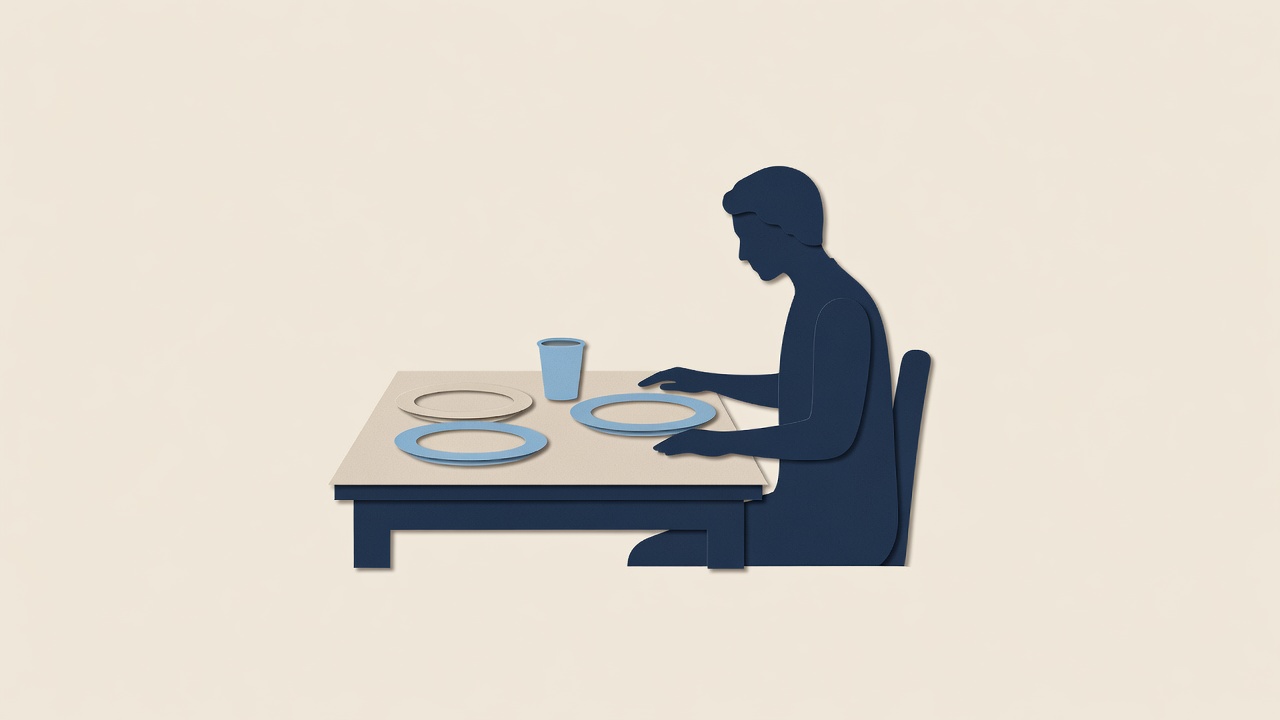
It is seven in the evening. The kitchen is clean, the kids have eaten, and Sunday is coming. Everything, on the outside, is in order. And still you have been walking through the house for months with the sense that nothing is happening that counts. You are not short on anything material. What is missing is that some of it gets lived.
In the United States there is a figure of around 75,000 dollars a year that gets quoted constantly, and it is worth saying exactly what it refers to, because it is usually cited backwards. What stops rising above that point is not your global evaluation of life: the evaluation keeps rising. What plateaus is the everyday emotion — how many good days you have, how much laughter, how much affection. The finding is Kahneman and Deaton’s, and what it shows is uncomfortable: money still buys “my life as a whole is going well”, but it stops buying “today I was fine”. And that is exactly the gap where what you are describing sits: a life that goes well and a day that does not.
When everything on the outside is fine and nothing on the inside lands, what is underneath is not your material life. It is the global evaluation your mind makes of it. That evaluation moves with sustained practices, not with more achievements. And there is an order worth learning before trying to change it: first understand what holds it up, then decide what to move.
1. The figure that does not match what you see
The 75,000 dollar figure is not a loose number. It comes from more than 450,000 responses to the Gallup-Healthways Well-Being Index, collected day by day, and it separates two things we tend to mix up. The first is the evaluation a person makes when asked “how well do you judge your life when you look at it as a whole?”. The other collects the mood of a typical day: was there anger, stress, joy, affection. Two different questions, with different results against money. Kahneman and Deaton published this in 2010 (DOI: 10.1073/pnas.1011492107), and at the time it was even more uncomfortable than it looks today: it went against the consensus that more income always adds up to well-being. It showed that the sum stops where the ability of money to reach ordinary life stops, not where the bank balance stops.
The complaint is not the one of someone who has nothing; it also shows up in someone who has plenty and, on paper, should be satisfied with the life they built. So when someone says “I have everything and yet…”, it is not a whim and it is not cheap: it is a literal translation of what the data describes. The dissatisfaction that shows up in the upper half of the economic distribution does not get fixed with more consumption. It gets fixed with something else, and to get to that something else it is worth starting from the beginning: when it appears, how it holds, and where you are on the path.
2. How it started
It almost always starts on an ordinary day, not in a crisis. Nobody loses a loved one, nobody loses their job, nobody receives a diagnosis. What happens is quieter: a Sunday at seven in the evening, looking at the ceiling, and you notice that nothing is wrong. And that is exactly where the problem is. A life that is “fine” and generates not a little enthusiasm is already telling you something, and the body registers it before the mind does.
There are three common ways it appears, and all three work as a map for locating yourself before you have put a name to it. The first is silent comparison: someone your age buys a house, you do too, and it said nothing to you. The second is the contrast with an earlier moment when life did have a centre — a project, a cause, a person — and now the day has the same shape but is missing that centre. The third is fulfilment: you got to the goal and the goal did not fill it. Of the three, the first is the most common, the second is the quietest, and the third takes longest to be recognised, because when it is not recognised the person feels bad about feeling bad, and that adds another layer.
3. How it settles in
Once it appears, it does not stay loud. It lowers its volume, and that is more disorienting than the first weeks. The acute version has a shape you can point at; the settled version does not.
- The first weeks. The contrast between how things should feel and how they feel is sharp. You can still name what is missing, which makes it workable.
- The second month. The contrast narrows. You stop being able to say what is missing, but you have not started to feel better either. This is the phase people describe as going through something without knowing what.
- Around four months. It has become the default tone, and the default tone is what you compare your good days against. A good day now means a normal day, and normal is not enough.
- A year in. The question has usually changed shape. It is no longer “why do I feel like this” but “is this what it is going to be like”. That second question is the one that closes doors.
4. Where you are now
Most people who land here are in one of three places, and each needs a different thing rather than more of the same.
If the emptiness has been with you for under six months and you are functioning. The work is practice, and the rest of this piece is enough. You do not need a diagnosis to know where to start.
If it has been longer than six months without variation. That length is the point at which doing it alone stops reaching. The clearest sign is that it has stopped being about mood and started touching other parts of daily life: sleep breaks, work gets hard, relationships cool, a tiredness shows up that rest does not fix.
If there is anything else alongside it. No energy, no interest, sleep or appetite changed. That is a different piece of work, and it deserves a professional rather than another article. This one is about the fine-life emptiness specifically, and it is careful about the border.
Does this mean I should just go and get a diagnosis?
No. The emptiness described here is not a pathology, and it does not need a diagnosis to be worked on. What the scale is useful for is showing you the gap between how your life is going and how it is being lived, and the gap does not close on its own. What a professional is for is the case where the flatness is accompanied by other symptoms — sleep, appetite, interest — because then it is a different thing and deserves different work.
5. What the global evaluation does not tell you
It is worth knowing, at least by name, the instrument Diener published in 1985. It is called the Satisfaction With Life Scale (DOI: 10.1207/s15327752jpa4901_13). It asks you to rate five statements and it measures exactly what the title says: the global evaluation a person makes of their life. There are five statements, and the person marks how much they agree with each one. There are people who score 30 out of 35 and feel empty. There are people who score 14 and say they are fine. The number does not capture everything, but it does capture something: the gap that opens between your life as you live it and the story you tell about it.
The uncomfortable part of the instrument is that the answer was built to hold steady over time. If today was bad at work, the score does not move. If you argued with someone, it does not move either. That is deliberate: the idea is to measure the overall evaluation, not the mood of the moment. And that is exactly why it is useful for what we care about here. When a person says “everything is fine and yet”, what they are describing is a low score on that scale in the presence of high vital signs. That is called misalignment, and the evidence shows it has treatment.
Can I be fine and feel bad at the same time?
Yes, and that is precisely what misalignment means. Diener’s scale measures the global evaluation, not emotions. Kahneman and Deaton show that evaluation and emotion are two systems that can come apart. You can have a low evaluation (you feel empty) and, at the same time, days with laughter and good moments (high everyday emotion). That combination is more common than it looks, and it is usually the most confusing one, because the person cannot find a reason to feel bad, and not finding one makes them feel bad about feeling bad. Feeling bad about feeling bad, on top of everything else, lowers the evaluation a little further.
6. The case of someone who looks fine from the outside
A thirty-eight-year-old woman, married, two children, steady job, her own house. Everything any of your acquaintances has. What is not visible: three nights a week she goes to bed thinking her life is slipping away, and she has nobody to say it to. Her husband is fine, the children are fine, the job is fine. She does not have the exact word, but when she is pushed she says “empty”. As if the whole day were covered in glass.
What happened, looking back, was gradual. After motherhood she gradually dropped the things that made her feel alive: the guitar, the nights out with friends, the pottery workshop. She did it with the best intentions, to have more time for the family. It worked for a while, and then it stopped working. And at some point the good decision of the first months got confused with a permanent state.
What moved her was not a revealing conversation and not a crisis. It was a small decision: going back to one class a week. Not the guitar, not the pottery: a class in something new, so as not to ask the routine for permission. Three months later the emptiness had not gone, but it had competition. The day had a little of her in it again, and with that the evaluation started to move. Not because the class was the answer, but because it reintroduced something the rest of the day was not giving her.
7. The moves that actually change the evaluation
What the evidence has found is that evaluated well-being responds to three kinds of factor, and it is worth naming them before going further, because when you do not have them clear you end up working on the one that moves least, the effort does not show on the barometer, and frustration becomes the landscape. One genetic, which is the strongest and does not move. One circumstantial, which adapts quickly and returns to the starting point. And one of practices and activities, which is the only one you have real leverage over. What helps, and what does not, comes out of that.
Practices with evidence. Writing down concrete gratitude a couple of times a week. Putting your strengths into something concrete each day. Setting goals with meaning rather than with results: the process matters more than the close. Giving time to a relationship you chose to keep. Doing something that makes you lose track of time, even if it looks useless. All five work, and they can be combined.
Circumstances that look like solutions and are not. Moving house, changing the car, changing the partner, changing the job, earning more. Each can add something at the start and then returns to the starting point. The exception is when the circumstance is objectively bad (a toxic job, a damaging relationship), and there the change really is part of the solution, just not for the reasons we usually give.
What does not work however long you try. Thinking more about the problem. Looking for the hidden cause. Waiting for the right moment. Deciding that next year you will make changes. All of that is how the emptiness protects itself: it keeps you busy without moving.
Why do the genetic factors weigh so much if they cannot be moved?
The genetic component explains an important part of the variance in subjective well-being, according to twin and adoption studies. What that does not mean is that you are determined; it means the range within which you move is partly given from there. Practices and circumstances operate inside that range: they do not take you out of it, but they do take you to your own ceiling. That is why two people with similar lives can have very different evaluations, and why two people with very different lives can have similar ones. Genetics carries around half the weight according to that estimate, and the exact split is debated: it is not a sentence, it is the starting point you work from.
| Kind of factor | What it changes | How long it lasts | What happens over time |
|---|---|---|---|
| Genetic (set point) | The possible range | A lifetime | Stable, not negotiable |
| Circumstances (income, marital status, place) | The evaluation at the start | Months | Adapts and returns to the range |
| Chosen practices and activities | The evaluation in use | As long as they are sustained | Accumulate, cumulatively |
The row in the middle, the one about income, is the one that surprises people most. If you double your income, the evaluation rises a little and comes back. If you keep a practice with meaning going for six months, the evaluation rises a little and stays. The difference between the two is what Kahneman and Deaton are showing almost in passing: circumstances are a floor, and practices are a ceiling you can raise.
8. What to stop doing
There are moves that look like part of the solution and are part of the problem. It is worth catching them early, because each one can hold the emptiness in place for months without the person noticing.
- Looking for the hidden reason. “Something must be happening to me to feel like this.” There is not always a reason. Stable dissatisfaction is a state, not a symptom.
- Waiting for the right moment. The right moment does not arrive on its own; it arrives when you start something small. While you wait, the emptiness settles in.
- Comparing your evaluation with someone else’s. Everyone’s evaluation is private, and it has no useful comparison point. “So-and-so seems more content with their life” tells you nothing about yours.
- Deciding that your age has passed. Life satisfaction moves at any age. There is consistent data on change in people in their seventies and eighties, and the effects are of the same order as in younger people.
- Asking rest to fix the day. If the day is empty, rest only hides the emptiness for a while. Rest is useful, but it does not replace what the day is not giving you.
9. The difference between emptiness and other similar things
It is worth opening two different drawers here, because some things resemble emptiness and need a different approach. The most common confusion is with depression, and that is why it is worth marking the border.
| What you notice | What usually sits behind it | What confirms it | What helps |
|---|---|---|---|
| Stable emptiness, you function well | A gap between judgment and mood | No other symptoms | Practices with meaning |
| No energy and no interest | Mild depression | How you sleep, how you eat, how the mood varies | Seeking support |
| Sadness about something specific | An expected reaction | There is a clear fact | Time and company |
| Sustained tiredness | Burnout or another picture | A map of energy | Rethinking the load, not the evaluation |
If you are on the first line, this piece is your work: read it slowly and pick one thing from what it proposes. When you are on any of the other three, the work is different. The problem is that stable emptiness is often misdiagnosed as depression, and medicated without a clinical picture being there. The most honest tool is your own observation over two weeks: if there are no other symptoms, it is probably misalignment. If there are, it is worth consulting.
10. What to expect from the process
It is worth saying this without decoration. Evaluated well-being does not change from one day to the next; whoever tells you it does is selling you something. What does move is the daily version: practices with meaning show measurable effects at eight to twelve weeks. If it goes faster, it is usually enthusiasm rather than a real change.
This is how it moves inside. At first, the days with practice are a little different from the rest, but the background does not change. After that, you notice the background has changed a little, you have a bad day, and it no longer feels like a bad day. Further on, the distance between a day with practice and a day without becomes more visible. And at some point you stop measuring your life against an ideal and start measuring it against what you actually want. What moves the needle is not achieving more. It is wanting differently.
11. When to ask for help
The fine-life emptiness is enough on its own for a lot of people, until there comes a point where it is better worked on with company, because working alone has a ceiling you notice when the emptiness starts reaching further than one person can hold. The clearest sign is that the emptiness stops being limited to mood and starts touching other areas of daily life: sleep breaks, work gets hard, relationships cool, and a tiredness shows up that rest does not fix. The other sign is duration: if you have been in the same low tone for more than six months without variation, working alone probably no longer reaches it.
And if the thought of harming yourself crosses your mind, that is not resolved with practices or with time, and it is not something you wait out. That is now, and the helplines are there, open day and night.
This piece writes about emptiness, not about diagnosis: it does not replace a clinical evaluation or a professional diagnosis. If the thought of harming yourself shows up, if you have had weeks of broken sleep or no appetite, or if none of this moves, what is needed is a consultation, not more practice.
12. Crisis box
If you are in crisis right now, with thoughts of harming yourself or that nothing makes sense, put this reading down and call.
- Colombia: Línea 123 (national emergency) · Línea 106 (mental health)
- United States: 988 (Suicide & Crisis Lifeline)
- United Kingdom: 116 123 (Samaritans)
If you can, stay with someone while you call. When the emptiness has been going for months, it is sometimes no longer only a low tone: it is the tip of something deeper, and on those nights the only thing needed is a voice that does not get frightened.
13. The exercise: the question you can answer today
Back to the finding at the start. Life satisfaction moves with chosen practices, not with new circumstances. And the first practice is a single one: identifying something the day has to be yours alone. Not a goal, not a six-month plan: a small thing you can do today, specifically.
It works like this, in five steps:
- Write down when the last time was that you were exactly where you wanted to be. Not the exact hour: the moment. An afternoon, a song, a conversation. If nothing comes, write “I don’t remember”, and that already says something.
- Write what was happening in that moment. A class, a walk, a call. It does not have to be important.
- Put a 45-minute block in the calendar for next week. Dedicated to something with that texture, not to something “useful” or “productive”.
- Tell someone you are going to do it. If there is nobody, tell yourself in a note on your phone. The note counts as someone.
- After the block, write down how you felt. One word, not an analysis. If words are hard, an image. The memory of a good day fades faster than the memory of a bad one.
It sounds too simple, and it is exactly what the emptiness cannot do: stop being the main character. You are not broken for feeling this: what you feel has a name and a way out. And if nothing comes of it today, once counts anyway: you did it once and the next time can be easier. It does not have to be perfect for it to count. If today you have the strength, do it. If you do not, leave this piece open as a reminder that next week has a block. What counts is that the movement does not stay a thought.
The life satisfaction hub gathers the rest of what we have written about the emptiness that does not explain itself, and the interactive tools turn this into something you can sit with today. If what is happening to you is that things are fine on the outside and nothing lands, that is also written up in the piece on the hollow fulfilment; and if what you are asking is what actually moves the global evaluation, the text to read is the barometer. If you want to see what shape your evaluation has today, there is a short questionnaire that gives you a picture of the current state, not a clinical diagnosis. And if what you feel no longer moves with practices, therapy at rdkterapia is one possible door.
Seligman, Steen, Park and Peterson (2005, DOI: 10.1037/0003-066X.60.5.410) went through the interventions with experimental evidence behind them, and their conclusion is not comfortable: getting more does not change the meter. The only thing that moved it, in the studies that held up, were concrete repeated practices.