Self-esteem and body: the relationship with the mirror
What you see in the mirror is not your value: it's a reading. Five ways body image lowers self-esteem, and what to do today to look at yourself differently.
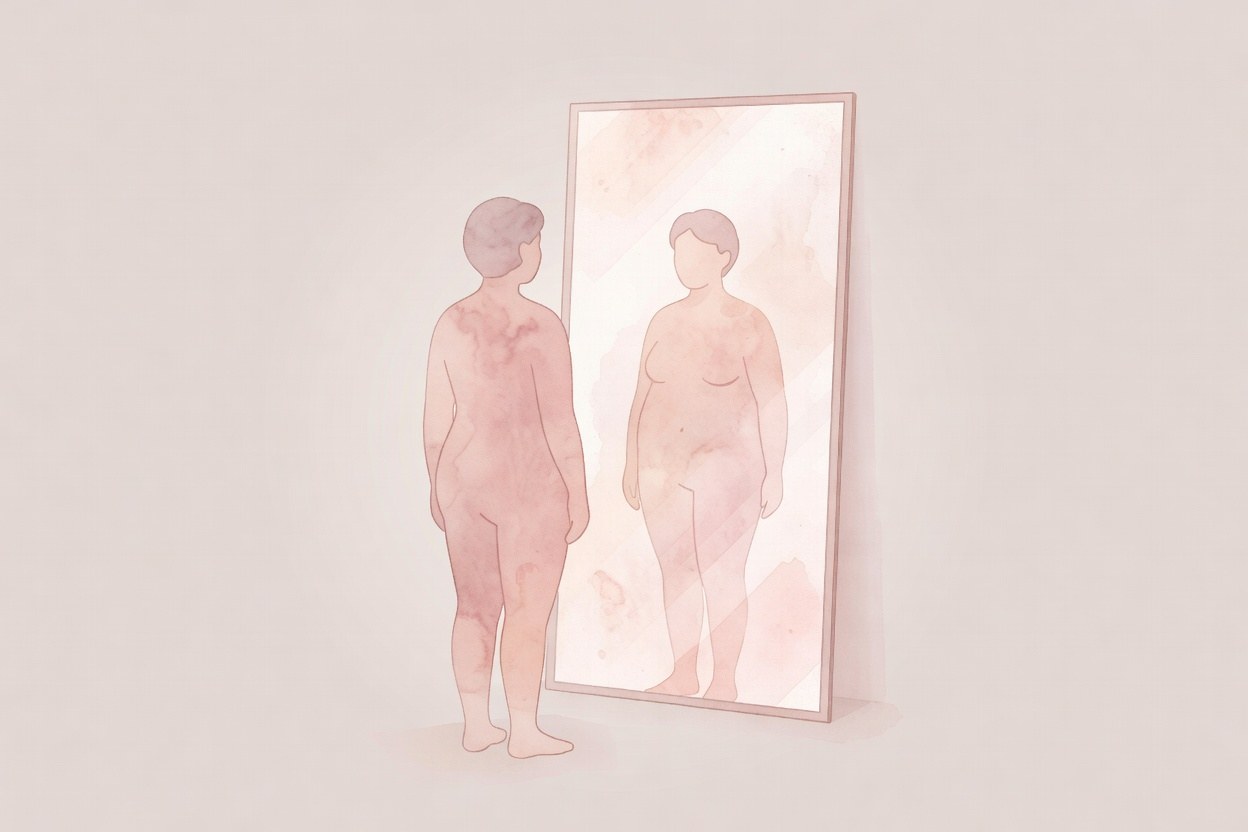
The mirror doesn’t give you back a value. It gives you back a reading. The difference matters, because we’ve spent our whole lives treating that reading as if it were a verdict.
When you look at yourself and the first thing that appears is “how fat I look”, “how old I look”, or “I’m not up to par”, you’re not looking at your body: you’re reading an old judgment in it. Many times that judgment was learned before age ten, in a kitchen, in a fitting room, in a school photo. What you see today in the mirror is the mixture between your real body and the critical voice you learned to put on top of it.
This article is to separate the two things: what the mirror shows from what your head adds to it. If body image weighs on you and you suspect it underpins a lower self-esteem than you deserve, this reading can give you a map. If what’s moving is broader, the complete guide to low self-esteem covers the topic end to end, and the piece on the inner critical voice that sabotages you shows how that inner judge is formed.
TL;DR
- Body image is not a fact: it’s a perception filtered by the critical voice, comparisons, and memories.
- Five ways that perception lowers self-esteem: self-objectification, social media comparison, generalization “my body = my value”, mirror avoidance, and anticipated public shame.
- A concrete five-minute practice to start looking at yourself from curiosity instead of judgment.
- If the mirror has weighed on you for years, it’s not vanity: it’s possible work, and there’s a way out.
Why what you see in the mirror isn’t what you are
There’s a technical term for this: body image. It’s not your body. It’s the mental representation you built of it — made of how you see yourself, how you think others see you, how you feel when you see yourself, and how you act accordingly. Four layers, not one.
Research is consistent on one thing: body image correlates with self-esteem, but doesn’t determine it. You can have a body that doesn’t fit any standard and still feel at home. And you can meet several external standards and still hate what you see. The variable isn’t the body. It’s the reading.
The short piece: what happens with the mirror has less to do with your real body and more with the lens you learned to use. That lens can be changed.
Five ways body image lowers self-esteem
Note before the list: Not everyone with difficult body image lives it the same way. The five patterns below are the ones that appear most often in clinic and in the literature. Look at them with honesty, to see which one is yours.
Not everyone with difficult body image lives it the same. But there are five patterns that appear again and again in clinic and in the literature. It’s worth looking at them one by one, with honesty, to see which one is yours.
1. Self-objectification: looking at yourself as if you were an object
Self-objectification is looking at yourself from the outside, as if you were a photo others will judge. You see yourself and the first thing that appears is “how will I look?”, instead of “how do I feel?”. It’s a pattern that research consistently associates with worse self-esteem, worse mood, and greater body avoidance.
If when you look in the mirror the first thing you do is turn to see yourself in profile, tense your abdomen, or evaluate whether “it shows”, you’re in object mode. The body stops being your home and becomes a product to evaluate.
2. Comparison with other bodies, especially on social media
Humans compare. It’s a reflex that can’t be eliminated, but can be regulated. What changed in the last fifteen years is the frequency and direction of comparison: today whether you choose it or not, screens put in front of you edited, filtered, curated bodies as if they were the default.
Longitudinal research shows that social media use correlates with worse body image and worse self-esteem, especially when appearance comparison happens. The mechanism isn’t that social media causes the problem, but that it amplifies the comparison that already existed and puts it on a constant diet of idealized bodies.
The hard part: the feed isn’t going to change. The reading you make of it can change.
3. “My body is my value”: the silent generalization
This is the most subtle pattern and the hardest to dismantle. It consists of an automatic fusion between body and self-worth. If I gained a kilo, “I’m worth less”. If I look tired, “I’m useless”. If I have a mark on my skin, “I’m no longer attractive”.
It’s a generalization that the critical voice learns to do in silence. It works because it seems reasonable at the start (“the body matters”) and then extends to everything. The trap is that the body becomes the thermometer of value, and since the body changes daily, your self-worth ends up changing with it.
4. Avoiding the mirror (or avoiding your own image)
It seems counterintuitive, but one of the most common reactions to negative body image is not looking. You get dressed in the dark. You change quickly. You avoid photos. You walk past your bathroom mirror without stopping.
Avoidance brings short-term relief, but reinforces the problem: each time you don’t look, the brain interprets that “there’s something dangerous there”. Over time, avoidance spreads — avoiding mirrors, avoiding photos, avoiding situations where your body might be seen (beach, gym, medical appointment).
5. Anticipated public shame
The last pattern is the most relational. It consists of assuming others see you the way your critical voice sees you. You anticipate the rejection. You walk into a meeting thinking “everyone noticed I looked bad”. You come out of a group photo checking it only to confirm the verdict you expected.
Anticipated shame is a form of internalized social comparison: you don’t need anyone to criticize you, because you already did it for yourself in advance. And self-esteem suffers because there’s no way to win: if external feedback is good, you dismiss it as courtesy; if it’s bad, it confirms what you already believed.
What the mirror doesn’t tell you
It’s worth stopping here for a moment, because there’s something the mirror doesn’t tell you that matters a lot: the mirror isn’t looking at you, it’s looking at your expectation.
If the expectation is “I should look like I did ten years ago”, no current body will pass that test. If the expectation is “I should look like the edited Instagram version”, no real body will pass that test either. The mirror doesn’t fail: what fails is the bar you put in front of it.
Research on mirror exposure in clinical contexts shows that what changes the relationship with the mirror isn’t the image, but the type of attention placed on it. Curiosity instead of judgment. Description instead of evaluation. “I see a mark on my shoulder” instead of “I look horrible”.
Three phrases the mirror doesn’t say that are worth remembering:
- “You’re not broken.” A difficult body image is not a manufacturing defect.
- “It has a name and a way out.” It’s called negative body image, it can be worked on, and there’s evidence it improves.
- “One time counts.” A mirror looked at with curiosity doesn’t erase a hundred mirrors looked at with judgment, but it does open a door.
A five-minute practice to look at yourself differently
This practice comes from clinical work with people with difficult body image, and research backs it up. It’s not magic. It’s kind repetition.
Step 1 — Before looking at yourself, name it. Say softly or mentally: “Now I’m going to look at myself”. This lowers the reflex’s automaticity and opens a space of choice.
Step 2 — Look without evaluating. For one minute, describe what you see without judging. “My hair is longer. There’s a shadow under my eyes. My left shoulder is higher.” If a judgment appears (“how ugly”), name it without fighting: “the critical voice is sounding, thanks for showing up”, and return to describing.
Step 3 — Ask yourself what you feel. Not how you look, what you feel. “I’m tired. I’m tense. I’m calm.” The body as sensation, not as product.
Step 4 — Thank something concrete. One single thing your body did for you yesterday. “My legs carried me on a walk.” “My throat let me talk to someone I care about.” “My eyes read something that helped me.”
Step 5 — Close with a phrase. “This is a reading, not a verdict.” And leave the bathroom.
Five minutes. Once a day for a week. It won’t erase the problem. It will open a crack where something different can begin to enter.
When body image is a sign of something more
When body image stops being only body: sometimes what looks like a mirror problem is the doorway to something larger — an eating disorder in progress, a depression that speaks through the body, a trauma that became fixed in the skin. It’s worth naming.
Negative body image isn’t always an isolated issue. Sometimes it’s the doorway to something larger: an eating disorder in progress or at risk, a depression expressing itself through the body, trauma that became fixed in the skin. It’s worth naming it.
If you recognize yourself in any of these points, you’re not exaggerating and it’s worth talking to someone:
- You avoid eating certain foods out of fear of the mirror, not out of hunger.
- You weigh yourself more than once a day, or never weigh yourself out of fear of the number.
- Meals generate anxiety, not rest.
- You look at yourself and the only thing that appears is repulsion or emptiness.
- It’s been more than a month since you avoided the mirror and it’s affecting your daily life.
This doesn’t get fixed with willpower alone or with wanting to love yourself. It’s worked on, and there’s a way out with professional accompaniment.
If at any point an idea of hurting yourself or not wanting to continue appears, call now: 988 (Suicide and Crisis Lifeline, 24h, US) or Samaritans 116 123 (UK). If you’re in another country, find your local crisis line. Save these numbers before continuing.
What is in your hands
Body image isn’t a mirror problem or a body problem. It’s a reading problem. And readings can be rewritten.
Four things that are in your hands, that evidence supports:
- Lower social comparison. You don’t need to delete social media: it’s enough to stop following accounts that make you feel worse after seeing them, and review your feed as a conscious spectator, not as a contestant.
- Replace self-objectification with self-attention. Ask yourself “what do I feel?” before “how do I look?” when you look in the mirror.
- Do the mirror practice with curiosity. Five minutes a day, one week, with honesty.
- Talk. With someone you trust or with a professional. Negative body image in silence becomes chronic. In company, it gets worked on.
You don’t have to do them all at once. One, with honesty, already opens the way.
A note before closing
If you made it this far, something in this piece resonated with you. That’s not a defect or a weakness: it’s a part of you asking for attention. One time counts.
Remember three things before continuing: “you’re not broken”, “it has a name and a way out”, “one time counts”. If this resonated, you’re not alone in this.
This article is informational. It doesn’t substitute professional psychological attention; it’s a complement. If what you read moved something that needs more space, seeking professional help is an option, not a defeat.
References
- Holland, A. S., et al. (2021). Body weight contingent self-worth predicts depression in adolescent girls. Body Image, 38, 295-304. DOI: 10.1016/j.bodyim.2020.10.009
- Turk, F., & Rogers, M. (2018). Comparing the efficacy of a brief self-esteem and self-compassion intervention. Body Image, 27, 38-44. DOI: 10.1016/j.bodyim.2018.08.008
- Eberhardt, L., et al. (2024). Social media and body image: appearance preoccupation and body dissatisfaction. Body Image, 49, 101767. DOI: 10.1016/j.bodyim.2024.101767
- Szymanski, D. M., et al. (2011). Mental health risks of self-objectification: disordered eating. APA, 141-164. DOI: 10.1037/12304-007
- Daye, C. A., et al. (2017). Self-compassion and self-esteem writing tasks in reducing body image concerns. Body Image, 23, 206-213. DOI: 10.1016/j.bodyim.2017.09.003
There is a thread that connects what the mirror shows with something deeper: handing over your own judgment so the other approves. If that pattern is familiar, what a need for approval is separates it from healthy kindness, and stop seeking approval works on holding your judgment.