What you were told about resilience will not help you
Enduring, not breaking, pure willpower: five myths about resilience that leave you alone. What the evidence says and how resilience actually gets built.
 Ricardo De Castro KingPsychologist · Meet the author
It is 6:20 on a Tuesday morning and Julian has been awake for forty minutes without his alarm going off. He is not thinking about anything in particular. He is going down the list: the nine o’clock meeting, the email he never answered, the payment due Friday, the call he owes his mother since Sunday. It is 6:20 and he is already tired, and the day has barely started.
In the mirror he says the line he has been repeating since March: “I have to be stronger”. He picked it up somewhere, and it does not help him. This piece is about the four or five things he was told about resilience that, in that bathroom at 6:20, make no difference at all.
Direct answer. Enduring is carrying the load without moving it; resilience is getting back to functioning after the hit. Confusing the two has a price: whoever endures runs out of reserve and believes they are failing. Resilience is not a trait only a few have, but ordinary resources that get built.
1. Myth 1: resilience means enduring without breaking
This is the myth most people repeat and the one that does the most damage, because it sounds like praise. It is said of the person who does not complain, of the one who showed up for work the next day, of the one who “did not fall apart”. The image it brings is somebody standing with a weight on their shoulders, jaw tight, not moving.
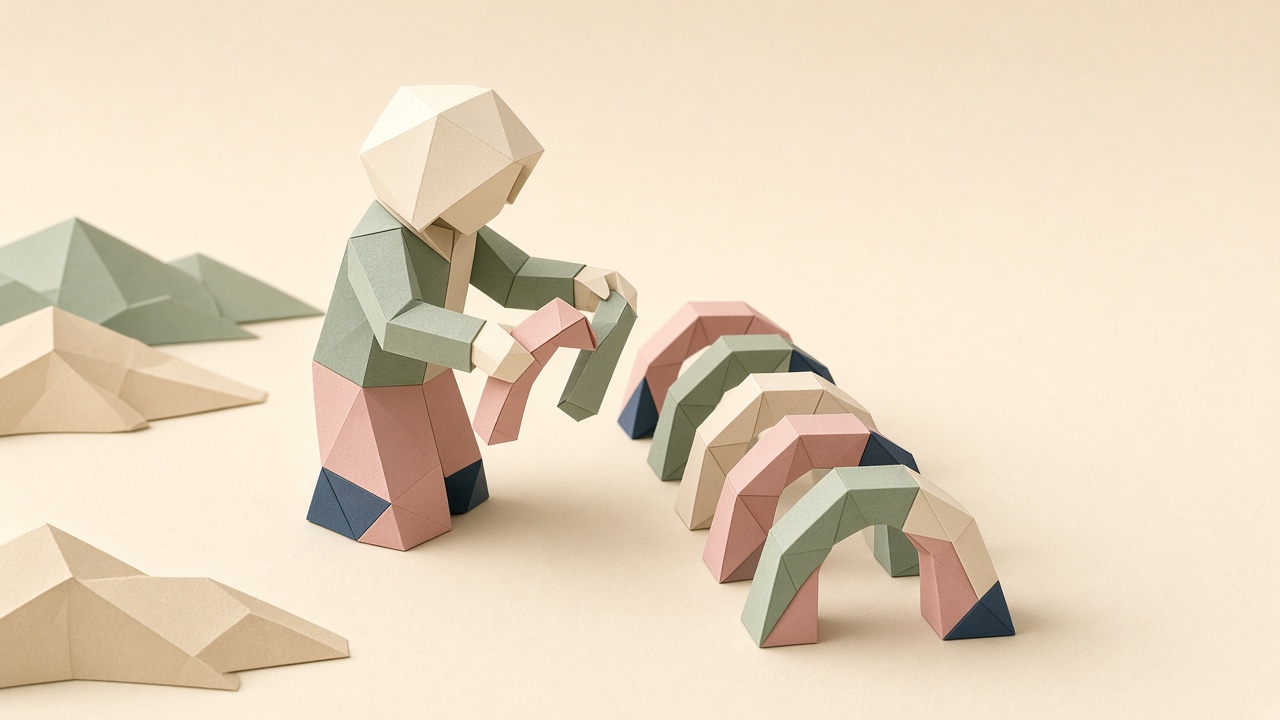
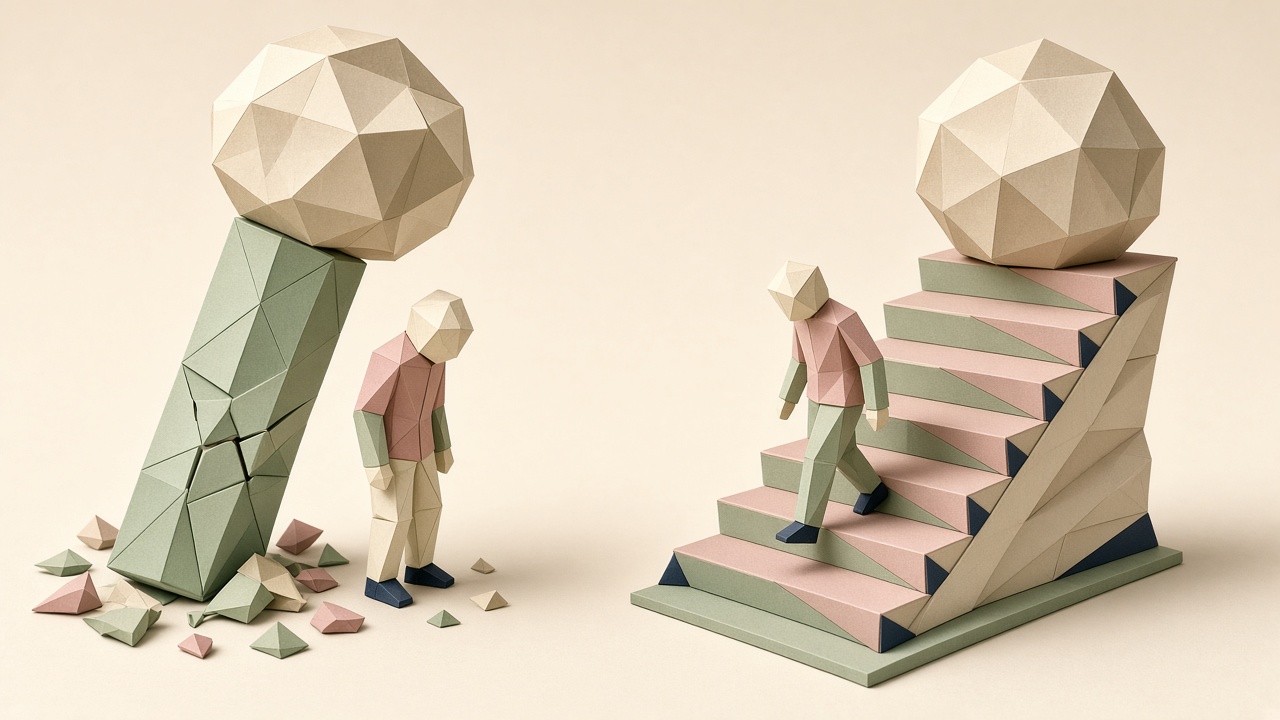
That is not resilience. That is endurance, and endurance has a known mechanics: it carries the load without moving it. The person keeps functioning and the weight stays on top, intact, charging interest. What changes over the months is not the load, it is the reserve: every week there is less margin, less sleep, less patience, and less appetite for anything.
The difference shows up in the result. Someone who endured for eighteen months is not ahead of someone who, three months in, asked for help and rearranged their life. They are behind: more tired and with more unfinished things piled up. Resilience is measured by how you get back to functioning, and getting back requires movement, not staying under the weight.
That is why the line in the mirror is badly assembled. “I have to be stronger” is asking for more endurance. What Julian needs at 6:20 is the opposite: move something off the weight and put it somewhere else.
There is a test you can run at home to tell the two apart. If by the end of the day you had no margin left for the people you love and no patience for the smallest things, you did not get stronger: you moved the same weight with less reserve.
2. Myth 2: the resilient person does not fall apart
The second myth says the resilient person walks through the hit intact. They do not cry, do not get sick, do not lose sleep, do not stop cooking. If they fall apart, then they were never resilient and you have to find another example to look up to.
That myth leaves almost everyone with no exit, because falling apart is what a normal body does when the load goes past what it can carry. There is no version of this that gets walked through on your feet, and pretending otherwise only teaches people to hide the part that hurts.
Research on grief and loss showed it clearly. When people are followed before and after a major loss, most maintain steady functioning, while a minority shows a sadness that settles in over the months. That second group is not anybody’s failure. It is the reason professional support exists, and the reason comparing yourself with whoever came out fast is a bad idea.
What separates recovery is not the absence of falling apart. It is what happens afterwards, and there the support around you weighs more than character.
3. Myth 3: resilience is a trait only a few people have
The third myth is the most comfortable to believe and the one that isolates the most. It says there are people who were born with it and people who were not, and that if it did not land on you, there is not much to be done. It gets told as if it were a character virtue, handed out the way talent gets handed out.
The evidence has been saying the opposite for decades, and it says it with a name that strips out all the drama: ordinary adaptive systems. In a classic review of development, resilience shows up as the result of common processes — a bond that answers, a routine that holds, a predictable environment — and not as a heroic trait belonging to a few (DOI: 10.1037/0003-066X.56.3.227).
That rearranges the whole thing. If resilience were a trait, there would be nothing to do except accept it or not. If it is the result of resources and conditions, then there is work available, and that work does not consist of wanting it harder.
This is the version of the myth that gets discussed least and repeated most inside families. It is not said as a judgement: it is said as a fact. “She is so strong”, “he always comes through”.
There is a more uncomfortable second half to the myth. If it is a trait, then whoever fails to recover is defective. And that idea is what makes people blame themselves at the worst moment, when what they need is the opposite: for someone to tell them their difficulty has causes, not defects.
4. Myth 4: willpower and attitude are enough
This myth has good press because it can be repeated in a motivational talk. It says the problem is attitude, that if you decide to get up you get up, and that whoever does not manage simply did not want it enough.
Willpower exists and it works. It is enough for a hard afternoon, for a conversation that has to happen today, for starting something. What it cannot do is hold up months of load with no sleep, no support and no pause on the calendar. Not from weakness: the capacity to sustain effort gets spent as it is used, and at 8:30 in the evening there is less of it left than at nine in the morning.
When somebody treats willpower as the main tool, the predictable happens: they hold on for two weeks on a strong decision, the reserve runs out, and then they read the collapse as a lack of character. From there they go back to the third myth, and the circle closes.
It is worth naming what willpower can do, because it is not a small thing. It can make a call you have been avoiding. It can book the appointment. It can take a commitment off the calendar. What it cannot do is repeat itself every day for months while nobody else moves anything. Willpower is the engine turning over, not the fuel for the whole trip.
Willpower makes the first move. The resources do the rest.
5. Myth 5: asking for help is for people who cannot cope
The last myth is the most expensive one, because it cuts off the exit. It says asking for help contradicts your strength: if you need somebody, it means you could not do it alone, and that leaves you in debt.
None of that survives a minute of examination. In the research on stress and recovery, support from other people shows up again and again among the factors that improve the outcome, not among the ones that worsen it. The person carrying everything alone is not more resistant: they are using the most expensive mode there is.
There is a practical detail. Asking for help does not mean dumping your problem on someone else. It means moving the weight for a while: a phone call, a concrete favour, some company. Nobody is asking anyone to carry the whole thing. And whoever refuses even that is left without the resources that are, precisely, the ones that move recovery.
What if asking for help was always a sign of weakness in my family?
That is not a fact about you: it is what got learned in a house where showing need had a cost. It gets inherited the way other customs get inherited, and it holds itself up with the same logic: nobody wants to be the one who fails. Question it before applying it to yourself as if it were a fact. What you were taught about asking for help is not a law of nature; it is a habit of your surroundings, and habits get reviewed.
There is an asymmetry worth looking at. When a friend tells you they are not doing well, you do not think they are weak: you think they are going through something and that talking will help. The same scene, applied to you, reads as a fault. That double standard is not a fact about your strength. It is the habit of the myth.
6. Why these five myths cost you
All five myths share one shape: they put the whole weight of recovery on the person and take everything else off their shoulders. Endurance, composure, character, willpower and self-sufficiency are all things you are supposedly issued with at birth. If recovery depends only on that, then when it does not arrive, the blame is yours.
That is the price. Whoever believes these myths leaves off the radar the three or four things that actually move the needle — sleep, having somebody, being able to stop, stepping out of what is harming you — and keeps trying with the only thing that cannot be forced any further: the wish to feel better.
There is a second bill, quieter. The myths make people measure their progress wrong. Because the myth says the resilient person does not fall apart, every ordinary day reads as failure. Because it says willpower is enough, every collapse after a strong effort reads as a lack of character. The person is sitting an exam nobody can pass.
| What you were told | What it does in practice | What actually sustains |
|---|---|---|
| Endure without breaking | Piles up load and spends the reserve | Moving part of the weight somewhere else |
| The resilient person does not fall apart | Turns falling apart into shame | Support when the mood does not come back |
| It is a trait only a few have | Isolates you and hides the exit | Bonds, routines and real conditions |
| Willpower is enough | It runs out, and the drop reads as a fault | Habits you can sustain, and rest |
| Asking for help is weakness | Cuts off the most efficient route | Concrete support, shared |
Look at the last column. None of the five things that do sustain is an internal decision. All of them are conditions you can set in motion, and almost all of them depend on something that is not you alone. That is exactly what the myths hide.
7. What the evidence does support
When resilience stops being looked at as a trait and starts being looked at as a process, the map changes. What shows up in the research is not a list of virtues: it is a list of conditions.
A review of the construct that ordered the field pointed out that resilience is not a fixed attribute you either have or lack, but a process that varies with context and time, and that it requires distinguishing between the outcome — recovering — and the mechanisms that produce it (DOI: 10.1111/1467-8624.00164). That distinction is what dismantles the trait myth: if it is a process, it has conditions, and conditions can be changed.
The conditions that carry the most weight are few and not glamorous. Sleeping, even badly and in pieces, and getting back to a set bedtime. Having at least one bond where you can say what is happening without editing it. Being able to stop part of the day without a list of pending things on top. Stepping out of what is hurting you, when that is in your hands. And asking for help before you hit the bottom, not after.
None of those conditions demands that you be stronger. All of them demand that you move something concrete, and several demand that you let somebody in. These five can be counted at the end of a week; the myths cannot.
8. The case of Julian, mid-career
Julian is thirty-nine, an operations coordinator at a logistics company, and he has been like this for eleven months. There was no tragedy. There was a restructure in November, a team that went from nine people to five, two maternity leaves nobody replaced, and a new manager who called at ten at night.
The first thing that went was sleep. He started waking at four and five with no reason, head already switched on. Then lunch went: he ate at the desk while answering things. Then Thursday football with his friends went, first once, then twice, then not at all.
Julian did not fall apart at any point. He kept delivering, kept being the one who solved things, kept saying he was fine when his mother asked. And that is the part that was hard for him to see: he was running all five myths at once. Endurance, composure, the belief that he could do it alone, the willpower to carry everything, and the shame about asking for help.
| What he said | What was actually happening |
|---|---|
| ”It is a rough patch, it will pass” | Eleven months of load with not one pause |
| ”I just need to organise myself better” | Five hours of sleep and no meal sitting down |
| ”I do not want to bother anyone with this” | Zero people who knew what was going on |
| ”If I ask for help, they will notice” | It was already showing in meetings |
The change did not arrive with a heroic decision. It arrived with one small, concrete thing: his sister asked for an afternoon to talk and he did not know what to answer. That is where he started letting go. Then came two adjustments he had never considered part of the problem: he set a limit on calls after eight, and he got Thursday football back. Neither was about character. Both gave him hours back, and one gave him a bond back.
What if the problem is that my job is not going to change?
That is a real limit and it deserves to be named without decoration. If the source of the load - the schedule, the demand, the person calling at ten at night - cannot be moved, then everything else yields less, and no amount of resilience compensates for living exposed every day. There the conversation changes subject: it is not how do I endure this better, it is how much of this is acceptable to carry. And that second question is sometimes answered with a different job, not a different attitude.
9. What to do instead
If the five myths are out of the way, a simple map of three moves is left. They are not steps in order and not a recipe: they are the three directions recovery travels when something breaks.
The first is to lower the load, and there is almost always something that can move. A conversation that gets postponed, a commitment that gets dropped, a call that gets delegated, a schedule that closes at eight. You do not need to reorganise your whole life: you need to take one piece off the weight and watch what happens to the week.
The second is to refill the reserve, and there sleep and food come first because they hold up everything else. Sleeping badly for months is not a minor symptom: it is one of the causes that aggravates the whole thing the most, and it makes every other thing you try harder.
The third is to let somebody in. A bond, not a network. One person with whom you can say the real things without compressing them into “I’m fine”.
| Move | What it looks like today | Why it works |
|---|---|---|
| Lower the load | Drop or postpone one concrete commitment | Reduces the weight instead of carrying it better |
| Refill the reserve | Get sleep and a meal sitting down back | Without reserve no other step holds |
| Let somebody in | Tell one person, without editing | Support is one of the factors that shifts the outcome most |
One honest warning: this does not work the same for everyone. Someone who has been exposed to the same load for years finds that lowering one thing is not enough and that sleeping again does not cover it. In that case the three moves are still correct, but they fall short, and what makes the difference is professional support. It is not the last resort: it is the route that fits when the time has run long.
The three moves can be tried in any order, and it is worth starting with the one that costs you least, not the one that sounds most important. If dropping a commitment makes you feel guilty, start with sleep. If asking for help embarrasses you, start by taking something off the calendar. The order is not sacred; what matters is that at least one of the three moves.
What if there is nobody I can tell?
Start with the closest, least committed option: somebody you already deal with, a colleague, a cousin, a person from a group. You do not need to tell the whole story: one honest sentence is enough, “I am going through something heavy”. If no person appears, a support space - a group, a helpline, a professional - counts as support too. And if there is simply nobody nearby, that fact says nothing bad about you: it says that loneliness is part of what is weighing on you, and that this can be worked on as well.
10. The exercise to disarm the myth that weighs most
The five myths do not weigh the same on everyone. This exercise is for finding the one costing you most and taking it apart with one action. It takes twenty minutes, it happens today, and it runs on paper.
- Write the five myths in a column: endure, do not fall apart, only a few have it, willpower is enough, asking for help is weakness.
- Next to each one, mark a number from 0 to 5 for how often you repeat it in your own voice, with nobody telling you to.
- Pick the one you scored highest. That is the one charging you the most, and it is usually the one you learned at home.
- Underneath it, write the sentence that myth says to you when something breaks. Write it exactly, in quotes, without fixing it.
- Write the opposite sentence, same format, as if you were speaking to somebody you love. “You do not have to carry this alone” or “asking for help is not failing”.
- Mark one single concrete action for this week that contradicts the myth. Not an attitude: a move with a time and a name, on the calendar.
- At the end of the week, reread what you wrote and note what happened. If the action happened, the myth lost a point. If it did not, swap it for a smaller one and try again.
The first time you get a page of uncomfortable sentences. By the third, the sentence you pick is no longer the same, because the myth that weighed most stopped giving orders.
A note on how this feels. In the first week, the action you chose looks ridiculous because it is so small. Almost everyone starts with something bigger than they can sustain and abandons it on day three. Resisting that temptation is the most useful part of the exercise: an action that actually happens is worth more than an ambitious one that collapses, because it teaches your body that the thing moves.
11. Crisis box
If you are in crisis now, with thoughts of harming yourself or of nothing making sense, put this reading down and call.
- Colombia: Line 123 (national emergency) · Line 106 (mental health)
- United States: 988 (Suicide & Crisis Lifeline)
- United Kingdom: 116 123 (Samaritans)
If you can, stay with someone while you call. There are moments when what is hard is not a habit you train, but something deeper that needs a voice that does not flinch.
12. The question you can answer now
Julian at 6:20 in the bathroom, the list in his head, the line in the mirror. “I have to be stronger.” Twenty minutes ago that scene read as proof he was not measuring up. After this it reads differently: the line in the mirror was not a diagnosis, it was an inherited myth, and the tiredness at 6:20 was not a lack of character.
The question left is not whether you are strong. After what you read, that question is badly built. The one that works is smaller and more concrete:
Which of the five things on top of you can you move this week, and who could know that you moved it?
Do not answer it from memory. Sit with it for a moment. The answer that appears is usually more concrete than you expected: a phone call, a commitment you drop, an hour of sleep you get back. And the second half of the question matters as much as the first: somebody knowing it is what makes it real.
The resilience hub stretches this beyond what you just read, and the interactive tools give you something to work with. If what is hard for you is telling endurance apart from holding yourself up, that is in enduring and being resilient are not the same; and if what you want is how it gets assembled piece by piece, that is in how resilience gets built. If you want to see where you stand, there is a resilience test that draws your situation into a result, without closing any diagnosis. And if you have been trying with willpower for months and it is not enough, therapy at rdkterapia is one possible door.