A SPACE TO UNDERSTAND
When you cannot stop going over it.
You replay a conversation, search for an explanation or revisit the same memory. Learn to distinguish rumination from useful reflection and explore what to do when it appears.
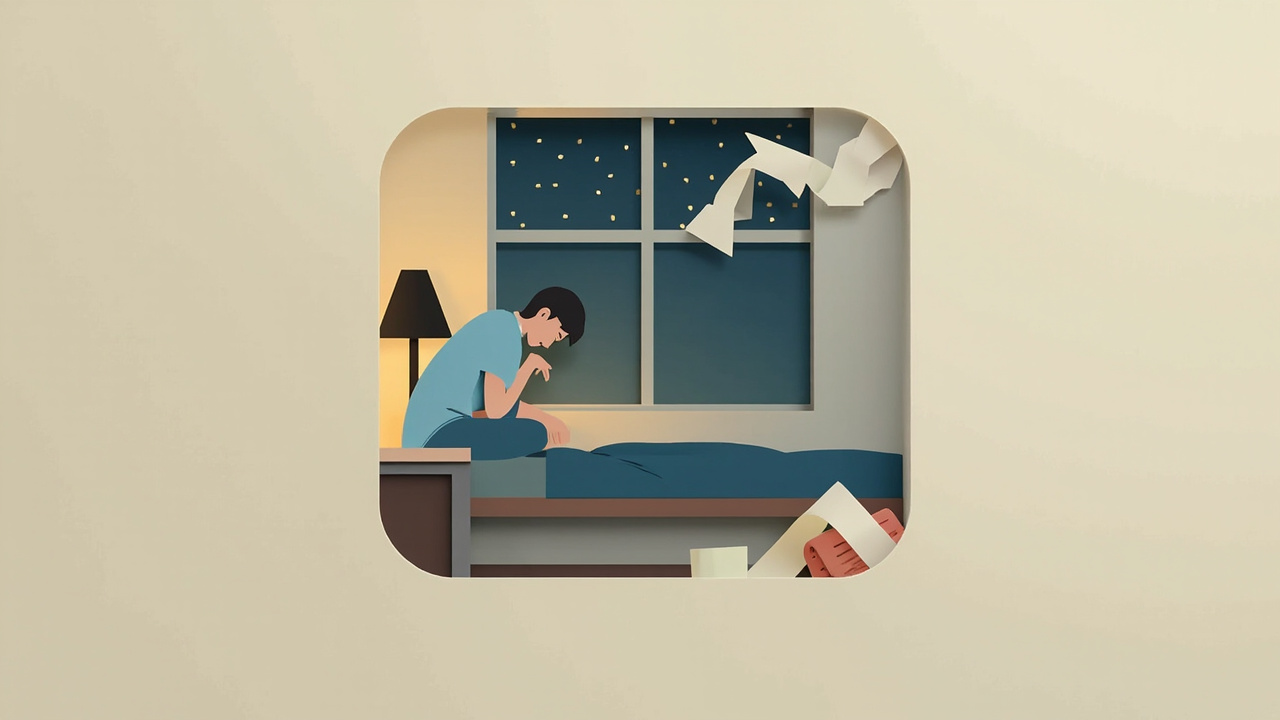
Thinking is not the problem
If you ended up here, chances are someone has already told you — or you have told yourself — that you think too much, that you overcomplicate things, that you should just let it go. As advice it sounds reasonable; as an instruction it does nothing. Nobody chooses to go over something again. If telling yourself to stop had worked, you would have stopped a long time ago.
Let us say it plainly. Rumination is not a character flaw: it is a thinking pattern that gets reinforced every time it repeats, which is why it feels so hard to put down. What changes with work is not that the loop disappears: it is that you recognize it earlier and have something to do with it.
- This is not a diagnosis. What you can look at today is the shape your loops take, not what you have.
- Thinking a lot is not ruminating. The difference is whether the thinking moves or always comes back to the same point.
- It hits harder at night. It is not that the issue grows: it is that everything holding it back drops.
This may be happening to you
These are not clinical criteria and not a list to self-diagnose with. They are experiences people recognize when thinking stopped helping and became a place to stay. Read them as a mirror, not a verdict.
With what you think about
- 1 You replay the same scene in the same words, and end up exactly where you started.
- 2 You rehearse conversations that have not happened and argue in your head with someone who is not there.
- 3 You ask yourself why you are like this, and that question has no answer that settles you either.
With what it costs you
- 4 The night goes into it. At one you are still awake, sure that at some point you will reach a conclusion.
- 5 You are with people and you are not there. The conversation goes on and you are somewhere else, in the scene you keep replaying.
- 6 You ask someone to tell you it does not matter anymore, and the calm lasts as long as the conversation.
Underneath
- 7 You feel that if you stop thinking about it, something bad will happen: as if going over it were a way of keeping it under control.
- 8 It is hard to ask for help with this because it seems you should be able to solve it yourself, by thinking harder.
This is not a diagnosis. Recognizing yourself in several of these experiences does not mean you have a clinical condition. What you can do with what you read is look at how much it is costing you — sleep, work, relationships — and decide where to start. If the cost is high or it has been months, professional support is the shortest path, not the last one.
Why your head will not switch off
Rumination looks like solving a problem, and that is its trap. While you go over it you feel you are doing something about it: you review, you compare, you rehearse. The problem is that the loop never reaches a decision and never closes. It ends where it started, and that is its signature.
And it reinforces itself. If you believe that thinking more will protect you from something happening, every loop confirms that staying alert works. So the pattern pays for itself: it leaves you the feeling of being in control and it costs you sleep, work and presence.
- The loop has no question. Reflecting starts from something answerable; ruminating starts from something that has no answer and will not get one by replaying it. With no question, there is no way out.
- Tiredness lets it go. When you are rested, attention holds and you can let the thread go. Tired, there is nothing left to grab it with, and the loop finds a clear path. That is why it hits at night.
- It feels like it protects you. Going over it feels like staying alert. Letting go feels like being careless. That false equivalence is what keeps the pattern alive for years.
With that you have the mechanism. Now look at the shape your loops take in concrete terms, with ten statements and not with memories.
What shape do your loops take today?
Ten statements, no sign-up and no email. They do one thing: show which of the five forms of repetitive thinking is weighing on you most right now. It does not measure "how much" of anything and it is not a diagnostic test.
Saved locally on this device (nowhere else). Nothing is sent.
What this map does not say
- It does not measure whether you have a clinical condition: it looks at five forms of repetitive thinking and how much they weigh on you today.
- A high bar is not a defect: it is a signal of where to put the work first, and all of them can move.
- This map is not a validated instrument. Measures with backing have fixed items and published studies; this is a guide to see how your head gets tangled.
One thing today: give the issue an hour
You are not going to stop thinking about it today. You are going to do one thing: give the issue a place with a set time instead of letting it run all day. It takes under two minutes and it works even if you have never tried it.
- Pick a specific hour today or tomorrow to think about that issue. Write it down: "today 7:30 pm", with a clock.
- When the loop shows up before that hour, do not argue with it or follow it. Tell it: "at 7:30". Nothing more.
- At the hour, sit with the issue for real, fifteen minutes, phone far away. Not before and not after.
- At the end of the fifteen minutes write a single line: what question is still open or what the next step is. That is what the loop never gives you.
- If there is no step and no question, the line can be "there is nothing to do about this yet". That is a conclusion too, and it also closes the day's turn.
If it sounds like too little, it is because the loop asks for all day. Do not believe it: giving it an hour already changes the scene.
Read something that gets what you are going through
No lectures. Three pieces on the difference between ruminating and reflecting, why your head will not switch off, and how to get out of the circle.
If you want to explore additional resources we have researched and recommend, they are here:
By rdkterapia · No spam · Unsubscribe whenever you want
Frequently asked questions
What is rumination?
It is thinking about the same thing over and over without the loop adding anything: same issue, same angle, same conclusion. It does not move toward a decision or a close. You go back over the fact, what it meant and what it will mean, and none of those passes changes anything. It is not a lack of willpower: it is a pattern that reinforces itself.
Is rumination the same as reflecting?
No. Reflecting has a question that can be answered and a next step. Rumination always returns to the same point and ends where it started. The difference is not how much you think but whether the thinking moves: reflection arrives somewhere, rumination only stretches out what you feel.
Why is it worse at night?
Three things come together at night: tiredness lowers your control over attention, there is nothing left to do that pulls your mind away, and the dark leaves thinking with no outside input. With less to hold it back, the loop finds open ground. That is why the same idea you manage at ten in the morning looks like a certainty at one in the morning.
Does distraction work when I am ruminating?
It works as a bridge, not as a cure. Distraction lowers the intensity in the moment and does not change the pattern: if you only distract yourself, the loop comes back. It holds better when something concrete follows it, such as giving the issue a set time or writing down the question that is really underneath.
When is it worth talking to a professional?
If the loops are costing you sleep, work or relationships; if you have been on the same issue for months without it moving; if lasting hopelessness or thoughts of hurting yourself appear. Rumination responds well to therapy, and there is no need to wait until things get worse to start. If thoughts of hurting yourself show up, the lines are below, available at any hour.