Signs of low self-esteem that disguise themselves as humility
A form of 'not thinking I'm better than anyone' that is actually a refusal to deserve. Seven signs to distinguish genuine humility from hidden low self-esteem.
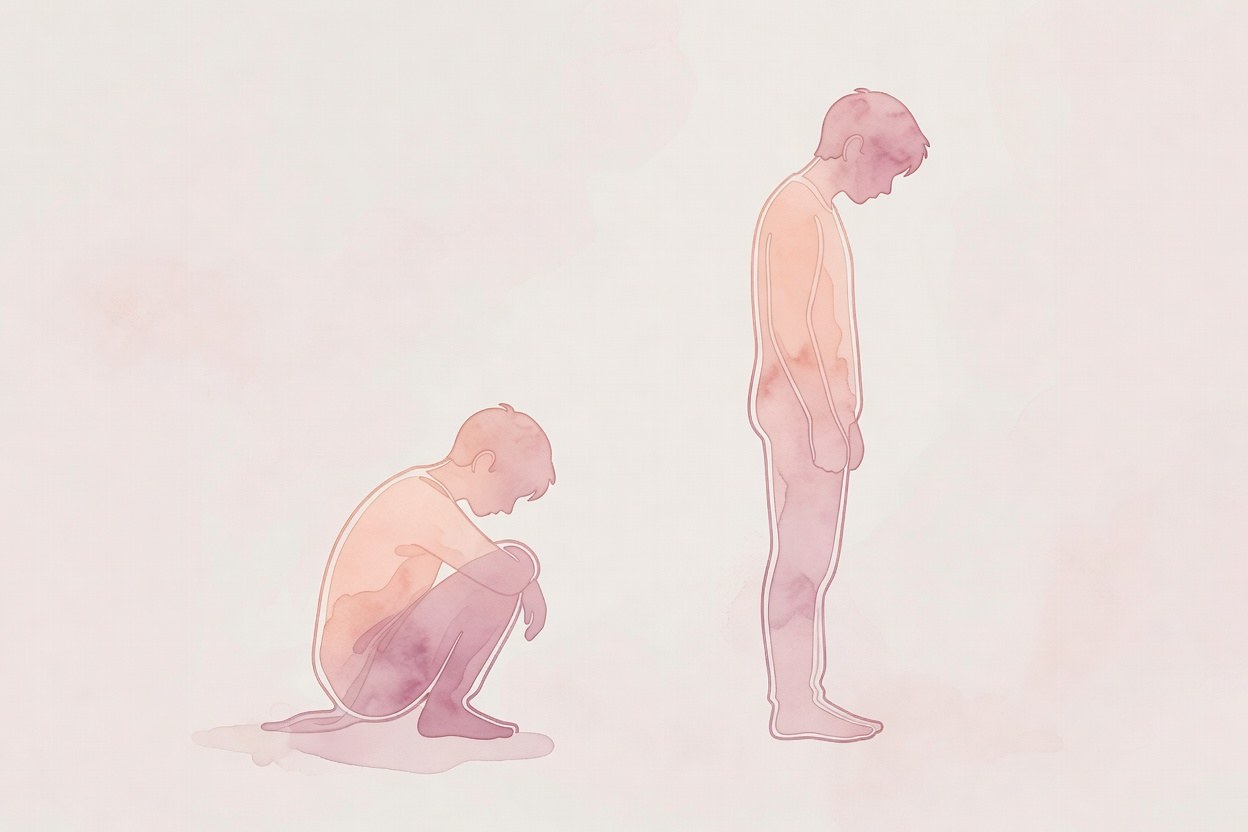
Saying “I don’t think I’m better than anyone” and feeling that you’re not worth as much as others can sound similar. They dress the same. But they’re not the same. And confusing them leads to something that many call humility and that, inside, is something else.
This article is so that, when you hear that phrase in your head, you know whether it’s genuine humility speaking — the kind that doesn’t need a mirror to rest — or a voice you learned to dress in modesty so you wouldn’t have to ask for what you deserve. If the critical voice weighs on you, the piece on the inner critical voice that sabotages you can help you see it from another angle. If what moves is how you see yourself in the mirror, the piece on self-esteem and body: the relationship with the mirror works on exactly that reading. If what you need is a broader map, the complete guide to low self-esteem covers the topic end to end.
TL;DR
- Genuine humility feels like rest. False humility feels like constant alert.
- Seven common beliefs (“I’m not one to brag”, “I’d rather go unnoticed”, “I don’t like being the center of attention) can be a symptom of low self-esteem, not modesty.
- The line that separates them: genuine humility lets you recognize value without having to demonstrate it; low self-esteem doesn’t let you see it in yourself.
- A concrete 60-second practice to distinguish which of the two voices is speaking when you judge yourself.
What almost no one tells you about humility
Psychology has spent decades trying to separate two things that in everyday speech get mixed up: humility and self-devaluation. They’re not opposites on a scale: they’re different things.
Humility, in serious research, is understood as a precise way of seeing yourself — with your limits and your value at the same time. Someone who’s humble doesn’t need to inflate themselves, but neither do they need to sink. Such a person can say “I don’t know” without feeling they lose stature, and can say “I accomplished this” without feeling credit is being given to them as a gift. Self-devaluation is something else: it’s stable refusal to deserve, sometimes dressed as modesty.
Look: when you were a kid, someone told you — with the best intentions, sometimes — that “being humble was not thinking you were better than others”. If to that phrase was added frequent criticism, constant comparison with siblings, with schoolmates, or with cousins “who were really brilliant”, what your brain ended up learning was not humility. It was something more like: “if I stand out, I bother; if I make myself small, I’m safe”. That’s the confusion. Humility doesn’t need to hide. Low self-esteem does.
The problem is that the two voices sound similar. And that’s why this article: to give you concrete tools for distinction. Not to convince you to be humble nor to stop being so. So you see what’s what, and decide from there.
How each one feels in the body
Before continuing, it’s worth stopping. If something tightened while you read — especially in your chest or jaw — that’s already information.
Genuine humility is usually experienced as a sensation of internal space. You can have posture, you can have a firm voice, you can say “I don’t agree” without feeling the floor moves. If you’re asked what you did well, you can say “this was hard for me, but I got it” without your voice trembling or a “but actually it wasn’t that big of a deal” invading you.
False humility, the one that’s actually low self-esteem, feels different:
- Constant alert for not being seen as “too much”. Watching what you say, how you dress, what achievements you mention, so as not to seem arrogant.
- Making yourself small before others do: speaking lower, not taking up space, asking permission before asking for what you’re entitled to.
- Apologizing for existing: when someone compliments you, the first thing that appears is “no, it was luck”, “it’s not that big a deal”, “anyone would have done it”.
- Taking care of everyone before yourself, and then feeling emptied, without quite understanding why.
- A chronic tiredness that isn’t physical: the tiredness of maintaining an edited version of yourself.
If any of this sounds familiar, you’re not broken. It has a name, it has a way out. One time counts, you don’t have to see it all at once — and you’re not alone in this.
A 60-second practice you can do right now, without changing chairs: close your eyes, place a hand on your chest, and repeat softly: “When I help others, do I do it from rest or from fear of being seen?”. It’s not meditation, not journaling, not therapy. It’s just naming what the body is already saying. If it works for you, do it. If it doesn’t, that’s okay too.
Seven signs that look like humility but aren’t
Note, before reading: This isn’t a diagnostic test. It’s a map to read what already happens to you, with the finest possible yardstick. Use it as a mirror, not a verdict.
What follows isn’t a diagnostic test. It’s a map to read what already happens to you — with the finest possible yardstick. For each sign you’ll find what’s seen from the outside, what’s usually going on inside, and what is useful to do.
For each sign, read first what’s seen from the outside, then what’s usually going on inside, and finally what is useful to do.
- “I’m not one to brag.” On the outside it looks like elegant humility. Inside there’s fear of being seen as arrogant. Useful: name a small achievement out loud once a week, without minimizing it.
- “I’d rather go unnoticed.” On the outside it looks like a low profile, calm. Inside there’s a belief that being seen = being evaluated = being found lacking. Useful: practice brief presence, walk into a place without looking at the floor.
- “I don’t like being the center of attention.” On the outside it looks like reserve, modesty. Inside there’s an association between attention and learned shame. Useful: accept a compliment without giving it back, just say “thank you”.
- “What I did wasn’t that big a deal.” On the outside it looks like sincere modesty. Inside there’s internalized self-criticism: success gets minimized before being questioned. Useful: acknowledge one concrete thing you did well, without “but”.
- “Anyone would have done the same.” On the outside it looks like naturalness, no ego. Inside there’s rejection of one’s own contribution as a way to avoid being “too much”. Useful: write down three times this week something of your own that cost you.
- “I’m not one to ask.” On the outside it looks like noble self-sufficiency. Inside there’s a belief that asking = bothering = losing the right to be loved. Useful: ask for something small — a coffee, a direction, an opinion — without justifying it.
- “Better not say anything.” On the outside it looks like patience, prudence. Inside there’s fear of anticipated judgment; silence as protection, not as choice. Useful: say one opinion of your own in a conversation this week, even if minor.
The uncomfortable conclusion: false humility is usually a very specific form of low self-esteem: the one that learned to dress in modesty because it noticed that, somewhere, “being less” was safer than “being seen”. Recent research on self-esteem and resilience found that people who develop a clear relationship with themselves — even in moments of failure — tend to show greater self-compassion and greater emotional stability, not out of pride, but because they don’t need external approval to know they are of some value (Frontiers in Psychology, 2026).
Genuine humility, on the other hand, doesn’t need you to hide. It can be firm without being noisy.
How this confusion forms
It doesn’t appear on its own. Three mechanisms repeat in what’s being researched:
1. Internalized criticism. You learned a voice — the voice of someone, once — that told you what was wrong with you. That voice can sound logical, protective, even “realistic”. But it doesn’t care for you: it judges you. Recent studies on self-criticism and self-concept clarity show that self-compassion functions as a regulator: people who treat themselves with kindness, instead of criticizing themselves, tend to have a more solid internal map of who they are, what they want, what they need (Frontiers in Psychology, 2026).
2. The comparison that stayed installed. Especially if in childhood, love or recognition depended on how you behaved, on grades, on not bothering, you learned that being loved is conditional. Today, as an adult, any bond that resembles that reactivates the old wound. And “humility” becomes an elegant way of not asking, not standing out, not risking. Research on conditional self-esteem shows that when parental love depended on behavior, children learn that their value is conditional on performance, not on what they are (BMC Psychology, 2023).
3. The culture of “not being too much”. If you grew up hearing that people who stood out were “conceited”, “know-it-alls”, “insufferable”, your brain did a simple sum: being seen = being rejected. Modesty, then, is not a moral choice: it’s a defense mechanism. Studies on cultural conceptions of modesty show that what is valued as “modesty” varies between contexts — in some traditions standing out is read as a lack of education; in others it’s read as authenticity. The problem appears when that cultural expectation mixes with the internal belief that you don’t deserve to be seen — and you can no longer tell whether you’re taking care of yourself culturally or hiding from the world (Journal of Cross-Cultural Psychology, 2021).
What does distinguish genuine humility
There’s no closed list, but there are three markers that research and clinic repeat:
1. Genuine humility doesn’t need to hide. You can have achievements and recognize them. You can say “I did this well” without feeling your ego inflating. The difference isn’t “saying nothing”: it’s not needing external approval to know your worth.
2. Genuine humility isn’t lived as alert. If being with people activates a constant monitoring system — “did I say too much?”, “do they see me as arrogant?”, “did I expose myself too much?” — that’s not humility, it’s vigilance. Humility is more like standing in a room without checking the walls every two minutes.
3. Genuine humility can receive a compliment. If someone tells you “that turned out really well” and the first thing that appears in your head is “no, it was luck” or “anyone would have done it”, that’s self-criticism, not modesty. Genuine humility accepts the compliment without giving it back, without explaining it, without reducing it.
The line is thin but clear: humility lets you see your value without asking permission to see it. Low self-esteem asks you to deny it, minimize it, or hide it, so as not to bother.
Three things you can do this week
Not a list of 11 things. Three. So you do them, not just read them.
1. The compliment without discount (1 minute, once a day)
When someone says something positive to you — a compliment, a thank you, a praise for your work — don’t give it back. Don’t say “no, it was nothing”. Don’t explain why it wasn’t that big a deal. Just say “thank you”, or “good that you noticed”. And let the phrase exist without editing it.
Research has been showing that systematically returning the compliment — “no, anyone else would have done the same” — reinforces the belief that your contribution isn’t valuable. Self-compassion, on the other hand, lets you receive without feeling in debt. Studies in clinical populations show that brief self-compassion interventions reduce self-criticism and increase the capacity to receive positive feedback without defenses (Personality and Individual Differences, 2021; Frontiers in Psychology, 2020). It’s not arrogance. It’s permission for something good you did not to evaporate on contact with your inner voice.
Soft version (1 min): next time someone compliments you, say “thank you” and nothing else, without adding a “but”. Full version (3 min): write the literal compliment on paper, read it aloud once, and notice the discomfort that appears.
2. The visibility question (30 seconds, once a day)
At the end of the day, before sleeping, ask yourself one question:
“Was there a moment today when I made myself smaller than necessary to avoid being seen?”
Not to solve it. To see it. Internalized self-criticism works precisely because it operates on autopilot — we don’t even register it, we just obey it. Bringing it to light, even for 30 seconds, breaks the automatism. A study with job seekers showed that self-compassion benefits affect precisely because it reduces self-criticism — not by “thinking positive”, but by seeing the pattern without judging yourself for having it (Frontiers in Psychology, 2020).
Soft version: once a day, before sleeping. Full version: write down three times this week a specific moment when you made yourself smaller, and what triggered it.
3. A truth said out loud (this week)
Choose one specific situation — something you find hard to say, an opinion, a preference, a need — and say it out loud, to a real person, this week. It doesn’t have to be enormous. It could be “I’d rather go to that restaurant”, “I didn’t like that movie”, “I need Saturday for myself”. What matters is not editing it before saying it.
Genuine humility isn’t built only in thought: it’s trained in small, visible acts. Saying what you think — even if minor — is an act of deserving. Each truth said out loud teaches the body that it doesn’t need to edit itself to be loved.
Soft version: one truth said out loud, once, this week. Full version: three truths said out loud, in different contexts, this week.
When to seek professional help
When confusion becomes a real problem: when modesty starts costing you concrete things — promotions not asked for, love not declared, opportunities avoided — that’s the moment the pattern deserves attention.
The confusion between humility and low self-esteem becomes a problem when it starts costing you concrete things: not asking for raises, not telling someone you love them, avoiding opportunities for fear of being seen “too much”. If modesty is costing you bonds, work, or rest — and you notice it but can’t get out alone — it’s worth talking about.
Three things before continuing: it has a name and a way out, one time counts, and you don’t have to carry it alone. If this resonated, you’re not alone in this.
One concrete step, in case this is the moment: if you decided to seek help, start by writing on paper three things you would like a therapist to know about you before the first session. You don’t have to read it aloud, it’s not an exam, it’s just a private map. Three or five sentences that describe you: how you sleep, what costs you, what you’ve tried, what you hope for. That’s enough. If you find it tedious to do alone, ask someone you trust to help you put it together. The first session is 50 minutes, not a lifetime commitment — and most professionals offer a free 15-minute initial call to see if there’s a match. Small, concrete, now.
Line 106 (Colombia) — 24/7 crisis support. If you’re in another country, Línea de la Vida (Mexico: 800 911 2000) and 988 (United States) offer free support.
Written by Ricardo de Castro — Psychologist. Last review: 2026-07-31. This article is informational complement, not a substitute for professional attention.
References
- Frontiers in Psychology. (2026). Self-compassion and self-concept clarity mediated by resilience: variable-centered and person-centered approaches. 10.3389/fpsyg.2026.1714878
- Personality and Individual Differences. (2021). Domains of intellectual humility: Self-esteem and narcissism as independent predictors. 10.1016/j.paid.2021.110815
- Frontiers in Psychology. (2020). Testing a Self-Compassion Intervention Among Job Seekers: Self-Compassion Beneficially Impacts Affect Through Reduced Self-Criticism. 10.3389/fpsyg.2020.01371
- BMC Psychology. (2023). What if parental love is conditional …? Children’s self-esteem profiles and their relationship with parental conditional regard and shyness. 10.1186/s40359-023-01380-3
- Journal of Cross-Cultural Psychology. (2021). Lay Conceptions of Modesty in China: A Prototype Approach. 10.1177/0022022120985318